Department of Public Health and Center for Infectious Disease Epidemiology Research, China Medical University, Taichung, Taiwan.
BMC Public Health. 2011 Jan 17;11:41. doi: 10.1186/1471-2458-11-41.
It is speculated that the 2009 pandemic H1N1 influenza virus might fall into a seasonal pattern during the current post-pandemic period with more severe clinical presentation for high-risk groups identified during the 2009 pandemic. Hence the extent of likely excess healthcare needs during this period must be fully considered. We will make use of the historical healthcare record in Taiwan during and after the 1918 influenza pandemic to ascertain the scope of potential excess healthcare burden during the post-pandemic period.
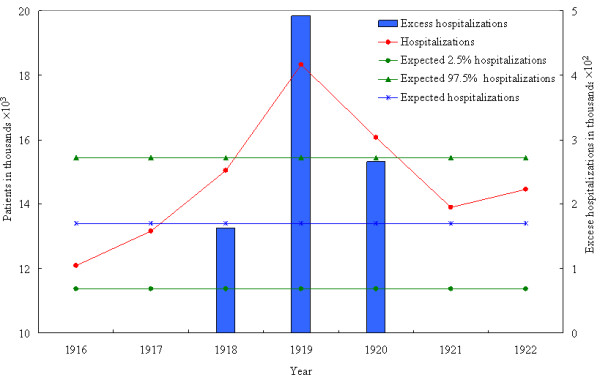
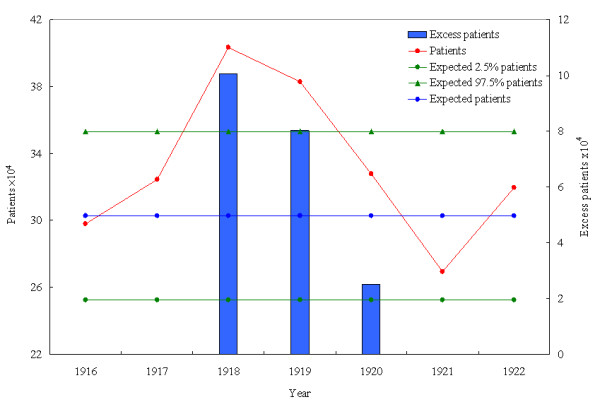
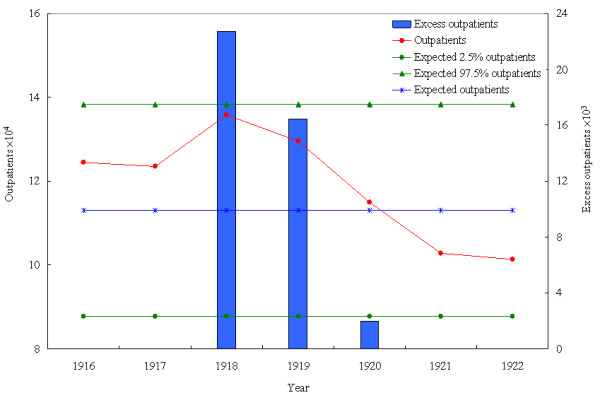
To establish the healthcare needs after the initial wave in 1918, the yearly healthcare records (hospitalizations, outpatients, etc.) in Taiwan during 1918-1920 are compared with the corresponding data from the adjacent "baseline" years of 1916, 1917, 1921, and 1922 to estimate the excess healthcare burden during the initial outbreak in 1918 and in the years immediately after.
In 1918 the number of public hospital outpatients exceeded the yearly average of the baseline years by 20.11% (95% CI: 16.43, 25.90), and the number of hospitalizations exceeded the corresponding yearly average of the baseline years by 12.20% (10.59, 14.38), while the excess number of patients treated by the public medics was statistically significant at 32.21% (28.48, 39.82) more than the yearly average of the baseline years. For 1920, only the excess number of hospitalizations was statistically significant at 19.83% (95% CI: 17.21, 23.38) more than the yearly average of the baseline years.
Considerable extra burden with significant loss of lives was reported in 1918 by both the public medics system and the public hospitals. In comparison, only a substantial number of excess hospitalizations in the public hospitals was reported in 1920, indicating that the population was relatively unprepared for the first wave in 1918 and did not fully utilize the public hospitals. Moreover, comparatively low mortality was reported by the public hospitals and the public medics during the second wave in 1920 even though significantly more patients were hospitalized, suggesting that there had been substantially less fatal illnesses among the hospitalized patients during the second wave. Our results provide viable parameters for assessing healthcare needs for post-pandemic preparedness.
据推测,2009 年大流行性 H1N1 流感病毒可能在当前大流行后时期进入季节性模式,在 2009 年大流行期间确定的高危人群的临床表现更为严重。因此,在此期间必须充分考虑可能过度的医疗保健需求。我们将利用台湾在 1918 年流感大流行期间和之后的历史医疗记录,以确定大流行后时期潜在过度医疗负担的范围。
为了确定 1918 年初始波之后的医疗保健需求,将台湾在 1918-1920 年的每年医疗保健记录(住院、门诊等)与相邻“基线”年(1916 年、1917 年、1921 年和 1922 年)进行比较,以估计 1918 年初始爆发和之后立即发生的过度医疗保健负担。
1918 年,公立医院门诊就诊人数比基线年的年平均值高出 20.11%(95%CI:16.43,25.90),住院人数比基线年的相应年平均值高出 12.20%(10.59,14.38),而公共医疗系统治疗的患者人数则比基线年的年平均值高出 32.21%(28.48,39.82),具有统计学意义。对于 1920 年,只有公立医院的住院人数比基线年的年平均值高出 19.83%(95%CI:17.21,23.38),具有统计学意义。
公共医疗系统和公立医院都报告称,1918 年的生命损失和额外负担都相当大。相比之下,仅报告称 1920 年公立医院有大量的额外住院人数,表明 1918 年第一波疫情时人群准备不足,并未充分利用公立医院。此外,尽管住院人数显著增加,但公立医院和公共医疗系统在 1920 年的第二波疫情中报告的死亡率相对较低,表明第二波疫情期间住院患者的致命疾病明显减少。我们的研究结果为评估大流行后医疗保健需求提供了可行的参数。