Microbial and Genetic Resources Research Group, Bioproduction Research Institute, National Institute of Advanced Industrial Science and Technology, Higashi Tsukuba, Ibaraki, Japan.
ISME J. 2011 Jul;5(7):1162-77. doi: 10.1038/ismej.2010.208. Epub 2011 Jan 20.
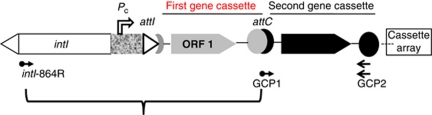
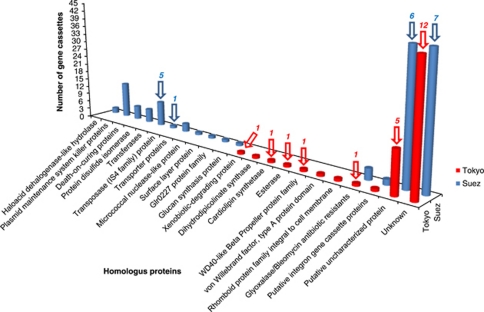
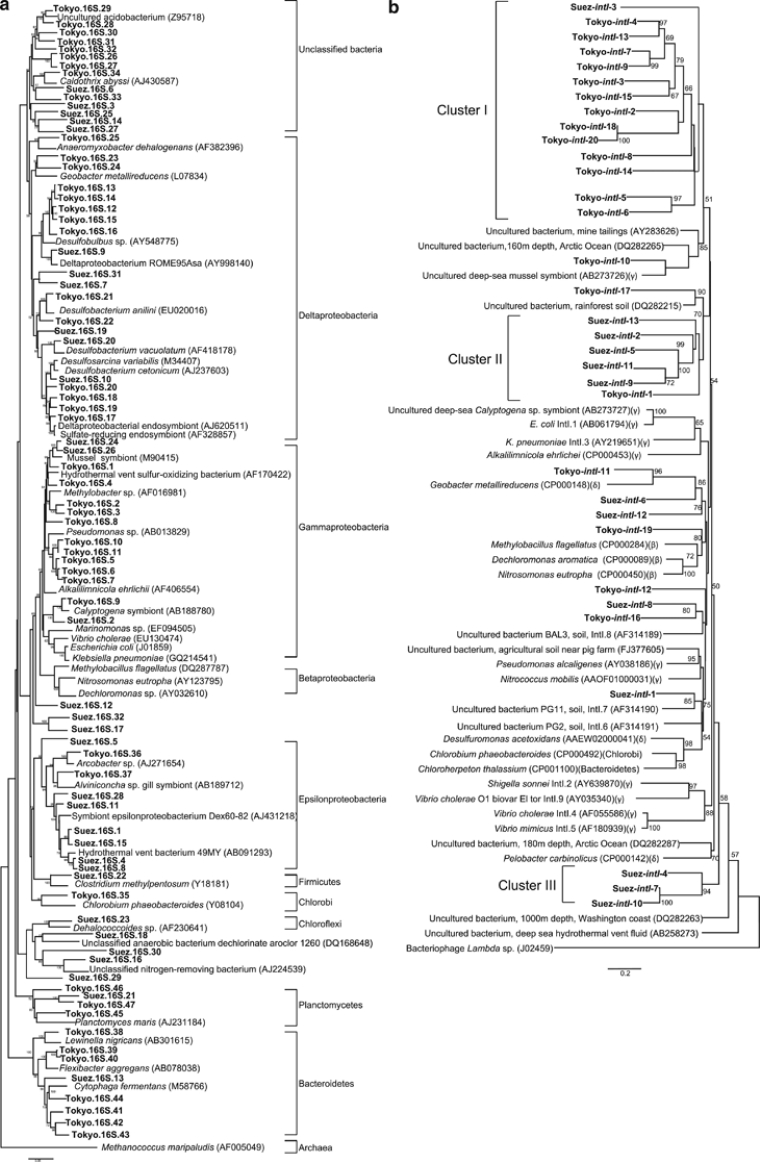
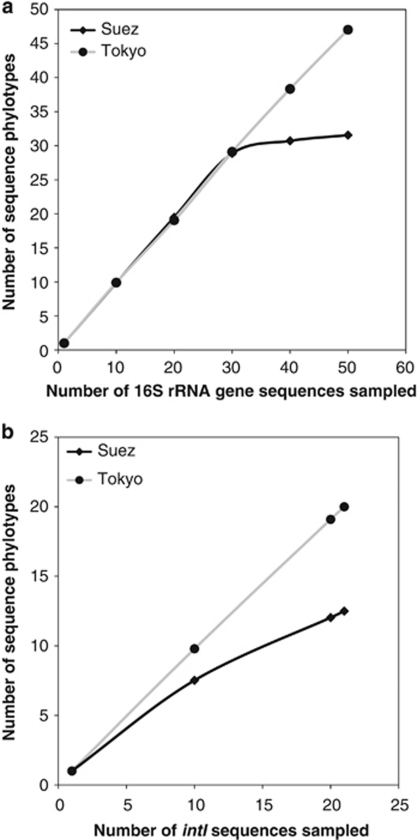
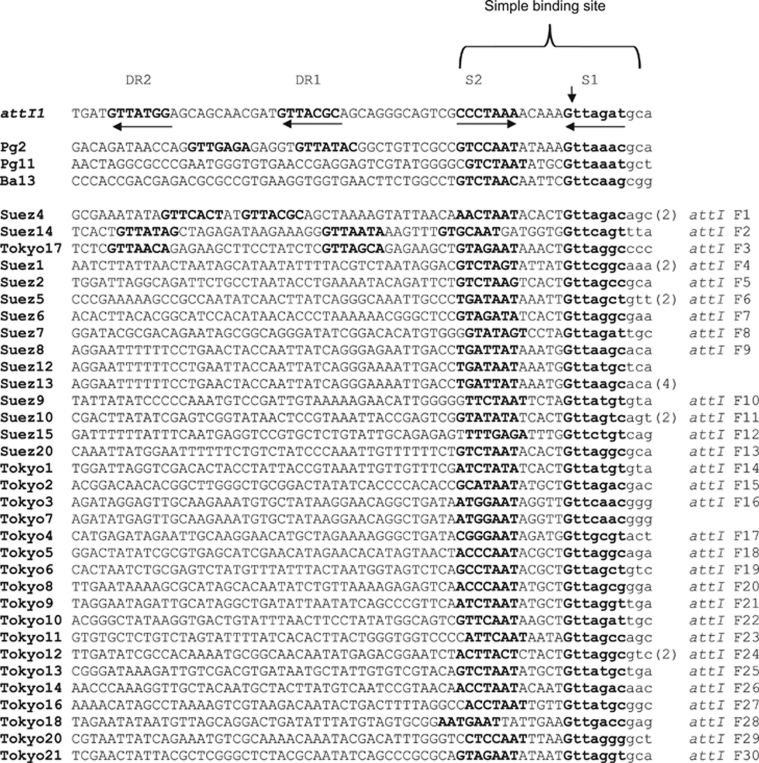
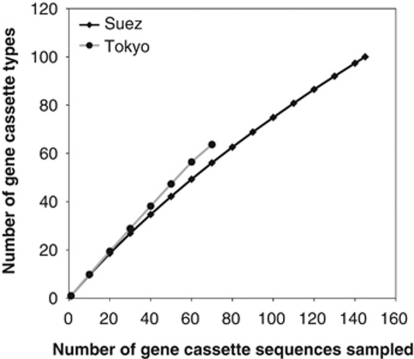
In order to understand the structure and biological significance of integrons and associated gene cassettes in marine polluted sediments, metagenomic DNAs were extracted from sites at Suez and Tokyo Bays. PCR amplicons containing new integrase genes, intI, linked with novel gene cassettes, were recovered and had sizes from 1.8 to 2.5 kb. This approach uncovered, for the first time, the structure and diversity of both marine integron attachment site, attI, and the first gene cassette, the most efficiently expressed integron-associated gene cassette. The recovered 13 and 20 intI phylotypes, from Suez and Tokyo Bay samples, respectively, showed a highly divergence, suggesting a difference in integron composition between the sampling sites. Some intI phylotypes showed similarity with that from Geobacter metallireducens, belonging to Deltaproteobacteria, the dominant class in both sampling sites, as determined by 16S rRNA gene analysis. Thirty distinct families of putative attI site, as determined by the presence of an attI-like simple site, were recovered. A total of 146 and 68 gene cassettes represented Suez and Tokyo Bay unsaturated cassette pools, respectively. Gene cassettes, including a first cassette, from both sampling sites encoded two novel families of glyoxalase/bleomycin antibiotic-resistance protein. Gene cassettes from Suez Bay encoded proteins similar to haloacid dehalogenases, protein disulfide isomerases and death-on-curing and plasmid maintenance system killer proteins. First gene cassettes from Tokyo Bay encoded a xenobiotic-degrading protein, cardiolipin synthetase, esterase and WD40-like β propeller protein. Many of the first gene cassettes encoded proteins with no ascribable function but some of them were duplicated and possessed signal functional sites, suggesting efficient adaptive functions to their bacterial sources. Thus, each sampling site had a specific profile of integrons and cassette types consistent with the hypothesis that the environment shapes the genome.
为了了解海洋污染沉积物中整合子和相关基因盒的结构和生物学意义,从苏伊士湾和东京湾的地点提取了宏基因组 DNA。回收了含有新整合酶基因 intI 的 PCR 扩增子,该基因与新的基因盒相连,大小为 1.8 至 2.5 kb。这种方法首次揭示了海洋整合子附着位点 attI 的结构和多样性,以及第一个基因盒,即表达效率最高的整合子相关基因盒。从苏伊士湾和东京湾样本中回收的 13 和 20 个 intI 系统发育型表现出高度的分化,表明采样点之间整合子组成存在差异。一些 intI 系统发育型与在两个采样点都占优势的δ变形菌门中的 Geobacter metallireducens 的相似,这是通过 16S rRNA 基因分析确定的。通过存在类似于 attI 的简单位点,回收了 30 个不同的假定 attI 位点家族。总共从苏伊士湾和东京湾回收了 146 和 68 个基因盒,分别代表不饱和基因盒库。来自两个采样点的基因盒,包括第一个基因盒,编码两种新型的甘氨酸醛缩酶/博来霉素抗生素抗性蛋白家族。来自苏伊士湾的基因盒编码的蛋白质类似于卤代酸脱卤酶、蛋白质二硫键异构酶和死亡治愈和质粒维持系统杀伤蛋白。来自东京湾的第一个基因盒编码了一种外源性化合物降解蛋白、心磷脂合成酶、酯酶和 WD40 样β推进器蛋白。许多第一个基因盒编码的蛋白质没有可归因的功能,但其中一些是重复的,并具有信号功能位点,这表明它们对其细菌来源具有有效的适应性功能。因此,每个采样点都有特定的整合子和盒型特征,这与环境塑造基因组的假设一致。