Park Jae-Hyeong, Park Yun Seon, Kim Yeon Ju, Lee In Sook, Kim Jun Hyung, Lee Jae-Hwan, Choi Si Wan, Jeong Jin-Ok, Seong In-Whan
Division of Cardiology, Department of Internal Medicine, School of Medicine, Chungnam National University, Chungnam National University Hospital, Daejeon, Korea.
J Cardiovasc Ultrasound. 2010 Dec;18(4):121-6. doi: 10.4250/jcu.2010.18.4.121. Epub 2010 Dec 31.
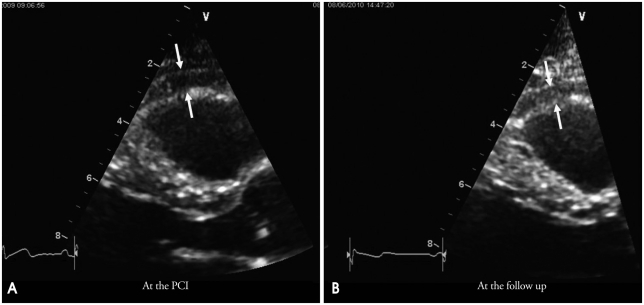
Epicardial fat is a visceral thoracic fat and known to be related with presence of dyslipidemia and coronary arterial stenosis. We evaluated the effects and differences of statins on epicardial fat thickness (EFT) in patients underwent successful percutaneous coronary intervention (PCI).
In this retrospective cohort study, we enrolled consecutive patients underwent successful PCI and scheduled six to eight-months follow-up coronary angiography from March 2007 to June 2009. EFT was measured by echocardiography twice at the time of PCI and the follow-up coronary angiography. We included 145 patients (58 females; mean, 63.5 ± 9.5 years).
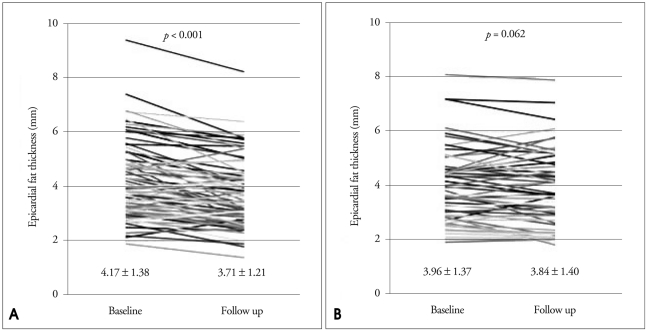
Of the 145 patients, 82 received 20 mg of atorvastatin (atorvastatin group) and 63 medicated with 10 mg of simvastatin with 10 mg of ezetimibe (simvastatin/ezetimibe group). With statin treatments, total cholesterol concentration (189.1 ± 36.1 to 143.3 ± 36.5 mg/dL, p < 0.001), triglycerides (143.5 ± 65.5 to 124.9 ± 63.1 mg/dL, p = 0.005), low density lipoprotein-cholesterol (117.4 ± 32.5 to 76.8 ± 30.9 mg/dL, p < 0.001) and EFT (4.08 ± 1.37 to 3.76 ± 1.29 mm, p < 0.001) were significantly decreased. Atorvastatin and simvastatin/ezetimibe showed similar improvements in the cholesterol profiles. However, atorvastatin decreased EFT more significantly than simvastatin/ezetimibe (EFT change 0.47 ± 0.65 in the atorvastatin vs. 0.12 ± 0.52 mm in the simvastatin/ezetimibe group; p = 0.001).
In this study, the atorvastatin group showed significant reduction in EFT than in the simvastatin/ezetimibe group. This might be originated from the statin difference. More large, randomized study will be needed to evaluate this statin difference.
心外膜脂肪是一种胸腔内脏脂肪,已知与血脂异常和冠状动脉狭窄的存在有关。我们评估了他汀类药物对成功接受经皮冠状动脉介入治疗(PCI)患者的心外膜脂肪厚度(EFT)的影响及差异。
在这项回顾性队列研究中,我们纳入了2007年3月至2009年6月期间连续成功接受PCI并计划进行6至8个月随访冠状动脉造影的患者。在PCI时和随访冠状动脉造影时通过超声心动图测量EFT两次。我们纳入了145例患者(58名女性;平均年龄63.5±9.5岁)。
145例患者中,82例接受20mg阿托伐他汀(阿托伐他汀组),63例服用10mg辛伐他汀加10mg依折麦布(辛伐他汀/依折麦布组)。接受他汀类药物治疗后,总胆固醇浓度(从189.1±36.1降至143.3±36.5mg/dL,p<0.001)、甘油三酯(从143.5±65.5降至124.9±63.1mg/dL,p = 0.005)、低密度脂蛋白胆固醇(从117.4±32.5降至76.8±30.9mg/dL,p<0.001)和EFT(从4.08±1.37降至3.76±1.29mm,p<0.001)均显著降低。阿托伐他汀和辛伐他汀/依折麦布在胆固醇谱方面显示出相似的改善。然而,阿托伐他汀降低EFT的效果比辛伐他汀/依折麦布更显著(阿托伐他汀组EFT变化0.47±0.65,辛伐他汀/依折麦布组为0.12±0.52mm;p = 0.001)。
在本研究中,阿托伐他汀组的EFT降低幅度比辛伐他汀/依折麦布组更大。这可能源于他汀类药物的差异。需要更多大规模的随机研究来评估这种他汀类药物差异。