Department of Clinical Pharmacology and Therapeutics, Asan Medical Center, University of Ulsan College of Medicine, Seoul, Korea.
Korean J Anesthesiol. 2010 Dec;59(6):403-10. doi: 10.4097/kjae.2010.59.6.403. Epub 2010 Dec 31.
Small interfering RNAs (siRNAs) have been used to knockdown specific gene expression in various cells. Astrocytes and microglial cells play a key role in fundamental central nervous system functions and in chronic neuroinflammation. The aims of this study were to determine the optimal concentration of siRNA demonstrating efficient transfection and inhibition of gene expression via RNA interference (RNAi) and lower cytotoxicity, in primary cultured astrocytes and microglial cells of rats.
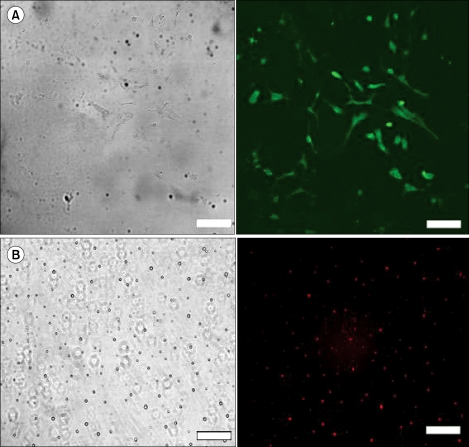
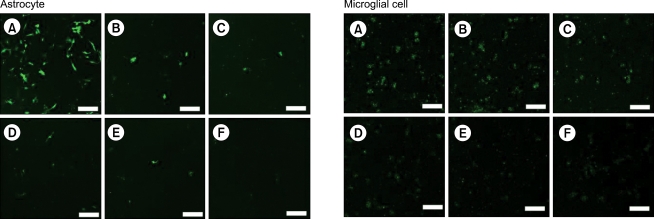
Astrocytes and microglial cells were isolated from the cerebral cortices of 2-day-old rats. Both the cells were transfected using transfection reagent (Lipofectamine™ 2000), and fluorescein-labeled double-stranded RNA (dsRNA) or siRNA targeting green fluorescent protein. Transfection efficiency and cytotoxicity of dsRNA, and the degrees of RNAi induced by siRNA in these cells, were evaluated at various concentrations of RNA.
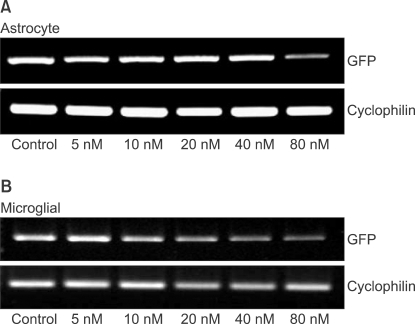
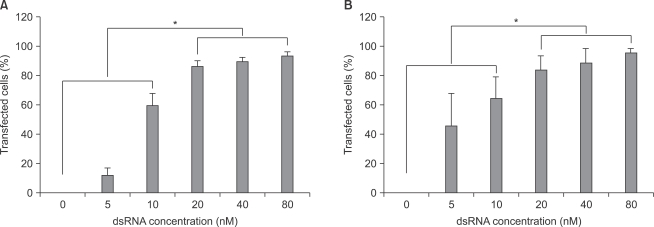
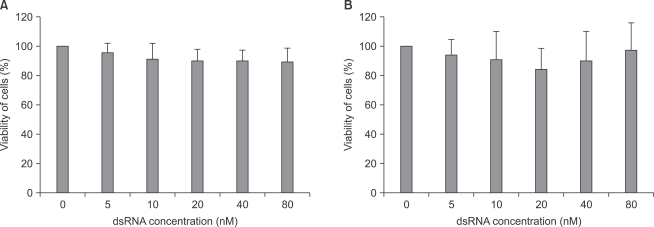
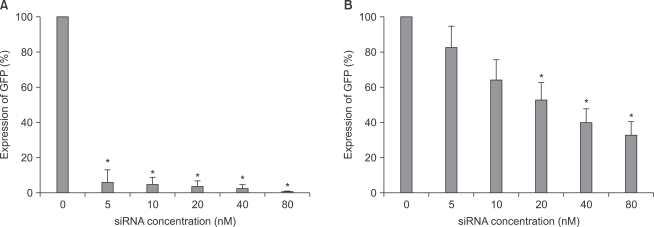
Transfection efficiencies of dsRNA in both astrocytes and microglial cells were significantly higher (P < 0.05) at the concentrations of 20, 40, and 80 nM than at the concentrations of 0, 5, and 10 nM. There were no significant cytotoxicities within the applied concentrations of dsRNA (0-80 nM). The degrees of RNAi induced by siRNA were significantly higher (P < 0.05) at the concentrations of 5, 10, 20, 40, 80 nM, and 20, 40, 80 nM in astrocytes and microglial cells, respectively, compared with the control (0 nM).
The siRNA concentration of 20 nM may be appropriate to induce RNAi in both astrocytes and microglial cells, while demonstrating low cytotoxicity, high transfection efficiency, and effective RNAi.
小干扰 RNA(siRNA)已被用于在各种细胞中敲低特定基因的表达。星形胶质细胞和小胶质细胞在中枢神经系统的基本功能和慢性神经炎症中发挥关键作用。本研究的目的是确定最佳的 siRNA 浓度,以实现通过 RNA 干扰(RNAi)进行有效的转染和基因表达抑制,同时具有较低的细胞毒性,这在原代培养的大鼠星形胶质细胞和小胶质细胞中。
从 2 日龄大鼠的大脑皮质中分离星形胶质细胞和小胶质细胞。使用转染试剂(Lipofectamine™2000)将荧光素标记的双链 RNA(dsRNA)或靶向绿色荧光蛋白的 siRNA 转染到这些细胞中。在不同 RNA 浓度下评估 dsRNA 的转染效率和细胞毒性,以及 siRNA 在这些细胞中诱导的 RNAi 程度。
dsRNA 在星形胶质细胞和小胶质细胞中的转染效率在 20、40 和 80 nM 的浓度下显著高于 0、5 和 10 nM 的浓度(P<0.05)。dsRNA 的应用浓度(0-80 nM)内无明显细胞毒性。siRNA 在星形胶质细胞和小胶质细胞中的 RNAi 诱导程度分别在 5、10、20、40、80 nM 和 20、40、80 nM 的浓度下显著高于对照(0 nM)(P<0.05)。
20 nM 的 siRNA 浓度可能适合在星形胶质细胞和小胶质细胞中诱导 RNAi,同时具有低细胞毒性、高转染效率和有效的 RNAi。