Sage Analytica, Bethesda, Maryland, USA.
mBio. 2011 Jan 25;2(1):e00309-10. doi: 10.1128/mBio.00309-10.
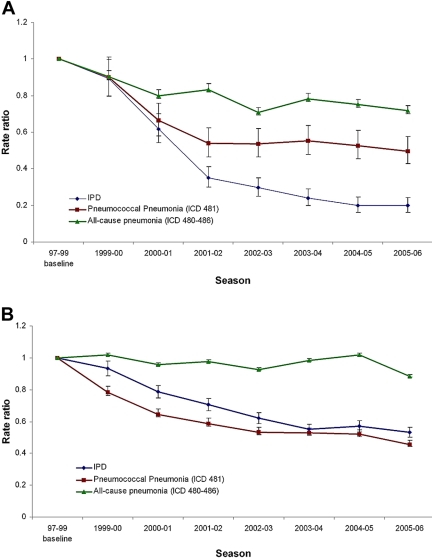
A seven-valent pneumococcal conjugate vaccine (PCV7) introduced in the United States in 2000 has been shown to reduce invasive pneumococcal disease (IPD) in both vaccinated children and adults through induction of herd immunity. We assessed the impact of infant immunization on pneumococcal pneumonia hospitalizations and mortality in all age groups using Health Care Utilization Project State Inpatient Databases (SID) for 1996 to 2006 from 10 states; SID contain 100% samples of ICD9-coded hospitalization data for the selected states. Compared to a 1996-1997 through 1998-1999 baseline, by the 2005-2006 season, both IPD and pneumococcal pneumonia hospitalizations and deaths had decreased substantially in all age groups, including a 47% (95% confidence interval [CI], 38 to 54%) reduction in nonbacteremic pneumococcal pneumonia (ICD9 code 481 with no codes indicating IPD) in infants <2 years old and a 54% reduction (CI, 53 to 56%) in adults ≥65 years of age. A model developed to calculate the total burden of pneumococcal pneumonia prevented by infant PCV7 vaccination in the United States from 2000 to 2006 estimated a reduction of 788,838 (CI, 695,406 to 875,476) hospitalizations for pneumococcal pneumonia. Ninety percent of the reduction in model-attributed pneumococcal pneumonia hospitalizations occurred through herd immunity among adults 18 years old and older; similar proportions were found in pneumococcal disease mortality prevented by the vaccine. In the first seasons after PCV introduction, when there were substantial state differences in coverage among <5-year-olds, states with greater coverage had significantly fewer influenza-associated pneumonia hospitalizations among children, suggesting that PCV7 use also reduces influenza-attributable pneumonia hospitalizations.
2000 年在美国引入的 7 价肺炎球菌结合疫苗(PCV7)通过诱导群体免疫,已被证明可降低接种儿童和成人的侵袭性肺炎球菌病(IPD)。我们使用来自 10 个州的 1996 年至 2006 年的医疗保健利用项目州住院数据库(SID)评估了婴儿免疫对所有年龄组的肺炎球菌性肺炎住院和死亡率的影响;SID 包含了为选定州编码的住院数据的 100%样本。与 1996-1997 年至 1998-1999 年的基线相比,到 2005-2006 年季节,所有年龄组的 IPD 和肺炎球菌性肺炎住院和死亡人数均大幅下降,包括<2 岁婴儿非菌血症性肺炎球菌肺炎(ICD9 编码 481 无 IPD 编码)的发病率下降了 47%(95%置信区间[CI],38 至 54%)和≥65 岁的成年人下降了 54%(CI,53 至 56%)。为计算美国婴儿 PCV7 疫苗接种预防肺炎球菌性肺炎的总负担而开发的模型估计,2000 年至 2006 年期间,可预防 788,838 例(CI,695,406 至 875,476)肺炎球菌性肺炎住院治疗。模型归因的肺炎球菌性肺炎住院人数减少的 90%归因于 18 岁及以上成年人的群体免疫;疫苗预防的肺炎球菌病死亡率也有类似的比例。在 PCV 引入后的最初几个季节中,在 5 岁以下儿童的覆盖率存在很大的州差异,覆盖范围较大的州中儿童因流感相关肺炎住院的比例显著降低,这表明 PCV7 的使用也可减少流感相关肺炎的住院治疗。