Department of Pathology, VU University Medical Center, Amsterdam 1007 MB, The Netherlands.
Br J Cancer. 2011 Feb 15;104(4):685-92. doi: 10.1038/sj.bjc.6606067. Epub 2011 Jan 25.
Despite programmed screening in the Netherlands, the decrease in incidence of cervical carcinoma lags behind. We analysed screening results preceding carcinoma cases, timeliness in case of follow-up, and FIGO (International Federation of Gynaecology and Obstetrics) stages as efficiency parameters for screening were taken.
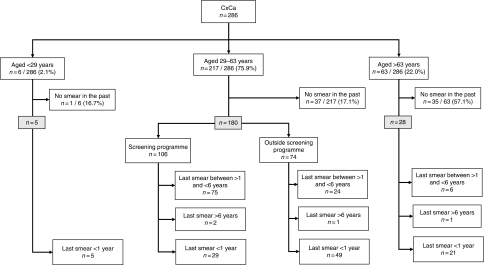
We analysed 286 women with cervical cancer between 2005 and 2007 for cytology history preceding carcinoma, hierarchically arranging cytology history (if present) into three groups: 'screened', 'work-up', and 'underscreened' (>6 yrs before diagnosis). For screen- and work-up smears, we analysed timeliness. FIGO stage was measured in relation to cytology history.
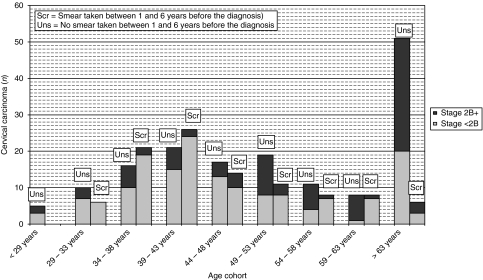
A total of 105 out of 286 (36.7%) women with cervical carcinoma were screened preceding the diagnosis. Delayed time intervals in case of abnormal cytology were 43.5% for borderline/mild dyskaryosis (BMD) and 38.0% for BMD (moderate dyskaryosis or worse; P=0.51). A total of 108 out of 286 (36.4%) women were underscreened, and 73 out of 286 (25.5%) were unscreened. Advanced carcinoma or FIGO stage ≥2B in screened women was 16.0 vs 48.7% in work-up, underscreened, or unscreened (P<0.001).
Women with cervical cancer are underscreened and have poor timeliness in case of abnormal cytology. Being un- or underscreened correlates significantly with higher cervical cancer stages, especially in older women (aged ≥49 years; P<0.001). Improvement of attendancy is needed to meet the standard of quality for screening programmes.
尽管荷兰已经开展了有计划的筛查,但宫颈癌的发病率下降仍较为滞后。我们分析了癌前病例的筛查结果、随访的及时性以及国际妇产科联合会(FIGO)分期,将这些作为筛查的效率参数。
我们分析了 2005 年至 2007 年间 286 例宫颈癌患者的细胞学病史,根据细胞学病史(如果存在)将其分为三组:“筛查”、“检查”和“未筛查”(诊断前>6 年)。对于筛查和检查涂片,我们分析了及时性。FIGO 分期与细胞学病史相关。
在 286 例宫颈癌患者中,共有 105 例(36.7%)在诊断前接受了筛查。异常细胞学的延迟时间间隔分别为边缘型/轻度不典型增生(BMD)的 43.5%和 BMD(中度不典型增生或更严重)的 38.0%(P=0.51)。在 286 例患者中,共有 108 例(36.4%)未筛查,73 例(25.5%)未筛查。在筛查组中,晚期癌或 FIGO 分期≥2B 的比例为 16.0%,而在检查、未筛查或未筛查组中,这一比例为 48.7%(P<0.001)。
宫颈癌患者存在未筛查和异常细胞学随访及时性差的问题。未筛查或未筛查与更高的宫颈癌分期显著相关,尤其是在年龄较大的女性(年龄≥49 岁;P<0.001)中。需要提高就诊率,以满足筛查计划的质量标准。