Institute of Metabolic Science, Addenbrooke's Hospital, University of Cambridge Metabolic Research Laboratories, Cambridge, UK.
Diabetes. 2011 Mar;60(3):925-35. doi: 10.2337/db10-1334. Epub 2011 Jan 26.
Genetic defects in human pericentrin (PCNT), encoding the centrosomal protein pericentrin, cause a form of osteodysplastic primordial dwarfism that is sometimes reported to be associated with diabetes. We thus set out to determine the prevalence of diabetes and insulin resistance among patients with PCNT defects and examined the effects of pericentrin depletion on insulin action using 3T3-L1 adipocytes as a model system.
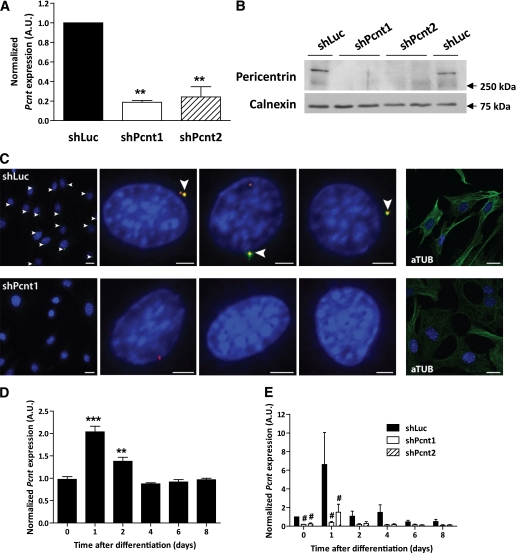
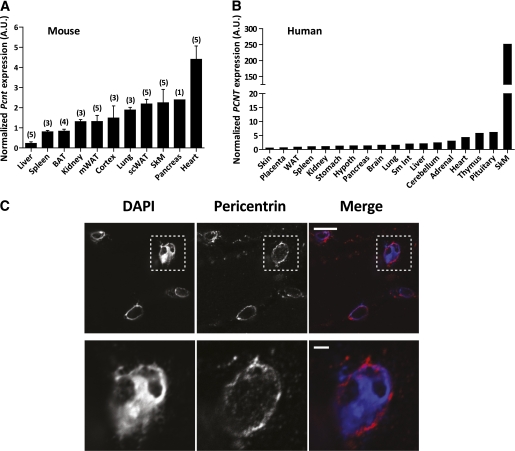
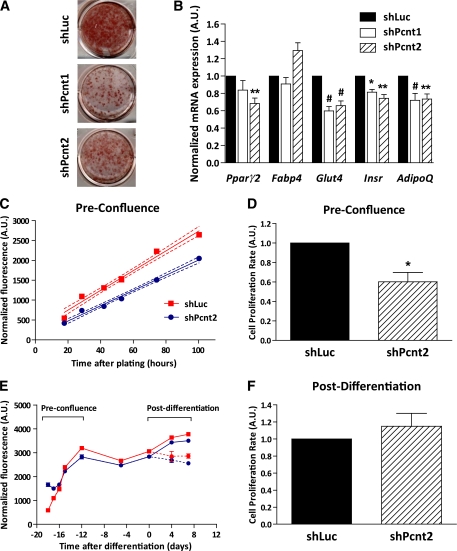
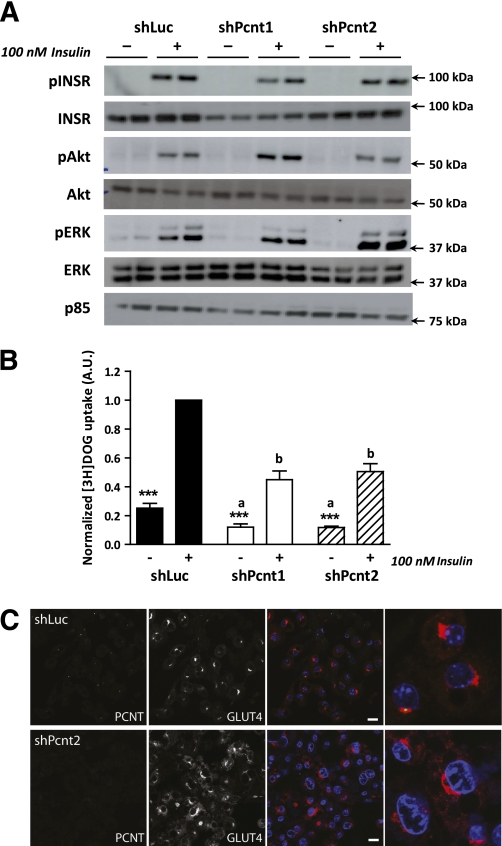
A cross-sectional metabolic assessment of 21 patients with PCNT mutations was undertaken. Pericentrin expression in human tissues was profiled using quantitative real-time PCR. The effect of pericentrin knockdown on insulin action and adipogenesis in 3T3-L1 adipocytes was determined using Oil red O staining, gene-expression analysis, immunoblotting, and glucose uptake assays. Pericentrin expression and localization also was determined in skeletal muscle.
Of 21 patients with genetic defects in PCNT, 18 had insulin resistance, which was severe in the majority of subjects. Ten subjects had confirmed diabetes (mean age of onset 15 years [range 5-28]), and 13 had metabolic dyslipidemia. All patients without insulin resistance were younger than 4 years old. Knockdown of pericentrin in adipocytes had no effect on proximal insulin signaling but produced a twofold impairment in insulin-stimulated glucose uptake, approximately commensurate with an associated defect in cell proliferation and adipogenesis. Pericentrin was highly expressed in human skeletal muscle, where it showed a perinuclear distribution.
Severe insulin resistance and premature diabetes are common features of PCNT deficiency but are not congenital. Partial failure of adipocyte differentiation may contribute to this, but pericentrin deficiency does not impair proximal insulin action in adipocytes.
人类中心体蛋白蛋白(PCNT)的基因突变会导致一种形式的骨发育不良性原始侏儒症,这种疾病有时与糖尿病有关。因此,我们着手确定 PCNT 缺陷患者中糖尿病和胰岛素抵抗的患病率,并使用 3T3-L1 脂肪细胞作为模型系统,研究中心体蛋白缺失对胰岛素作用的影响。
对 21 名 PCNT 突变患者进行了横断面代谢评估。使用定量实时 PCR 对人组织中的中心体蛋白表达进行了分析。通过油红 O 染色、基因表达分析、免疫印迹和葡萄糖摄取测定,确定中心体蛋白敲低对 3T3-L1 脂肪细胞中胰岛素作用和脂肪生成的影响。还确定了骨骼肌中的中心体蛋白表达和定位。
在 21 名存在 PCNT 基因缺陷的患者中,有 18 名存在胰岛素抵抗,其中大多数患者的胰岛素抵抗严重。10 名患者确诊患有糖尿病(发病平均年龄为 15 岁[范围为 5-28 岁]),13 名患者存在代谢性血脂异常。所有无胰岛素抵抗的患者均小于 4 岁。在脂肪细胞中敲低中心体蛋白对近端胰岛素信号没有影响,但会导致胰岛素刺激的葡萄糖摄取减少两倍,与细胞增殖和脂肪生成的相关缺陷大致相当。中心体蛋白在人类骨骼肌中高度表达,呈核周分布。
严重的胰岛素抵抗和过早的糖尿病是 PCNT 缺乏症的常见特征,但并非先天性的。脂肪细胞分化的部分失败可能对此有贡献,但中心体蛋白缺失不会损害脂肪细胞中的近端胰岛素作用。