Lee J V, Lai S, Exner M, Lenz J, Gaia V, Casati S, Hartemann P, Lück C, Pangon B, Ricci M L, Scaturro M, Fontana S, Sabria M, Sánchez I, Assaf S, Surman-Lee S
Health Protection Agency, London, UK Institute for Hygiene and Public Health, Universität Bonn, Bonn, Germany Istituto Cantonale di Microbiologia, Bellinzona, Switzerland CHU Nancy, Nancy, France Institute of Medical Microbiology and Hygiene, University of Technology, Dresden, Germany Unité de Microbiologie-Hygiène, CH Versailles, Versailles, France Istituto Superiore di Sanità, Roma, Italy Autonomous University of Barcelona, Barcelona, Spain Pall GeneSystems, Bruz, France.
J Appl Microbiol. 2011 Apr;110(4):1032-44. doi: 10.1111/j.1365-2672.2011.04957.x. Epub 2011 Feb 18.
To perform an international trial to derive alert and action levels for the use of quantitative PCR (qPCR) in the monitoring of Legionella to determine the effectiveness of control measures against legionellae.
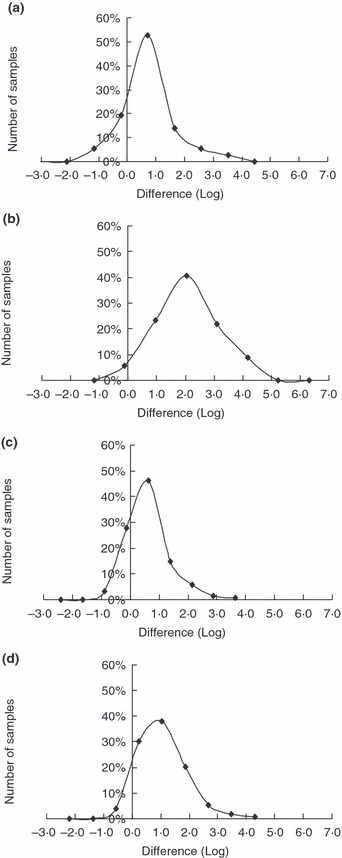
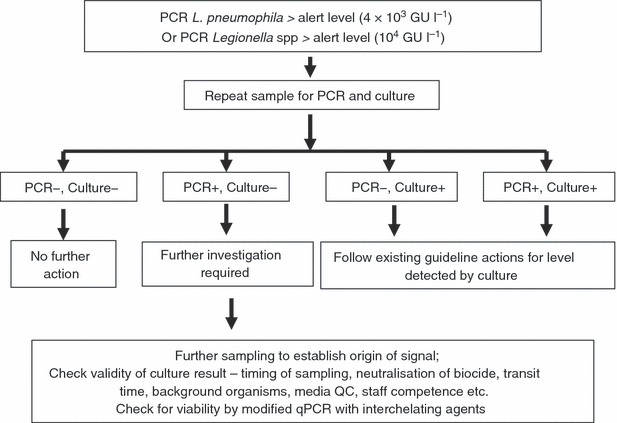
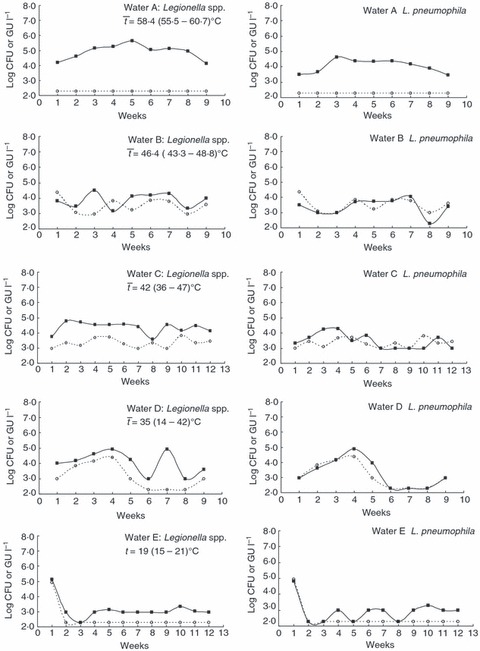
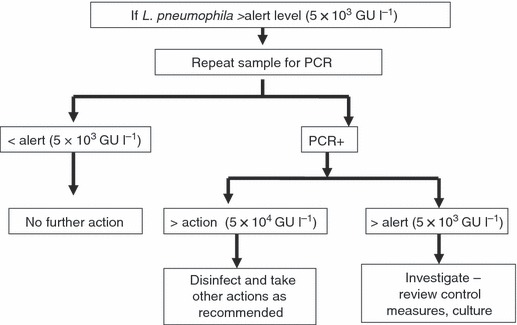
Laboratories (7) participated from six countries. Legionellae were determined by culture and qPCR methods with comparable detection limits. Systems were monitored over ≥10 weeks. For cooling towers (232 samples), there was a significant difference between the log mean difference between qPCR (GU l(-1) ) and culture (CFU l(-1) ) for Legionella pneumophila (0·71) and for Legionella spp. (2·03). In hot and cold water (506 samples), the differences were less, 0·62 for Leg. pneumophila and 1·05 for Legionella spp. Results for individual systems depended on the nature of the system and its treatment. In cooling towers, Legionella spp. GU l(-1) always exceeded CFU l(-1) , and usually Legionella spp. were detected by qPCR when absent by culture. The pattern of results by qPCR for Leg. pneumophila followed the culture trend. In hot and cold water, culture and qPCR gave similar results, particularly for Leg. pneumophila. There were some marked exceptions with temperatures ≥50°C, or in the presence of supplementary biocides. Action and alert levels for qPCR were derived that gave results comparable to the application of the European Guidelines based on culture. Algorithms are proposed for the use of qPCR for routine monitoring.
Action and alert levels for qPCR can be adjusted to ensure public health is protected with the benefit that remedial actions can be validated earlier with only a small increase in the frequency of action being required.
This study confirms it is possible to derive guidelines on the use of qPCR for monitoring the control of legionellae with consequent improvement to response and public health protection.
开展一项国际试验,以确定定量聚合酶链反应(qPCR)用于军团菌监测的警报和行动水平,从而判定针对军团菌的控制措施的有效性。
来自六个国家的7家实验室参与了试验。采用培养法和qPCR法测定军团菌,二者检测限相当。对各系统进行了≥10周的监测。对于冷却塔(232个样本),嗜肺军团菌qPCR结果(基因组单位/升)与培养结果(菌落形成单位/升)的对数平均差异为0·71,军团菌属的该差异为2·03,二者存在显著差异。在冷热水系统(506个样本)中,差异较小,嗜肺军团菌为0·62,军团菌属为1·05。各个系统的结果取决于系统的性质及其处理方式。在冷却塔中,军团菌属的基因组单位/升总是超过菌落形成单位/升,而且通常在培养法未检测到军团菌属时,qPCR法能检测到。嗜肺军团菌的qPCR结果模式与培养结果趋势一致。在冷热水系统中,培养法和qPCR法得出的结果相似,尤其是对于嗜肺军团菌。在温度≥50°C或存在补充性杀菌剂的情况下,存在一些明显的例外情况。得出了qPCR的行动和警报水平,其结果与基于培养法的欧洲指南应用结果相当。提出了将qPCR用于常规监测的算法。
可以调整qPCR的行动和警报水平,以确保公众健康得到保护,好处是只需小幅增加行动频率就能更早地验证补救措施。
本研究证实,有可能制定关于使用qPCR监测军团菌控制情况的指南,从而改进应对措施并加强公众健康保护。