State Key Laboratory of Pathogen and Biosecurity, Beijing Institute of Microbiology and Epidemiology, Beijing, People's Republic of China.
PLoS One. 2011 Jan 25;6(1):e16418. doi: 10.1371/journal.pone.0016418.
Several studies have shown that the predominant genotype of Chinese Japanese encephalitis virus (JEV) is evolving from genotype 3 to genotype 1. However, in recent years, almost all genotype 1 isolates were from mosquitoes, and genotype 1 has been less associated with human disease than genotype 3. This study reports the isolation of human genotype 1 JEV and its genetic characteristics to provide additional insights into human JE pathogens that are currently circulating in China.
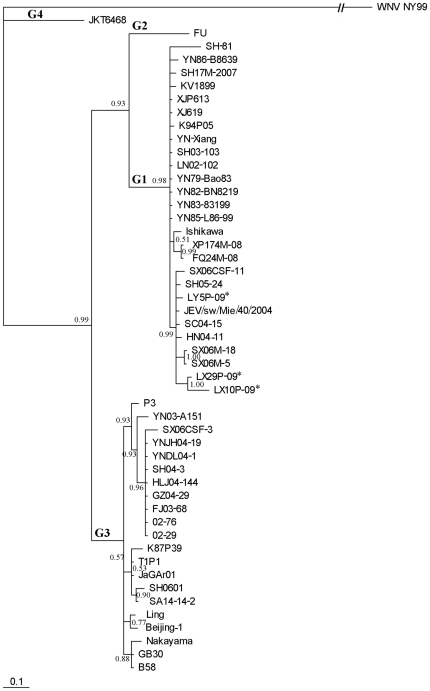
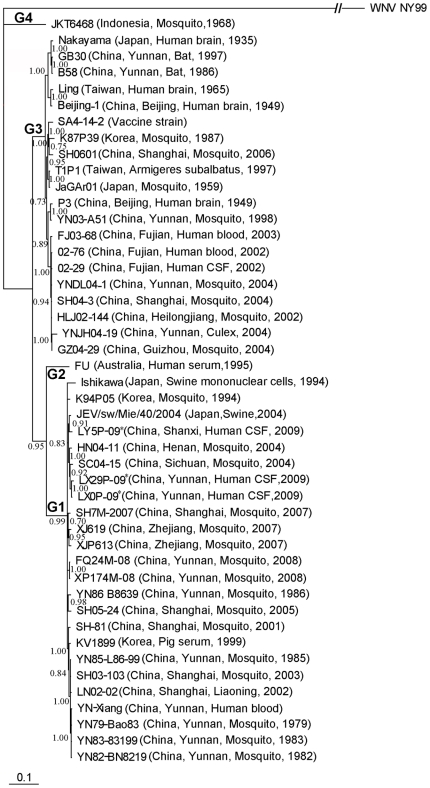
In 2009, 31 cerebrospinal fluid samples were collected from patients living in Yunnan and Shanxi provinces and were used to inoculate Aedes albopictus C6/36 cells for virus isolation. The JEV strains were identified using immunofluorescent assays and the reverse transcription-polymerase chain reaction. Phylogenetic analyses based on the partial capsid/pre-membrane and full envelope (E) sequences were performed using Clustalx 1.8 software. Three JEV isolates were obtained from a 4-year-old girl and a 2-year-old boy living in Yunnan and an 82-year-old woman in Shanxi. The boy had been immunized with one dose of JE live attenuated vaccine. New isolates were grouped into genotype 1. Amino acid sequence for the viral E protein indicated 95% to 100% identity with each other and with other JEV strains. When compared with a consensus sequence of E protein, two amino acid substitutions were found: Ser(E-123)-Asn in the two Yunnan isolates and Lys(E-166)-Arg in the Shanxi isolate.
Our findings indicate that the genotype 1 of JEV is causing human infections in China. Our observation of a previously vaccinated boy developing JE from genotype 1 virus infection also calls for more detailed studies, both in vitro and in vivo neutralization tests as well as active surveillance, to examine the possibility of a lack of complete protection conferred by the live attenuated JE vaccine against genotype 1 virus.
几项研究表明,中国日本脑炎病毒(JEV)的主要基因型正在从基因型 3 进化为基因型 1。然而,近年来,几乎所有的基因型 1 分离株均来自蚊子,而且与基因型 3 相比,基因型 1与人类疾病的关联较少。本研究报告了人类基因型 1 JEV 的分离及其遗传特征,为了解目前在中国流行的人类 JEV 病原体提供了更多的信息。
2009 年,从居住在云南和山西的 31 位患者的脑脊液样本中采集样本,并将其接种于白纹伊蚊 C6/36 细胞中进行病毒分离。使用免疫荧光测定法和逆转录-聚合酶链反应来鉴定 JEV 株。使用 Clustalx 1.8 软件对基于部分衣壳/前膜和全长包膜(E)序列的系统进化分析。从云南的一名 4 岁女孩和一名 2 岁男孩以及山西的一名 82 岁妇女中获得了三株 JEV 分离株。该男孩已接种一剂 JE 减毒活疫苗。新分离株被分为基因型 1。病毒 E 蛋白的氨基酸序列彼此之间以及与其他 JEV 株之间具有 95%至 100%的同一性。与 E 蛋白的共识序列相比,发现了两个氨基酸取代:云南的两个分离株中的 Ser(E-123)-Asn 和山西分离株中的 Lys(E-166)-Arg。
我们的研究结果表明,基因型 1 的 JEV 正在引起中国的人类感染。我们观察到一名以前接种过疫苗的男孩因基因型 1 病毒感染而发生 JEV,这也呼吁进行更详细的研究,包括体外和体内中和试验以及主动监测,以研究减毒活 JEV 疫苗对基因型 1 病毒的完全保护作用是否缺失的可能性。