BMC Infect Dis. 2013 Aug 8;13:368. doi: 10.1186/1471-2334-13-368.
Increasing virulence of Japanese encephalitis virus (JEV), a mosquito-borne zoonotic pathogen is of grave concern because it causes a neurotrophic killer disease Japanese Encephalitis (JE) which, in turn, is responsible globally for viral acute encephalitis syndrome (AES). Despite the availability of vaccine, JE/AES cases and deaths have become regular features in the different rural districts of West Bengal (WB) state, India, indicating either the partial coverage of vaccine or the emergence of new strain of JEV. Therefore, a study was undertaken to characterize and compare the complete envelope (E) protein gene based molecular changes/patterns of JEVs circulating in WB.
Total of 98 AES case-patients' samples were tested to detect the presence of JEV specific immunoglobulin M (IgM) antibody by Mac-ELISA method. Only JEV IgM negative samples with a history of ≤3 days' illness were screened for virus isolation and RT-PCR. E gene sequences of JEV isolates were subjected to molecular phylogeny and immunoinformatics analysis.
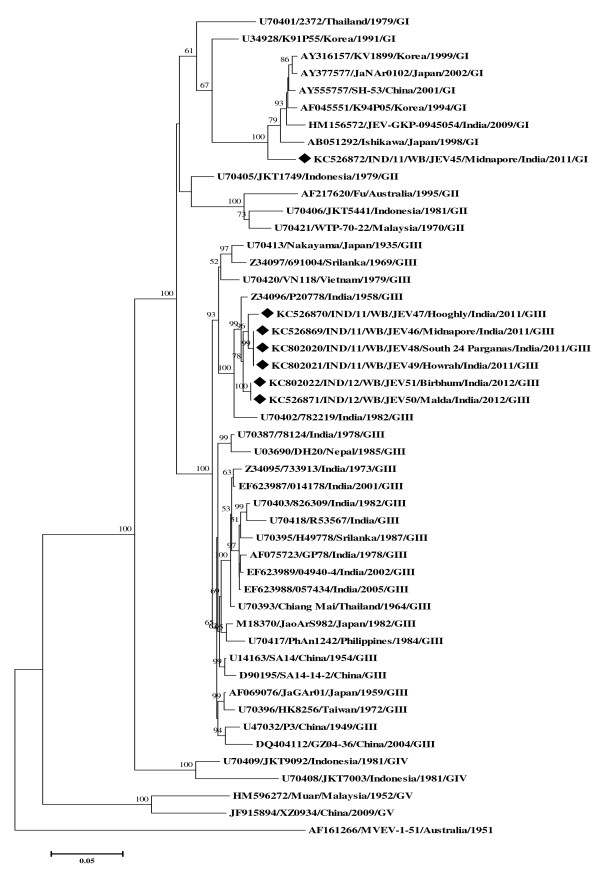
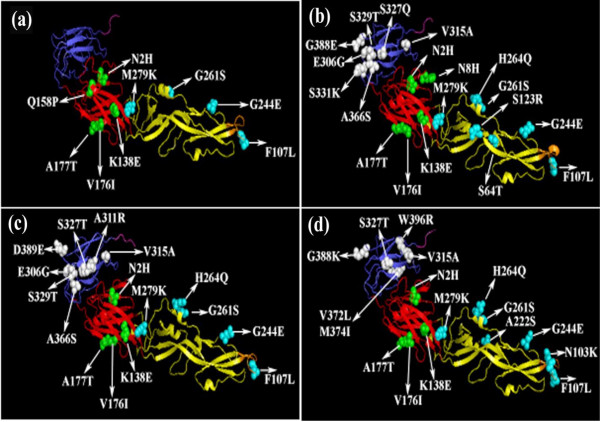
Present study confirmed JEV etiology in 39.7% and 29.1% of patients presenting ≤15 days' febrile illness, as determined by Mac-ELISA and RT-PCR respectively. Phylogenetic analysis based on complete E gene sequences of JEV isolates showed the co-circulation of JEV genotype I (GI) with genotype III (GIII). This study also demonstrated that isolate-specific crucial amino acid substitutions were closely related to neurovirulence/neuroinvasiveness of JE. On the basis of immunoinformatics analysis, some substitutions were predicted to disrupt T-cell epitope immunogenicity/antigenicity that might largely influence the outcome of vaccine derived from JEV GIII SA14-14-2 strain and this has been observed in a previously vaccinated boy with mild JE/AES due to JEV GI infection.
Based on molecular evolutionary and bioinformatic approaches, we report evolution of JEV at a local level. Such naturally occurring evolution is likely to affect the disease profile and the vaccine efficacy to protect against JEV GI may demand careful evaluation.
日本脑炎病毒 (JEV) 的毒力不断增强,令人深感担忧,因为它会导致一种神经滋养性杀伤性疾病,即日本脑炎 (JE),而 JE 是导致全球病毒性急性脑炎综合征 (AES) 的罪魁祸首。尽管有疫苗可用,但 JE/AES 病例和死亡在印度西孟加拉邦 (WB) 的不同农村地区已成为常态,这表明疫苗的覆盖面要么不完整,要么出现了 JEV 的新毒株。因此,进行了一项研究,以描述和比较在 WB 循环的 JEV 基于完整包膜 (E) 蛋白基因的分子变化/模式。
采用 Mac-ELISA 法检测 98 例 AES 病例患者样本中是否存在 JEV 特异性免疫球蛋白 M (IgM) 抗体。仅对具有≤3 天病史且 JEV IgM 阴性的样本进行病毒分离和 RT-PCR 筛选。对 JEV 分离株的 E 基因序列进行分子系统发育和免疫信息学分析。
本研究通过 Mac-ELISA 和 RT-PCR 分别确定 39.7%和 29.1%≤15 天发热性疾病患者的 JEV 病因。基于 JEV 分离株完整 E 基因序列的系统发育分析表明,JEV 基因型 I (GI) 与基因型 III (GIII) 同时流行。本研究还表明,分离株特异性关键氨基酸取代与 JE 的神经毒力/神经侵袭性密切相关。基于免疫信息学分析,一些取代被预测会破坏 T 细胞表位的免疫原性/抗原性,这可能会极大地影响来自 JEV GIII SA14-14-2 株的疫苗的效果,这在之前因 JEV GI 感染而接种过疫苗的轻度 JE/AES 男孩中得到了观察。
基于分子进化和生物信息学方法,我们报告了 JEV 在本地水平的进化。这种自然发生的进化可能会影响疾病谱,针对 JEV GI 的疫苗效果可能需要仔细评估。