Conservation Biology Unit, World Wide Fund for Nature Thailand, Bangkok, Thailand.
PLoS One. 2011 Jan 20;6(1):e14509. doi: 10.1371/journal.pone.0014509.
Ecologically similar species often coexist by partitioning use of habitats or resources. Such partitioning can occur through divergent or shared niches. We investigated overlap in habitat use and spatial co-occurrence by sympatric Asiatic black bears and sun bears in three habitats in Thailand, and thereby assessed which niche model best accounts for their coexistence.
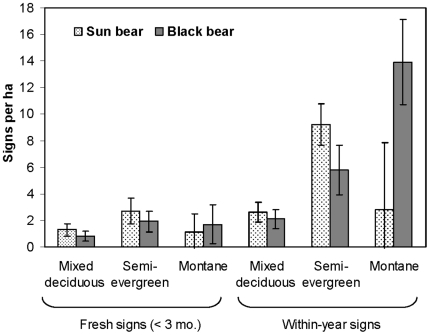
METHODS/PRINCIPAL FINDINGS: We used density of species-specific signs to assess habitat use. Signs of both bear species occurred in all three habitats, and on >60% of sampling transects. Both species fed mostly on fruit; insect feeding signs were uncommon, and were mostly from sun bears. Significant differences in habitat use occurred only in montane forest, the habitat in which fruit was most abundant; incidence of black bear sign there was six times higher than that of sun bears. Habitat use was similar between the two species in the other habitats, which comprised 85% of the area. Of 10 habitat attributes examined, fruiting tree density was the best predictor of occurrence for both species. Models that included interspecific competition (fresh foraging activity of the other species) were less supported than the top models without competition.
CONCLUSIONS/SIGNIFICANCE: Bear species co-occurrence at both coarse and fine spatial scales and use of the same resources (fruit trees) indicated common niche preferences. However, their habitat use differed in ways expected from their physical differences: larger black bears dominated in the most fruit-rich habitat, and smaller sun bears used less-preferred insects. These results indicate broadly overlapping fundamental niches combined with asymmetric competition-features consistent with the concept of shared preference niches. This model of the niche has received little attention in ecology, but appears to be relatively common in nature.
生态相似的物种通常通过划分对栖息地或资源的利用来共同生存。这种划分可以通过不同或共享的生态位来实现。我们调查了在泰国的三个栖息地中,同域分布的亚洲黑熊和马来熊对生境的利用和空间共存的重叠情况,并评估了哪种生态位模型最能解释它们的共存。
方法/主要发现:我们使用特定物种的标志密度来评估生境利用情况。这两个熊物种的标志都出现在所有三个栖息地,并且在超过 60%的采样样带上。两种熊类都主要以水果为食;昆虫取食的迹象很少见,而且大多来自马来熊。只有在高山森林中才出现显著的生境利用差异,在这个栖息地中水果最为丰富;那里黑熊的标志出现的频率是马来熊的六倍。在另外两个占总面积 85%的栖息地中,这两个物种的生境利用情况相似。在所检查的 10 个生境属性中,结果表明,结果树密度是这两个物种出现的最佳预测因子。包含种间竞争(另一种物种的新鲜觅食活动)的模型不如没有竞争的最佳模型支持度高。
结论/意义:在粗尺度和细尺度上,熊类物种的共存以及对相同资源(结果树)的利用表明它们有共同的生态位偏好。然而,它们的生境利用方式存在差异,这与它们的物理差异相符:体型较大的黑熊在最富水果的栖息地中占据主导地位,而体型较小的马来熊则利用不太受欢迎的昆虫。这些结果表明,广泛重叠的基本生态位与不对称竞争相结合的特征与共享偏好生态位的概念一致。这种生态位模型在生态学中很少受到关注,但在自然界中似乎相对普遍。