Department of Animal Production, Faculty of Veterinary Medicine, Aristotle University of Thessaloniki, Thessaloniki, Greece.
PLoS One. 2011 Jan 19;6(1):e14560. doi: 10.1371/journal.pone.0014560.
Single nucleotide polymorphisms (SNP) have proven to be powerful genetic markers for genetic applications in medicine, life science and agriculture. A variety of methods exist for SNP detection but few can quantify SNP frequencies when the mutated DNA molecules correspond to a small fraction of the wild-type DNA. Furthermore, there is no generally accepted gold standard for SNP quantification, and, in general, currently applied methods give inconsistent results in selected cohorts. In the present study we sought to develop a novel method for accurate detection and quantification of SNP in DNA pooled samples.
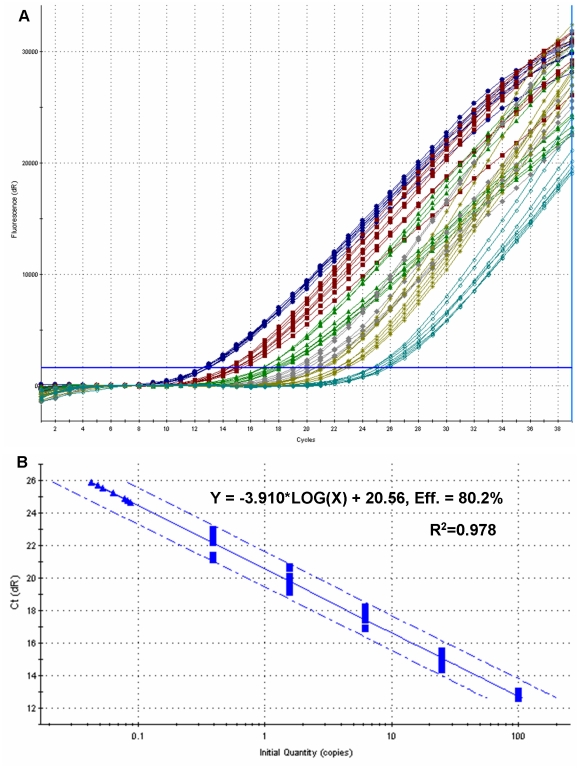
The development and evaluation of a novel Ligase Chain Reaction (LCR) protocol that uses a DNA-specific fluorescent dye to allow quantitative real-time analysis is described. Different reaction components and thermocycling parameters affecting the efficiency and specificity of LCR were examined. Several protocols, including gap-LCR modifications, were evaluated using plasmid standard and genomic DNA pools. A protocol of choice was identified and applied for the quantification of a polymorphism at codon 136 of the ovine PRNP gene that is associated with susceptibility to a transmissible spongiform encephalopathy in sheep.
The real-time LCR protocol developed in the present study showed high sensitivity, accuracy, reproducibility and a wide dynamic range of SNP quantification in different DNA pools. The limits of detection and quantification of SNP frequencies were 0.085% and 0.35%, respectively.
The proposed real-time LCR protocol is applicable when sensitive detection and accurate quantification of low copy number mutations in DNA pools is needed. Examples include oncogenes and tumour suppressor genes, infectious diseases, pathogenic bacteria, fungal species, viral mutants, drug resistance resulting from point mutations, and genetically modified organisms in food.
单核苷酸多态性(SNP)已被证明是医学、生命科学和农业中遗传应用的强大遗传标记。存在多种用于 SNP 检测的方法,但当突变 DNA 分子仅占野生型 DNA 的一小部分时,很少有方法可以定量 SNP 频率。此外,没有普遍接受的 SNP 定量黄金标准,并且通常应用的方法在选定的队列中给出不一致的结果。在本研究中,我们试图开发一种用于准确检测和定量 DNA 混合样本中 SNP 的新方法。
描述了一种新型连接酶链反应(LCR)协议的开发和评估,该协议使用 DNA 特异性荧光染料允许定量实时分析。检查了影响 LCR 效率和特异性的不同反应成分和热循环参数。使用质粒标准品和基因组 DNA 池评估了几种方案,包括缺口-LCR 修饰。选择了一种方案,并将其应用于绵羊 PRNP 基因 136 密码子多态性的定量,该多态性与绵羊传染性海绵状脑病的易感性相关。
本研究中开发的实时 LCR 协议在不同的 DNA 池中显示出 SNP 定量的高灵敏度、准确性、重现性和宽动态范围。SNP 频率的检测和定量下限分别为 0.085%和 0.35%。
当需要在 DNA 池中转录物水平检测和准确定量低拷贝数突变时,建议使用实时 LCR 协议。示例包括癌基因和肿瘤抑制基因、传染病、致病性细菌、真菌物种、病毒突变体、点突变引起的耐药性以及食品中的转基因生物。