The Heart and Vascular Center, The Christ Hospital, Cincinnati, Ohio, USA.
J Cardiovasc Magn Reson. 2011 Feb 2;13(1):12. doi: 10.1186/1532-429X-13-12.
Cardiac dysfunction in boys with Duchenne muscular dystrophy (DMD) is a leading cause of death. Cardiac resynchronization therapy (CRT) has been shown to dramatically decrease mortality in eligible adult population with congestive heart failure. We hypothesized that mechanical dyssynchrony is present in DMD patients and that cardiovascular magnetic resonance (CMR) may predict CRT efficacy.
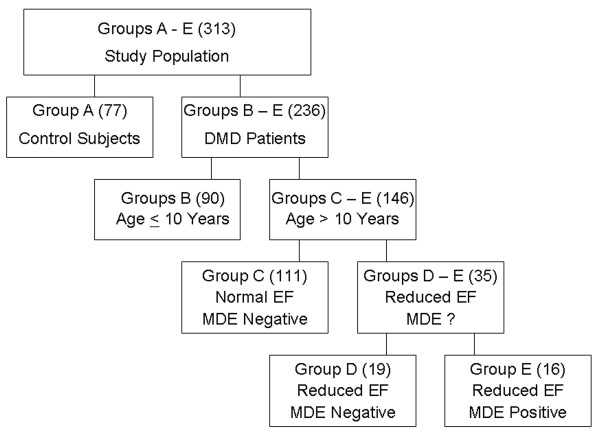
DMD patients (n = 236) were stratified into 4 groups based on age, diagnosis of DMD, left ventricular (LV) ejection fraction (EF), and presence of myocardial fibrosis defined as positive late gadolinum enhancement (LGE) compared to normal controls (n = 77). Dyssynchrony indices were calculated based on timing of CMR derived circumferential strain (ecc). The calculated indices included cross-correlation delay (XCD), uniformity of strain (US), regional vector of variance (RVV), time to maximum strain (TTMS) and standard deviation (SD) of TTMS. Abnormal XCD value was defined as > normal + 2SD. US, RVV, TTMS and SD were calculated for patients with abnormal XCD.
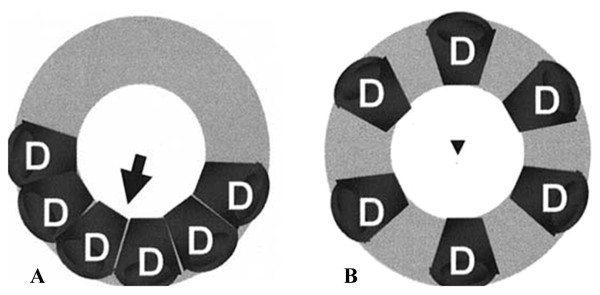
There was overall low prevalence of circumferential dyssynchrony in the entire DMD population; it increased to 17.1% for patients with abnormal EF and to 31.2% in the most advanced stage (abnormal EF with fibrosis). All but one DMD patient with mechanical dyssynchrony exhibited normal QRS duration suggesting absence of electrical dyssynchrony. The calculated US and RVV values (0.91 ± 0.09, 1.34 ± 0.48) indicate disperse rather than clustered dyssynchrony.
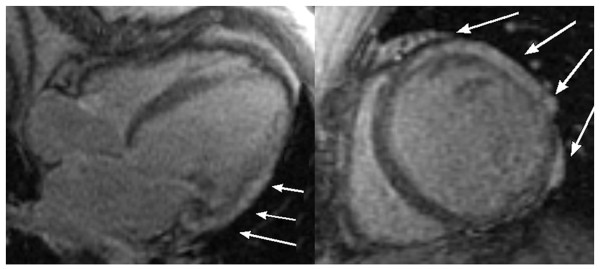
Mechanical dyssynchrony is frequent in boys with end stage DMD-associated cardiac dysfunction. It is associated with normal QRS complex as well as extensive lateral fibrosis. Based on these findings, it is unlikely that this patient population will benefit from CRT.
杜氏肌营养不良症(DMD)男孩的心脏功能障碍是导致死亡的主要原因。心脏再同步治疗(CRT)已被证明可显著降低充血性心力衰竭的合格成年人群的死亡率。我们假设机械不同步存在于 DMD 患者中,心血管磁共振(CMR)可预测 CRT 的疗效。
根据年龄、DMD 诊断、左心室(LV)射血分数(EF)以及与正常对照组(n = 77)相比是否存在心肌纤维化(定义为阳性延迟钆增强(LGE)),将 236 例 DMD 患者分为 4 组。基于 CMR 衍生的圆周应变(ecc)计算时,计算出不同步指数。计算出的指数包括互相关延迟(XCD)、应变均匀性(US)、区域方差向量(RVV)、最大应变时间(TTMS)和 TTMS 的标准差(SD)。异常 XCD 值定义为>正常+ 2SD。对于 XCD 异常的患者,计算 US、RVV、TTMS 和 SD。
整个 DMD 人群的圆周不同步发生率总体较低;EF 异常患者增加到 17.1%,最晚期(EF 异常伴纤维化)增加到 31.2%。除了一名患有机械不同步的 DMD 患者外,所有患者的 QRS 持续时间均正常,表明不存在电不同步。计算出的 US 和 RVV 值(0.91 ± 0.09,1.34 ± 0.48)表明不同步是分散的,而不是聚类的。
在终末期 DMD 相关心脏功能障碍的男孩中,机械不同步很常见。它与正常的 QRS 复合体以及广泛的外侧纤维化有关。基于这些发现,该患者人群不太可能从 CRT 中受益。