Women's and Children's Health, International Maternal and Child Health (IMCH), Uppsala University, Uppsala, Sweden.
J Psychosom Obstet Gynaecol. 2011 Mar;32(1):10-8. doi: 10.3109/0167482X.2010.547966.
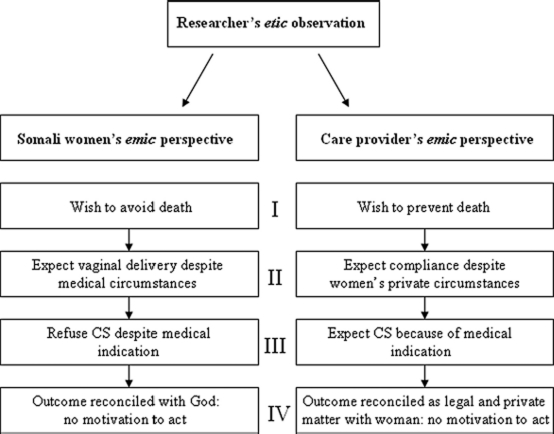
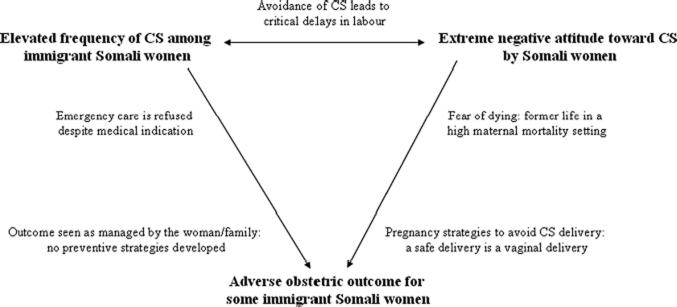
We explored the perceptions of 39 Somali women and 62 obstetric care providers in London in relation to caesarean birth, as borne out of a paradox we recognised from evidence-based information about the Somali group. Socio-cultural factors potentially leading to adverse obstetric outcome were identified using in-depth and focus group interviews with semi-structured, open-ended questions. A cultural anthropology model, the emic/etic model, was used for analysis. Somali women expressed fear and anxiety throughout the pregnancy and identified strategies to avoid caesarean section (CS). There was widespread, yet anecdotal, awareness among obstetric care providers about negative Somali attitudes. Caesarean avoidance and refusal were expressed as being highly stressful among providers, but also as being the responsibility of the women and families. For women, avoiding or refusing caesarean was based on a rational choice to avoid death and coping with adverse outcome relied on fatalistic attitudes. Motivation for the development of preventive actions among both groups was not described, which lends weight to the vast distinction and lack of correspondence in identified perspectives between Somali women and UK obstetric providers. Early booking and identification of women likely to avoid caesarean is proposed, as is the development of preventive strategies to address CS avoidance.
我们探索了 39 名索马里妇女和 62 名伦敦产科医护人员对剖腹产的看法,这是基于我们从基于证据的索马里群体信息中认识到的一个悖论。通过对深度访谈和焦点小组访谈,使用半结构化的开放式问题,确定了潜在导致不良产科结局的社会文化因素。采用文化人类学模型,即主位/客位模型进行分析。索马里妇女在整个怀孕期间都表达了恐惧和焦虑,并确定了避免剖腹产(CS)的策略。产科医护人员普遍存在,但只是传闻中的,对索马里人消极态度的认识。避免和拒绝剖腹产在提供者中被认为是非常有压力的,但也是妇女和家庭的责任。对于妇女来说,避免或拒绝剖腹产是基于避免死亡的理性选择,而应对不良后果则依赖于宿命论的态度。两组都没有描述制定预防措施的动机,这表明索马里妇女和英国产科提供者之间的观点存在巨大差异和缺乏对应。建议早期预约并确定可能避免剖腹产的妇女,并制定预防策略来解决 CS 避免的问题。