The George Institute for Global Health, the University of Sydney, Sydney, Australia.
Ophthalmology. 2011 May;118(5):920-6. doi: 10.1016/j.ophtha.2010.09.011. Epub 2011 Feb 4.
To study the epidemiology, clinical observations, and microbiologic characteristics of fungal keratitis at tertiary eye care centers in the United States.
Retrospective multicenter case series.
Fungal keratitis cases presenting to participating tertiary eye care centers.
Charts were reviewed for all fungal keratitis cases confirmed by culture, histology, or confocal microscopy between January 1, 2001, and December 31, 2007, at 11 tertiary clinical sites in the United States.
Frequency of potential predisposing factors and associations between these factors and fungal species.
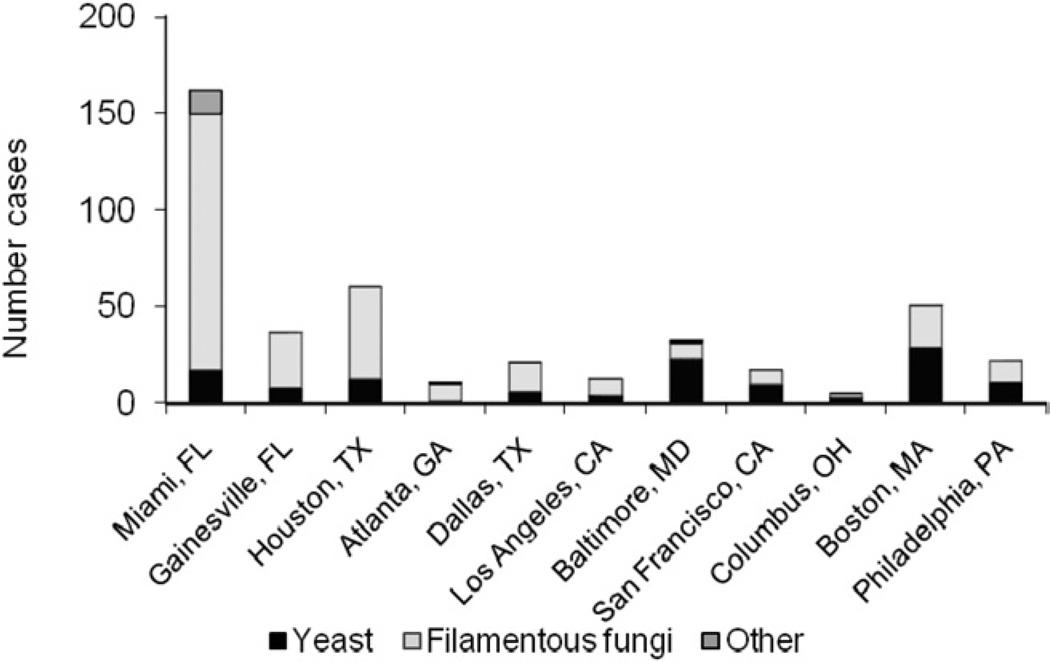
A total of 733 cases of fungal keratitis were identified. Most cases were confirmed by culture from corneal scraping (n = 693) or biopsies (n = 19); 16 cases were diagnosed by microscopic examination of corneal scraping alone; and 5 cases were diagnosed by confocal microscopy alone. Some 268 of 733 cases (37%) were associated with refractive contact lens wear, 180 of 733 cases (25%) were associated with ocular trauma, and 209 of 733 cases (29%) were associated with ocular surface disease. No predisposing factor was identified in 76 cases (10%). Filamentous fungi were identified in 141 of 180 ocular trauma cases (78%) and in 231 of 268 refractive contact lens-associated cases (86%). Yeast was the causative organism in 111 of 209 cases (53%) associated with ocular surface disease. Yeast accounted for few cases of fungal keratitis associated with refractive contact-lens wear (20 cases), therapeutic contact-lens wear (11 cases), or ocular trauma (21 cases). Surgical intervention was undertaken in 26% of cases and was most frequently performed for fungal keratitis associated with ocular surface disease (44%). Surgical intervention was more likely in cases associated with filamentous fungi (P = 0.03). Among contact lens wearers, delay in diagnosis of 2 or more weeks increased the likelihood of surgery (age-adjusted odds ratio = 2.2; 95% confidence interval, 1.2-4.2).
Trauma, contact lens wear, and ocular surface disease predispose patients to developing fungal keratitis. Filamentous fungi are most frequently the causative organism for fungal keratitis associated with trauma or contact lens wear, whereas yeast is most frequently the causative organism in patients with ocular surface disease. Delay in diagnosis increases the likelihood of surgical intervention for contact lens-associated fungal keratitis.
研究美国三级眼科护理中心真菌性角膜炎的流行病学、临床观察和微生物学特征。
回顾性多中心病例系列研究。
2001 年 1 月 1 日至 2007 年 12 月 31 日,在美国 11 个三级临床站点,对经培养、组织学或共聚焦显微镜检查证实的所有真菌性角膜炎病例进行了研究。
对所有病例的图表进行了回顾,这些病例是在美国 11 个三级临床站点,对 2001 年 1 月 1 日至 2007 年 12 月 31 日期间,经培养、组织学或共聚焦显微镜检查确诊的真菌性角膜炎病例。
潜在诱发因素的频率及这些因素与真菌种类之间的关系。
共发现 733 例真菌性角膜炎。大多数病例通过角膜刮片培养(n=693)或活检(n=19)得到证实;16 例仅通过角膜刮片的显微镜检查确诊;5 例仅通过共聚焦显微镜检查确诊。在 733 例中,有 268 例(37%)与屈光性隐形眼镜佩戴有关,180 例(25%)与眼外伤有关,209 例(29%)与眼表面疾病有关。76 例(10%)未发现诱发因素。在 180 例眼部外伤病例中,141 例(78%)和 268 例屈光性隐形眼镜相关病例中,231 例(86%)发现丝状真菌。在 209 例(53%)与眼表面疾病相关的病例中,酵母是致病微生物。在与屈光性隐形眼镜佩戴(20 例)、治疗性隐形眼镜佩戴(11 例)或眼外伤(21 例)相关的真菌性角膜炎中,酵母占少数。26%的病例接受了手术干预,最常进行的手术是针对眼表面疾病相关的真菌性角膜炎(44%)。与丝状真菌相关的病例更有可能进行手术干预(P=0.03)。在隐形眼镜佩戴者中,诊断延迟 2 周或更长时间会增加手术的可能性(年龄调整比值比=2.2;95%置信区间,1.2-4.2)。
创伤、隐形眼镜佩戴和眼表面疾病使患者易患真菌性角膜炎。丝状真菌是与外伤或隐形眼镜佩戴相关的真菌性角膜炎最常见的病原体,而酵母是与眼表面疾病相关的患者最常见的病原体。隐形眼镜相关真菌性角膜炎的诊断延迟会增加手术干预的可能性。