Division of Cardiovascular Diseases, Mayo Clinic, Rochester, Minnesota; Gonda Vascular Center, Mayo Clinic, Rochester, Minnesota, USA.
Am J Cardiol. 2011 Apr 15;107(8):1241-5. doi: 10.1016/j.amjcard.2010.12.023. Epub 2011 Feb 4.
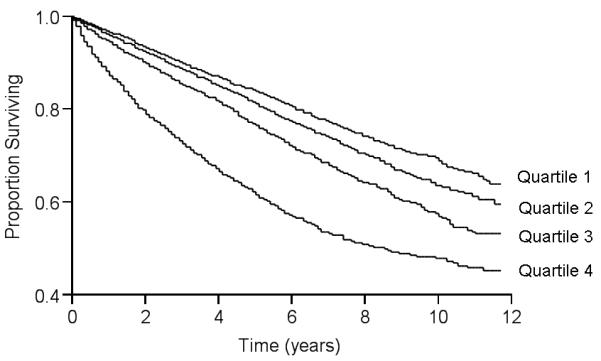
Increased red blood cell distribution width (RDW), a marker of anisocytosis, has been associated with adverse outcomes in multiple settings. Whether RDW is predictive of mortality in patients with peripheral artery disease (PAD) is unknown. We studied 13,039 consecutive outpatients (69.5 ± 12.0 years of age, 60.9% men, 97.6% white) with PAD identified by noninvasive lower-extremity arterial testing at the Mayo Clinic from January 1997 through December 2007, with follow-up through September 2009. We defined PAD as a low (≤ 0.9) or high (≥ 1.4) ankle-brachial index (ABI). Cardiovascular risk factors and co-morbidities were ascertained using electronic medical record-based algorithms. RDW was obtained from the complete blood cell count drawn around the time of arterial evaluation. Mortality was ascertained using the Mayo electronic medical record and Accurint databases. Association of RDW with all-cause mortality was analyzed by multivariable Cox proportional hazards regression. During a median follow-up of 5.5 years, 4,039 (31.0%) deaths occurred (28.7% in low and 38.9% in high ABI subsets). After adjustment for age, gender, cardiovascular risk factors, and co-morbidities, patients in the highest quartile of RDW (> 14.5%) had a 66% greater risk of mortality compared to the lowest quartile (< 12.8%, p < 0.0001); a 1% increment in RDW was associated with a 10% greater risk of all-cause mortality (hazard ratio 1.10, 95% confidence interval 1.08 to 1.12, p < 0.0001). The adjusted hazard ratio was similar in the low (1.10, 1.08 to 1.12) and high (1.09, 1.06 to 1.12) ABI subsets. In conclusion, RDW, a routinely available measurement, is an independent prognostic marker in patients with PAD.
红细胞分布宽度(RDW)增高是不均一性的标志物,与多种情况下的不良结局相关。RDW 是否可预测外周动脉疾病(PAD)患者的死亡率尚不清楚。我们研究了 13039 例连续门诊患者(年龄 69.5±12.0 岁,60.9%为男性,97.6%为白人),他们于 1997 年 1 月至 2007 年 12 月在梅奥诊所通过非侵入性下肢动脉检查确诊为 PAD,随访至 2009 年 9 月。我们将 PAD 定义为低(≤0.9)或高(≥1.4)踝臂指数(ABI)。心血管危险因素和合并症通过电子病历为基础的算法确定。RDW 是在动脉评估时抽取的全血细胞计数中获得的。使用梅奥电子病历和 Accurint 数据库确定死亡率。RDW 与全因死亡率的相关性通过多变量 Cox 比例风险回归分析。在中位随访 5.5 年期间,有 4039 例(31.0%)死亡(低 ABI 亚组为 28.7%,高 ABI 亚组为 38.9%)。在校正年龄、性别、心血管危险因素和合并症后,RDW 最高四分位数(>14.5%)患者的死亡率比最低四分位数(<12.8%)高 66%(p<0.0001);RDW 每增加 1%,全因死亡率的风险增加 10%(危险比 1.10,95%置信区间 1.08 至 1.12,p<0.0001)。RDW 与低 ABI(1.10,1.08 至 1.12)和高 ABI(1.09,1.06 至 1.12)亚组的调整后危险比相似。总之,RDW 是一种常规可用的测量方法,是 PAD 患者的独立预后标志物。