Liu Hua, Huang Hong, Wang Jinrong, Wang Wenming, Ruan Min, Liu Jiangang
Department of Neurosurgery, Affiliated Kunshan Hospital of Jiangsu University, Kunshan, China.
Kunshan Biomedical Big Data Innovation Application Laboratory, Kunshan, China.
Front Neurol. 2025 Jul 8;16:1534098. doi: 10.3389/fneur.2025.1534098. eCollection 2025.
This study leverages the eICU collaborative research database (eICU-CRD) to investigate the relationship between the hemoglobin-to-red blood cell distribution width ratio (HRR) and 28-day mortality in patients with epidural hematoma (EDH).
A total of 2,161 patients admitted between 2014 and 2015 with EDH were selected. Data included demographics, medical history, and laboratory tests. HRR was calculated and stratified into quartiles. Covariates included Glasgow Coma Scale (GCS), HDL, TG, hospital time, ICU time, LDL, age, BMI, gender, coma status, race, and medical conditions like COPD, CHF, and diabetes. Non-normal data distributions were analyzed using Kruskal-Wallis and chi-square tests, with logistic regression to explore the association of HRR and 28-day mortality.
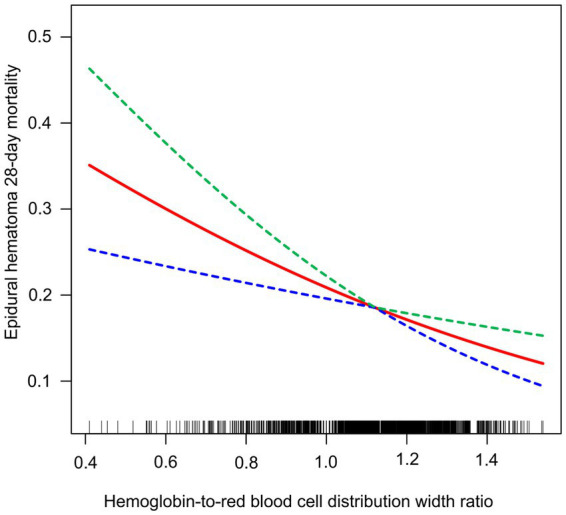
Higher HRR quartiles correlated with lower 28-day mortality ( = 0.024) and higher healthy discharge rates ( = 0.013). Univariate logistic analysis showed age positively associated with mortality (OR = 1.011, 95% CI: 1.004-1.018), while GCS, ICU time, hospital time, and HRR were negatively associated. Adjusted models confirmed an inverse relationship between HRR and mortality, with the fourth quartile showing a 40% reduced probability of mortality. Linear regression models indicated a 72% reduction in mortality risk per unit HRR increase and a critical HRR value of 1.12 for significant risk reduction.
HRR is significantly associated with 28-day mortality in EDH patients, with higher HRR values correlating with improved survival. ICU time also showed a correlation with reduced mortality, particularly up to a critical point.
本研究利用电子重症监护病房协作研究数据库(eICU-CRD)来调查血红蛋白与红细胞分布宽度比值(HRR)与硬膜外血肿(EDH)患者28天死亡率之间的关系。
选取了2014年至2015年间收治的2161例EDH患者。数据包括人口统计学信息、病史和实验室检查结果。计算HRR并将其分层为四分位数。协变量包括格拉斯哥昏迷量表(GCS)、高密度脂蛋白(HDL)、甘油三酯(TG)、住院时间、重症监护病房(ICU)时间、低密度脂蛋白(LDL)、年龄、体重指数(BMI)、性别、昏迷状态、种族以及慢性阻塞性肺疾病(COPD)、慢性心力衰竭(CHF)和糖尿病等医疗状况。使用Kruskal-Wallis检验和卡方检验分析非正态数据分布,并采用逻辑回归来探究HRR与28天死亡率之间的关联。
HRR四分位数越高,28天死亡率越低(P = 0.024),健康出院率越高(P = 0.013)。单因素逻辑分析显示年龄与死亡率呈正相关(比值比[OR] = 1.011,95%置信区间[CI]:1.004 - 1.018),而GCS、ICU时间、住院时间和HRR与死亡率呈负相关。校正模型证实了HRR与死亡率之间存在反向关系,第四四分位数显示死亡率概率降低40%。线性回归模型表明,HRR每增加一个单位,死亡风险降低72%,且显著降低风险的关键HRR值为1.12。
HRR与EDH患者的28天死亡率显著相关,HRR值越高,生存率越高。ICU时间也与死亡率降低相关,尤其是在达到临界点之前。