Department of Medicinal Chemistry, College of Pharmacy, University of Utah, Salt Lake City, Utah, USA.
Nucleic Acids Res. 2011 May;39(10):4499-512. doi: 10.1093/nar/gkr031. Epub 2011 Feb 3.
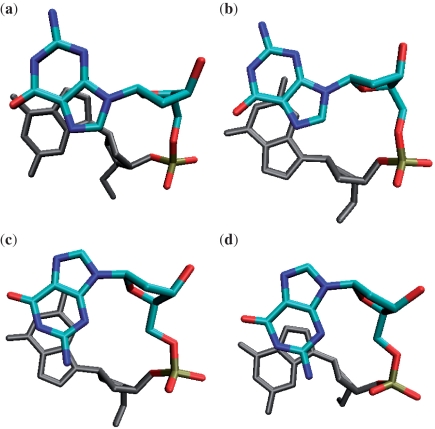
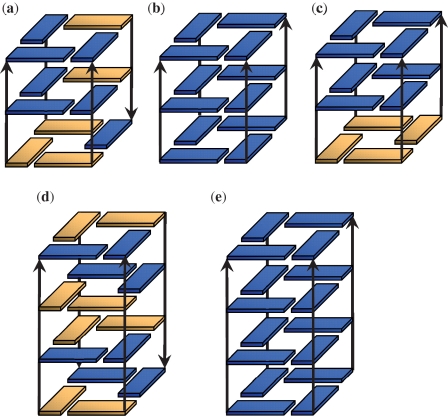
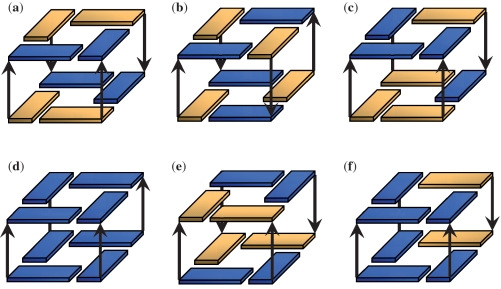
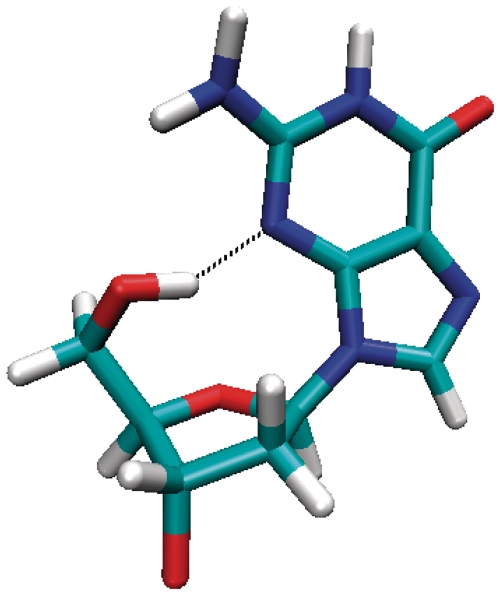
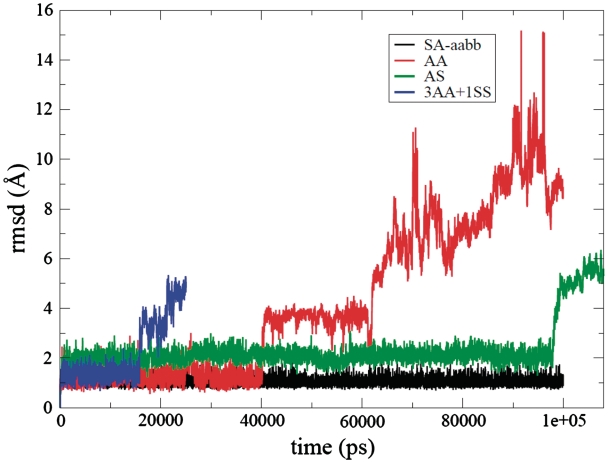
Guanine-rich DNA sequences tend to form four-stranded G-quadruplex structures. Characteristic glycosidic conformational patterns along the G-strands, such as the 5'-syn-anti-syn-anti pattern observed with the Oxytricha nova telomeric G-quadruplexes, have been well documented. However, an explanation for these featured glycosidic patterns has not emerged. This work presents MD simulation and free energetic analyses for simplified two-quartet d(GG) models and suggests that the four base pair step patterns show quite different relative stabilities: syn-anti > anti-anti > anti-syn > syn-syn. This suggests the following rule: when folding, anti-parallel G-quadruplexes tend to maximize the number of syn-anti steps and avoid the unfavorable anti-syn and syn-syn steps. This rule is consistent with most of the anti-parallel G-quadruplex structures in the Protein Databank (PDB). Structural polymorphisms of G-quadruplexes relate to these glycosidic conformational patterns and the lengths of the G-tracts. The folding topologies of G2- and G4-tracts are not very polymorphic because each strand tends to populate the stable syn-anti repeat. G3-tracts, on the other hand, cannot present this repeating pattern on each G-tract. This leads to smaller energy differences between different geometries and helps explain the extreme structural polymorphism of the human telomeric G-quadruplexes.
富含鸟嘌呤的 DNA 序列往往形成四链体 G-四链结构。特征性的糖苷构象模式沿着 G-链,如在 Oxytricha nova 端粒 G-四链体中观察到的 5'-顺式-反式-顺式-反式模式,已经得到了很好的记录。然而,对于这些特征性的糖苷模式还没有出现解释。这项工作通过 MD 模拟和自由能分析,对简化的四联体 [d(GG)]4 模型进行了研究,结果表明四碱基对步模式显示出相当不同的相对稳定性:顺式-反式>反式-反式>反式-顺式>顺式-顺式。这表明了以下规则:在折叠时,反平行 G-四链体倾向于最大化顺式-反式步的数量,并避免不利的反式-顺式和顺式-顺式步。这个规则与蛋白质数据库(PDB)中大多数反平行 G-四链体结构一致。G-四链体的结构多态性与这些糖苷构象模式和 G-链的长度有关。G2-和 G4-链的折叠拓扑结构不是非常多态,因为每条链都倾向于形成稳定的顺式-反式重复。另一方面,G3-链不能在每个 G-链上呈现这种重复模式。这导致不同几何形状之间的能量差异较小,有助于解释人类端粒 G-四链体的极端结构多态性。