Department of Biochemistry, School of Medicine, Keio University, JST, ERATO Suematsu Gas Biology Project, 35 Shinanomachi, Shinjuku-ku, Tokyo 160-8582, Japan.
J Clin Biochem Nutr. 2011 Jan;48(1):96-100. doi: 10.3164/jcbn.11-011FR. Epub 2010 Dec 28.
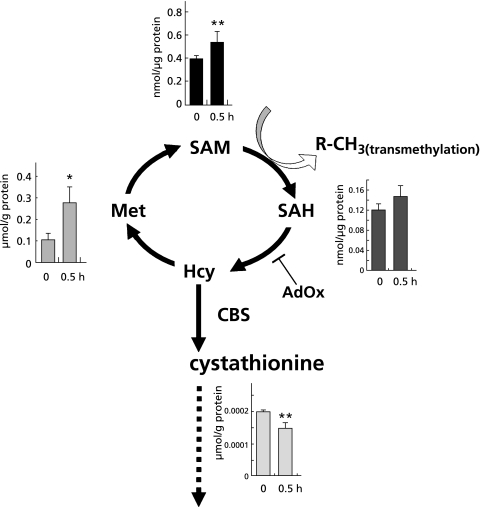
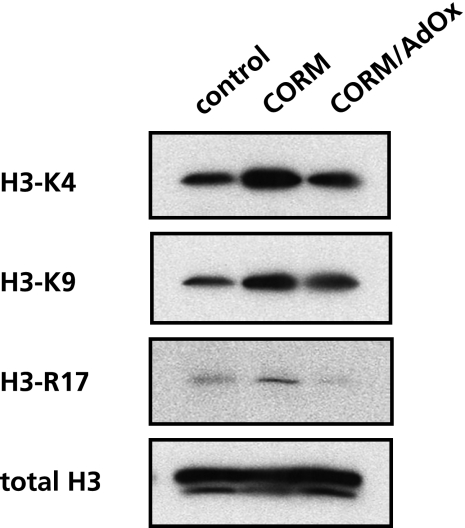
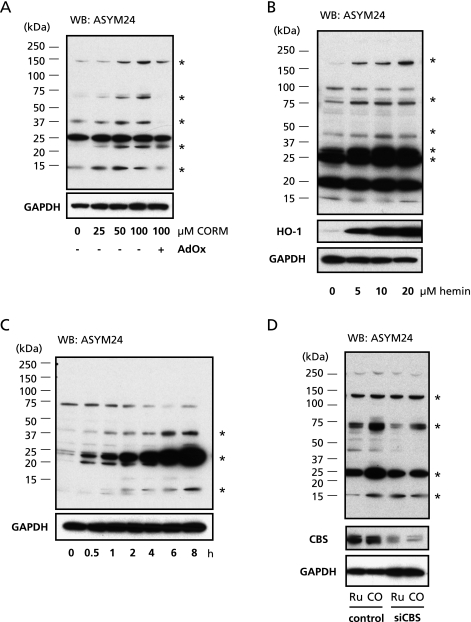
Although carbon monoxide derived from heme oxygenase has been reported to exert diverse biological actions in mammals, macromolecules responsible for its direct reception and functional outcomes of the gas binding remain largely unknown. Based on our previous results in vivo suggesting carbon monoxide serves as an inhibitor of cystathionine β-synthase that rate-limits transsulfuration pathway for generation of hydrogen sulfide, we have herein hypothesized that the gas might serve as a regulator of protein methylation through accelerating turnover of remethylation cycle residing at the upstream of the enzyme. Metabolomic analysis in human monoblastic leukemia U937 cells in culture revealed that application of carbon monoxide-releasing molecules caused increases in methionine and S-adenosylmethionine and a decrease in cystathionine in the cells, suggesting the cystathionine β-synthase inhibition by carbon monoxide. Under these circumstances, the cells exhibited global protein arginine methylation: this event was also reproduced by the cell treatment with hemin, a heme oxygenase-1 inducer. The protein arginine methylation elicited by carbon monoxide was attenuated by knocking down cystathionine β-synthase with its small interfering RNA or by blocking S-adenosylhomocysteine hydrolase with adenosine dialdehyde, suggesting remethylation cycling is necessary to trigger the methylation processing. Furthermore, proteins undergoing the carbon monoxide-induced arginine methylation involved histone H3 proteins, suggesting chromatin modification by the gas. Collectively with our studies in vivo showing its inhibitory action on endogenous hydrogen sulfide production, the current results suggest that not only inhibition of transsulfuration pathway for H(2)S generation but also activation of protein methylation accounts for notable biological actions of carbon monoxide via the cystathionine β-synthase inhibition.
虽然已有研究报道血红素加氧酶衍生的一氧化碳在哺乳动物中具有多种生物学作用,但负责其直接受体结合和气体结合功能的大分子仍知之甚少。基于我们之前在体内的研究结果表明,一氧化碳可作为胱硫醚β-合酶的抑制剂,而胱硫醚β-合酶是生成硫化氢的转硫途径的限速酶,我们假设该气体可能通过加速位于酶上游的再甲基化循环的周转率来作为蛋白质甲基化的调节剂。在培养的人单核白血病 U937 细胞中的代谢组学分析表明,一氧化碳释放分子的应用导致细胞中蛋氨酸和 S-腺苷甲硫氨酸增加,胱硫醚减少,提示一氧化碳抑制胱硫醚β-合酶。在这些情况下,细胞表现出全局蛋白质精氨酸甲基化:该事件也可以通过血红素氧合酶-1 诱导剂血红素处理细胞来复制。用小干扰 RNA 敲低胱硫醚β-合酶或用腺苷二醛阻断 S-腺苷同型半胱氨酸水解酶可减弱一氧化碳引起的蛋白质精氨酸甲基化,表明再甲基化循环是触发甲基化过程所必需的。此外,一氧化碳诱导的精氨酸甲基化涉及组蛋白 H3 蛋白,表明该气体可引起染色质修饰。综合我们在体内的研究结果表明其对内源性硫化氢生成的抑制作用,目前的结果表明,一氧化碳不仅通过抑制硫化氢生成的转硫途径,而且通过激活蛋白质甲基化来发挥显著的生物学作用,这归因于胱硫醚β-合酶的抑制。