Department of Experimental Psychology, University of Oxford, Oxford, United Kingdom.
PLoS One. 2011 Jan 28;6(1):e14620. doi: 10.1371/journal.pone.0014620.
In the current study we compared the effects of temporal orienting of attention based on predictions carried by the intrinsic temporal structure of events (rhythm) and by instructive symbolic cues; and tested the degree of cognitive, strategic control that could be exerted over each type of temporal expectation. The experiments tested whether the distinction between exogenous and endogenous orienting made in spatial attention may extend to the temporal domain.
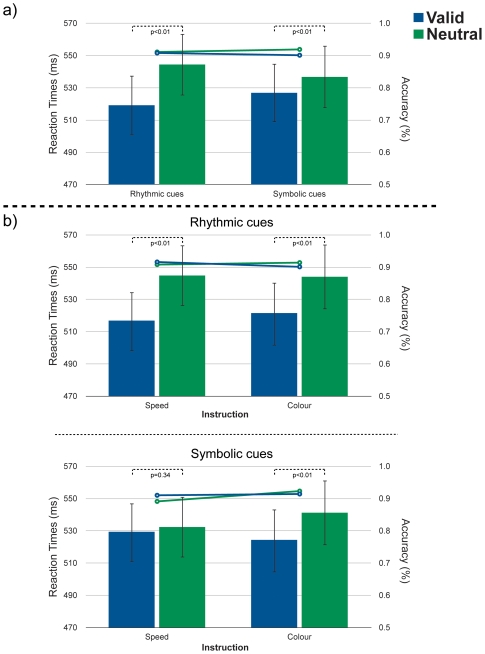
In this task, a ball moved across the screen in discrete steps and disappeared temporarily under an occluding band. Participants were required to make a perceptual discrimination on the target upon its reappearance. The regularity of the speed (rhythmic cue) or colour (symbolic cue) of the moving stimulus could predict the exact time at which a target would reappear after a brief occlusion (valid trials) or provide no temporal information (neutral trials). The predictive nature of rhythmic and symbolic cues was manipulated factorially in a symmetrical and orthogonal fashion. To test for the effects of strategic control over temporal orienting based on rhythmic or symbolic cues, participants were instructed either to "attend-to-speed" (rhythm) or "attend-to-colour". Our results indicated that both rhythmic and symbolic (colour) cues speeded reaction times in an independent fashion. However, whilst the rhythmic cueing effects were impervious to instruction, the effects of symbolic cues were contingent on the instruction to attend to colour.
Taken together, our results provide evidence for the existence of qualitatively separable types of temporal orienting of attention, akin to exogenous and endogenous mechanisms.
在当前的研究中,我们比较了基于事件固有时间结构(节奏)和指导符号线索进行的注意时间定向的效果;并测试了可以对每种时间预期施加的认知、策略控制程度。实验测试了在空间注意力中做出的外源性和内源性定向之间的区别是否可以扩展到时间领域。
在这个任务中,一个球以离散的步骤在屏幕上移动,并暂时消失在遮挡带下。参与者需要在目标重新出现时对其进行感知辨别。移动刺激的速度(节奏线索)或颜色(符号线索)的规律性可以预测目标在短暂遮挡后重新出现的确切时间(有效试验)或不提供时间信息(中性试验)。节奏和符号线索的预测性质以对称和正交的方式进行因子操纵。为了测试基于节奏或符号线索的时间定向的策略控制效果,参与者被指示“注意速度”(节奏)或“注意颜色”(符号)。我们的结果表明,节奏和符号(颜色)线索都以独立的方式加速了反应时间。然而,虽然节奏线索效应不受指令影响,但符号线索的效应取决于注意颜色的指令。
综上所述,我们的结果提供了证据,证明存在定性可分离的注意时间定向类型,类似于外源性和内源性机制。