
一种用于细菌核酸降解毒素的新型免疫防御系统及其在各种真核生物和 DNA 病毒系统中的招募。
A novel immunity system for bacterial nucleic acid degrading toxins and its recruitment in various eukaryotic and DNA viral systems.
机构信息
National Center for Biotechnology Information, National Library of Medicine, National Institutes of Health, Bethesda, MD 20894, USA.
出版信息
Nucleic Acids Res. 2011 Jun;39(11):4532-52. doi: 10.1093/nar/gkr036. Epub 2011 Feb 8.
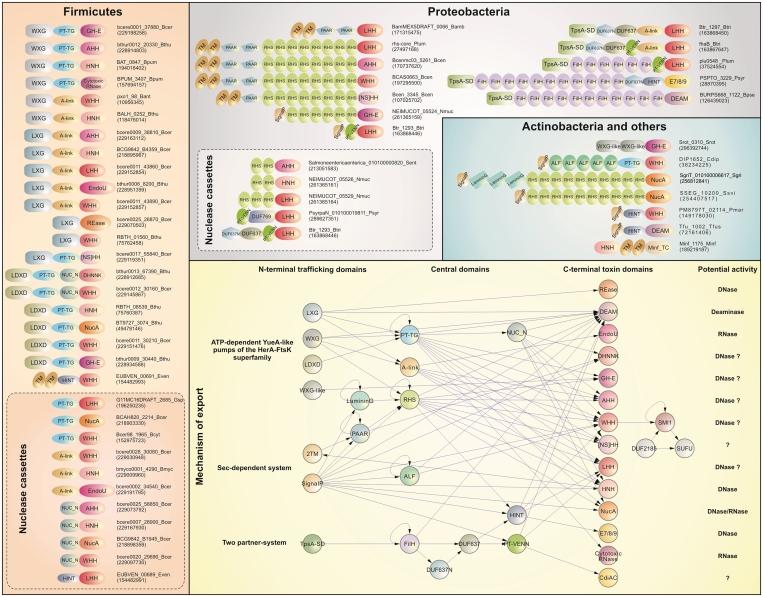
The use of nucleases as toxins for defense, offense or addiction of selfish elements is widely encountered across all life forms. Using sensitive sequence profile analysis methods, we characterize a novel superfamily (the SUKH superfamily) that unites a diverse group of proteins including Smi1/Knr4, PGs2, FBXO3, SKIP16, Syd, herpesviral US22, IRS1 and TRS1, and their bacterial homologs. Using contextual analysis we present evidence that the bacterial members of this superfamily are potential immunity proteins for a variety of toxin systems that also include the recently characterized contact-dependent inhibition (CDI) systems of proteobacteria. By analyzing the toxin proteins encoded in the neighborhood of the SUKH superfamily we predict that they possess domains belonging to diverse nuclease and nucleic acid deaminase families. These include at least eight distinct types of DNases belonging to HNH/EndoVII- and restriction endonuclease-fold, and RNases of the EndoU-like and colicin E3-like cytotoxic RNases-folds. The N-terminal domains of these toxins indicate that they are extruded by several distinct secretory mechanisms such as the two-partner system (shared with the CDI systems) in proteobacteria, ESAT-6/WXG-like ATP-dependent secretory systems in Gram-positive bacteria and the conventional Sec-dependent system in several bacterial lineages. The hedgehog-intein domain might also release a subset of toxic nuclease domains through auto-proteolytic action. Unlike classical colicin-like nuclease toxins, the overwhelming majority of toxin systems with the SUKH superfamily is chromosomally encoded and appears to have diversified through a recombination process combining different C-terminal nuclease domains to N-terminal secretion-related domains. Across the bacterial superkingdom these systems might participate in discriminating self' or kin from non-self' or non-kin strains. Using structural analysis we demonstrate that the SUKH domain possesses a versatile scaffold that can be used to bind a wide range of protein partners. In eukaryotes it appears to have been recruited as an adaptor to regulate modification of proteins by ubiquitination or polyglutamylation. Similarly, another widespread immunity protein from these toxin systems, namely the suppressor of fused (SuFu) superfamily has been recruited for comparable roles in eukaryotes. In animal DNA viruses, such as herpesviruses, poxviruses, iridoviruses and adenoviruses, the ability of the SUKH domain to bind diverse targets has been deployed to counter diverse anti-viral responses by interacting with specific host proteins.
在所有生命形式中,核酶被广泛用作防御、进攻或自我元素成瘾的毒素。我们使用敏感的序列特征分析方法,描述了一个新的超家族(SUKH 超家族),它联合了一组多样化的蛋白质,包括 Smi1/Knr4、PGs2、FBXO3、SKIP16、Syd、疱疹病毒 US22、IRS1 和 TRS1 及其细菌同源物。通过上下文分析,我们提供了证据表明,这个超家族的细菌成员是多种毒素系统的潜在免疫蛋白,这些毒素系统还包括最近被描述的接触依赖性抑制(CDI)系统。通过分析 SUKH 超家族编码的毒素蛋白,我们预测它们具有属于多种核酸酶和核酸脱氨酶家族的结构域。这些包括至少八种不同类型的属于 HNH/EndoVII-和限制内切酶折叠的 DNase,以及属于 EndoU 样和 colicin E3 样细胞毒性 RNase 折叠的 RNase。这些毒素的 N 端结构域表明,它们通过几种不同的分泌机制被挤出,例如在细菌中与 CDI 系统共享的两部分伙伴系统、革兰氏阳性菌中的 ESAT-6/WXG 样 ATP 依赖性分泌系统以及几个细菌谱系中的传统 Sec 依赖性系统。类胡瓜嵌合体结构域也可能通过自动蛋白水解作用释放一组毒性核酸酶结构域。与经典的 colicin 样核酸酶毒素不同,绝大多数具有 SUKH 超家族的毒素系统都是染色体编码的,并且似乎通过将不同的 C 端核酸酶结构域与 N 端分泌相关结构域结合的重组过程多样化。在细菌超级王国中,这些系统可能参与区分“自我”或亲缘体与“非自我”或非亲缘体菌株。通过结构分析,我们证明 SUKH 结构域具有多功能支架,可用于结合广泛的蛋白质伴侣。在真核生物中,它似乎被招募作为一种接头,用于调节蛋白质的泛素化或多谷氨酸化修饰。同样,这些毒素系统中的另一种广泛存在的免疫蛋白,即融合抑制物(SuFu)超家族,也被招募来在真核生物中发挥类似的作用。在动物 DNA 病毒中,如疱疹病毒、痘病毒、虹彩病毒和腺病毒中,SUKH 结构域结合多种靶标的能力已被用于通过与特定宿主蛋白相互作用来对抗各种抗病毒反应。


 Zotero 插件