
自分泌酶受 TSA 通过抑制 HDAC3 和 HDAC7 诱导,并拮抗 TSA 诱导的细胞凋亡。
Autotaxin is induced by TSA through HDAC3 and HDAC7 inhibition and antagonizes the TSA-induced cell apoptosis.
机构信息
The Key Laboratory for Cell Proliferation and Regulation Biology of Ministry of Education, College of Life Sciences, Beijing Normal University, China.
出版信息
Mol Cancer. 2011 Feb 12;10:18. doi: 10.1186/1476-4598-10-18.
BACKGROUND
Autotaxin (ATX) is a secreted glycoprotein with the lysophospholipase D (lysoPLD) activity to convert lysophosphatidylcholine (LPC) into lysophosphatidic acid (LPA), a bioactive lysophospholipid involved in diverse biological actions. ATX is highly expressed in some cancer cells and contributes to their tumorigenesis, invasion, and metastases, while in other cancer cells ATX is silenced or expressed at low level. The mechanism of ATX expression regulation in cancer cells remains largely unknown.
RESULTS
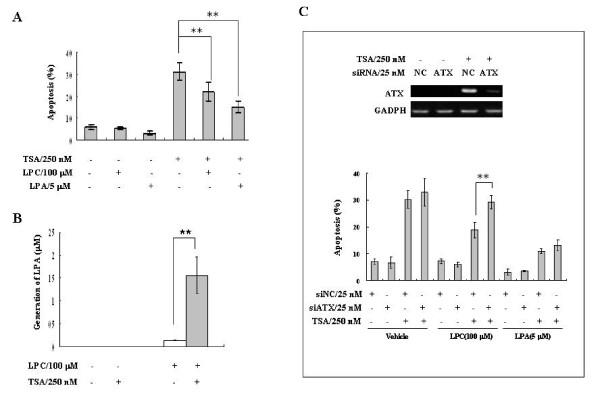
In the present study, we demonstrated that trichostatin A (TSA), a well-known HDAC inhibitor (HDACi), significantly induced ATX expression in SW480 and several other cancer cells with low or undetectable endogenous ATX expression. ATX induction could be observed when HDAC3 and HDAC7 were down-regulated by their siRNAs. It was found that HDAC7 expression levels were low in the cancer cells with high endogenous ATX expression. Exogenous over-expression of HDAC7 inhibited ATX expression in these cells in a HDAC3-dependent manner. These data indicate that HDAC3 and HDAC7 collaboratively suppress ATX expression in cancer cells, and suggest that TSA induce ATX expression by inhibiting HDAC3 and HDAC7. The biological significance of this regulation mechanism was revealed by demonstrating that TSA-induced ATX protected cancer cells against TSA-induced apoptosis by producing LPA through its lysoPLD activity, which could be reversed by BrP-LPA and S32826, the inhibitors of the ATX-LPA axis.
CONCLUSIONS
We have demonstrated that ATX expression is repressed by HDAC3 and HDAC7 in cancer cells. During TSA treatment, ATX is induced due to the HDAC3 and HDAC7 inhibition and functionally antagonizes the TSA-induced apoptosis. These results reveal an internal HDACi-resistant mechanism in cancer cells, and suggest that the inhibition of ATX-LPA axis would be helpful to improve the efficacy of HDACi-based therapeutics against cancer.
背景
自分泌酶(ATX)是一种分泌型糖蛋白,具有溶血磷脂酶 D(lysoPLD)活性,可将溶血磷脂酰胆碱(LPC)转化为溶血磷脂酸(LPA),后者是一种参与多种生物作用的生物活性溶血磷脂。ATX 在一些癌细胞中高度表达,有助于其发生肿瘤、侵袭和转移,而在其他癌细胞中 ATX 被沉默或低表达。癌细胞中 ATX 表达调控的机制在很大程度上尚不清楚。
结果
在本研究中,我们证明了曲古抑菌素 A(TSA),一种众所周知的组蛋白去乙酰化酶抑制剂(HDACi),可显著诱导 SW480 和其他几种内源性 ATX 表达水平低或检测不到的癌细胞中 ATX 的表达。当用 siRNA 下调 HDAC3 和 HDAC7 时,可观察到 ATX 的诱导作用。结果发现,内源性 ATX 表达水平高的癌细胞中 HDAC7 的表达水平较低。外源性过表达 HDAC7 以 HDAC3 依赖的方式抑制这些细胞中 ATX 的表达。这些数据表明,HDAC3 和 HDAC7 协同抑制癌细胞中 ATX 的表达,并表明 TSA 通过抑制 HDAC3 和 HDAC7 诱导 ATX 表达。通过证明 TSA 诱导的 ATX 通过其 lysoPLD 活性产生 LPA 来保护癌细胞免受 TSA 诱导的凋亡,从而揭示了这种调控机制的生物学意义,该作用可被 ATX-LPA 轴的抑制剂 BrP-LPA 和 S32826 逆转。
结论
我们已经证明,HDAC3 和 HDAC7 在癌细胞中抑制 ATX 的表达。在 TSA 处理期间,由于 HDAC3 和 HDAC7 的抑制,ATX 被诱导,并且在功能上拮抗 TSA 诱导的细胞凋亡。这些结果揭示了癌细胞中内在的 HDACi 耐药机制,并表明抑制 ATX-LPA 轴有助于提高基于 HDACi 的治疗癌症的疗效。



 Zotero 插件