Mount Sinai Liver Cancer Program, Division of Liver Diseases, Department of Medicine, Tisch Cancer Institute, New York, New York, USA.
Gastroenterology. 2011 May;140(5):1618-28.e16. doi: 10.1053/j.gastro.2011.02.009. Epub 2011 Feb 13.
BACKGROUND & AIMS: Hepatocellular carcinoma (HCC) is a heterogeneous tumor that develops via activation of multiple pathways and molecular alterations. It has been a challenge to identify molecular classes of HCC and design treatment strategies for each specific subtype. MicroRNAs (miRNAs) are involved in HCC pathogenesis, and their expression profiles have been used to classify cancers. We analyzed miRNA expression in human HCC samples to identify molecular subclasses and oncogenic miRNAs.
We performed miRNA profiling of 89 HCC samples using a ligation-mediated amplification method. Subclasses were identified by unsupervised clustering analysis. We identified molecular features specific for each subclass using expression pattern (Affymetrix U133 2.0; Affymetrix, Santa Clara, CA), DNA change (Affymetrix STY Mapping Array), mutation (CTNNB1), and immunohistochemical (phosphor[p]-protein kinase B, p-insulin growth factor-IR, p-S6, p-epidermal growth factor receptor, β-catenin) analyses. The roles of selected miRNAs were investigated in cell lines and in an orthotopic model of HCC.
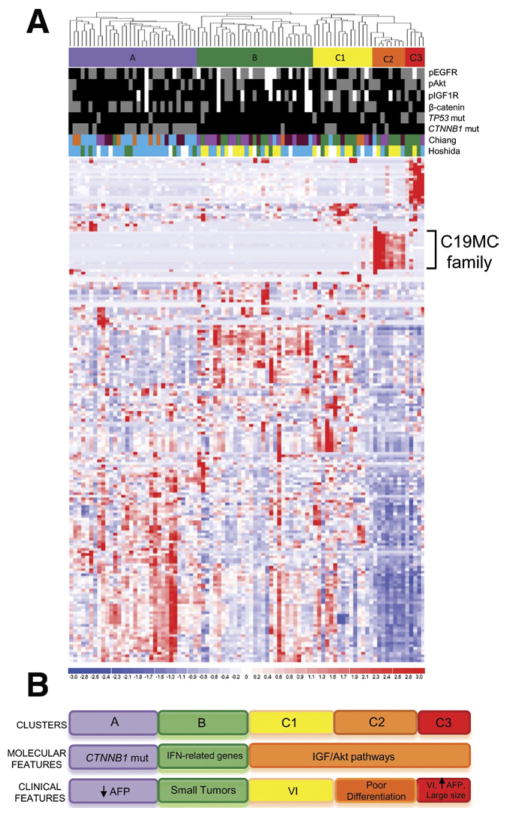
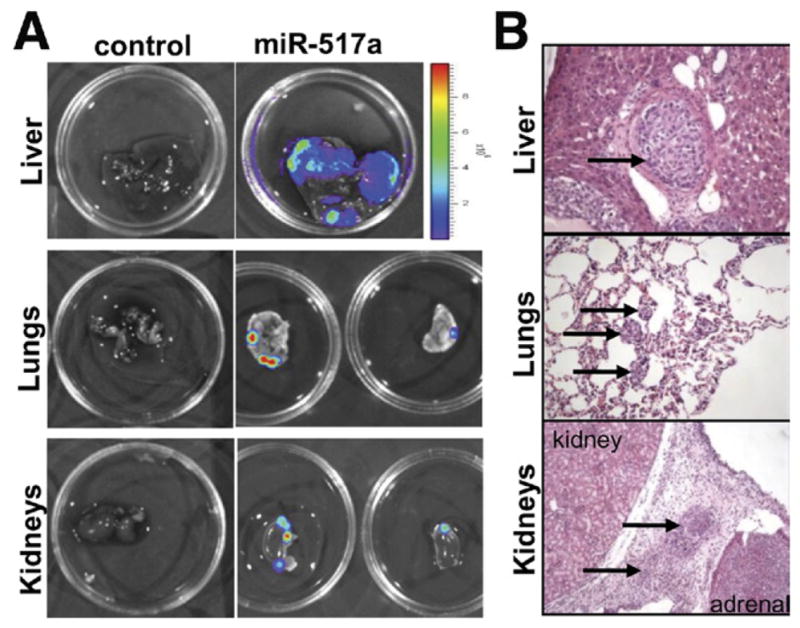
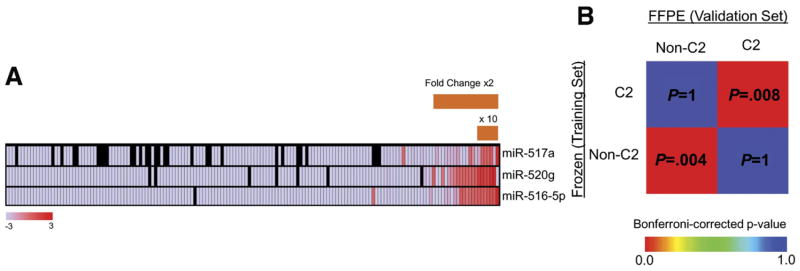
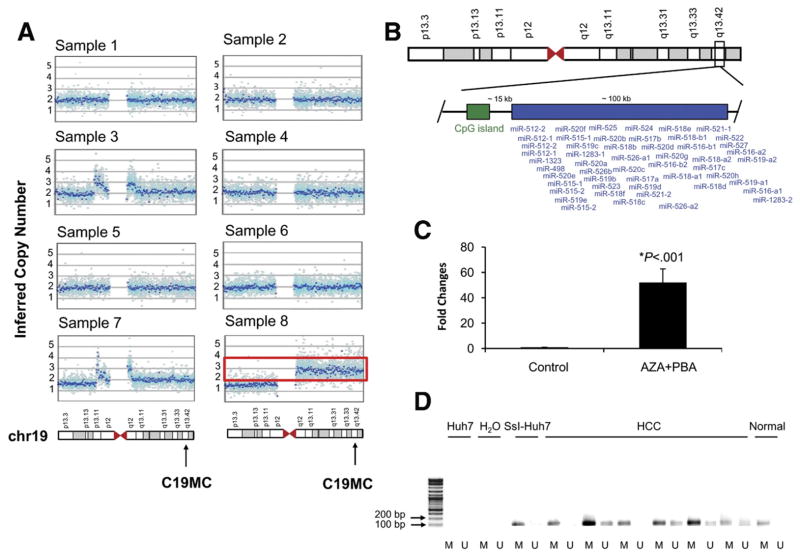
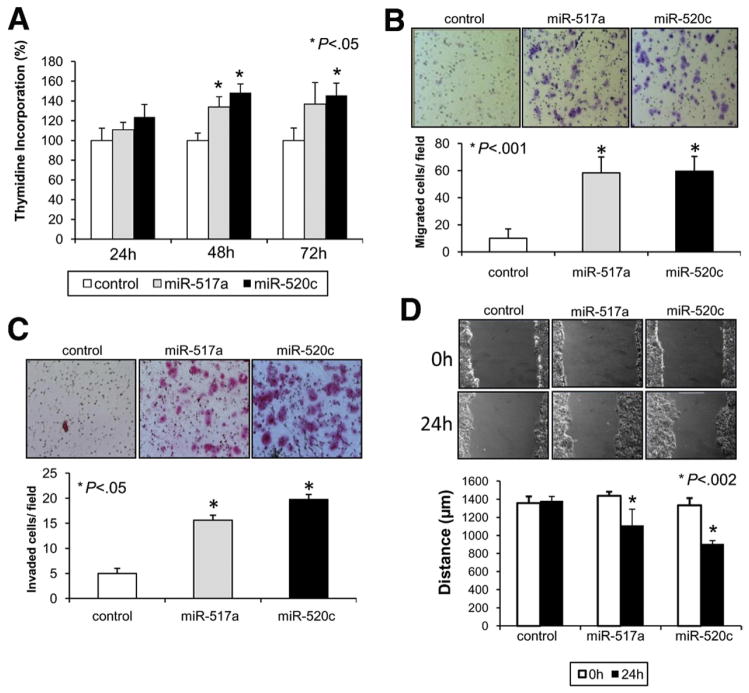
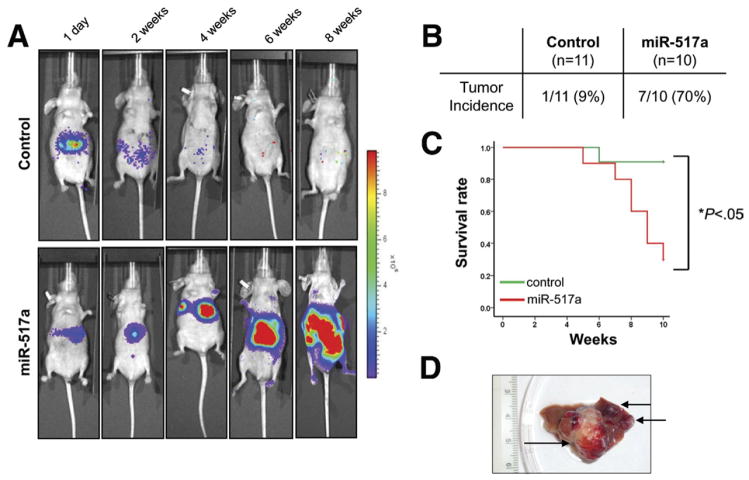
We identified 3 main clusters of HCCs: the wingless-type MMTV integration site (32 of 89; 36%), interferon-related (29 of 89; 33%), and proliferation (28 of 89; 31%) subclasses. A subset of patients with tumors in the proliferation subclass (8 of 89; 9%) overexpressed a family of poorly characterized miRNAs from chr19q13.42. Expression of miR-517a and miR-520c (from ch19q13.42) increased proliferation, migration, and invasion of HCC cells in vitro. MiR-517a promoted tumorigenesis and metastatic dissemination in vivo.
We propose miRNA-based classification of 3 subclasses of HCC. Among the proliferation class, miR-517a is an oncogenic miRNA that promotes tumor progression. There is rationale for developing therapies that target miR-517a for patients with HCC.
肝细胞癌(HCC)是一种异质性肿瘤,通过多条途径的激活和分子改变而发展。确定 HCC 的分子亚型并为每种特定亚型设计治疗策略一直是一项挑战。microRNAs(miRNAs)参与 HCC 的发病机制,其表达谱已被用于癌症分类。我们分析了人 HCC 样本中的 miRNA 表达,以鉴定分子亚型和致癌 miRNAs。
我们使用连接介导的扩增方法对 89 个 HCC 样本进行 miRNA 谱分析。通过无监督聚类分析鉴定亚类。我们使用表达模式(Affymetrix U133 2.0;Affymetrix,Santa Clara,CA)、DNA 变化(Affymetrix STY Mapping Array)、突变(CTNNB1)和免疫组织化学(磷酸化[p]-蛋白激酶 B、p-胰岛素生长因子-IR、p-S6、p-表皮生长因子受体、β-连环蛋白)分析鉴定每个亚类的特异性分子特征。在细胞系和 HCC 的原位模型中研究了选定 miRNAs 的作用。
我们鉴定了 3 种主要的 HCC 簇:无翅型 MMTV 整合位点(32/89;36%)、干扰素相关(29/89;33%)和增殖(28/89;31%)亚类。增殖亚类肿瘤患者的一部分(8/89;9%)过度表达来自 chr19q13.42 的一组未充分表征的 miRNAs。miR-517a 和 miR-520c(来自 ch19q13.42)的表达增加了 HCC 细胞在体外的增殖、迁移和侵袭。miR-517a 促进体内肿瘤发生和转移扩散。
我们提出了基于 miRNA 的 3 种 HCC 亚类分类。在增殖亚类中,miR-517a 是一种致癌 miRNA,可促进肿瘤进展。针对 miR-517a 为 HCC 患者开发治疗方法是合理的。