Medizinische Klinik II, St. Johannes Hospital, An der Abtei 7-11, 47166, Duisburg, Germany.
Ann Hematol. 2011 Jun;90(6):667-73. doi: 10.1007/s00277-011-1181-8. Epub 2011 Feb 16.
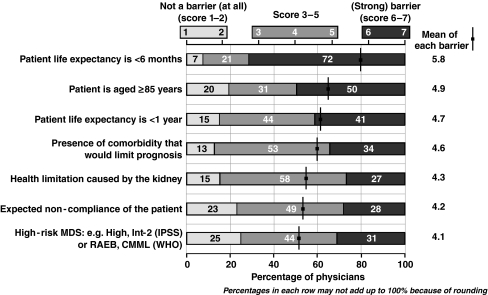
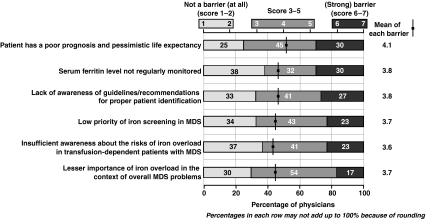
To better understand the detection and management of iron overload in transfusion-dependent patients with myelodysplastic syndromes (MDS), a 15-min web- or paper-based survey was conducted among 338 European physicians from 27 countries. Respondents had a mean of 18 years of clinical experience. Forty-six percent and 27% of physicians noted that detecting and treating iron overload were either "very important" or "important," respectively. The main reason for not actively exploring iron overload was related to poor patient prognosis, while the main reasons for not initiating iron chelation therapy were poor patient prognosis and older patient age. Thirty-seven percent and 31% of physicians believed that treating iron overload in these patients was "very important" or "important," respectively. Ninety percent of physicians prescribed iron chelation therapy, and 38% of transfusion-dependent patients received iron chelation therapy. The key reasons for not initiating iron chelation therapy were related to poor patient prognosis (72%), patient age ≥85 years (50%), and comorbidities (34%). The views of these experienced MDS physicians reflect available international MDS treatment guidelines.
为了更好地了解依赖输血的骨髓增生异常综合征(MDS)患者中铁过载的检测和管理,对来自 27 个国家的 338 名欧洲医生进行了一项 15 分钟的网络或纸质调查。受访者的平均临床经验为 18 年。46%和 27%的医生分别认为检测和治疗铁过载“非常重要”或“重要”。不积极探索铁过载的主要原因与患者预后不良有关,而不开始铁螯合治疗的主要原因是患者预后不良和年龄较大。37%和 31%的医生认为治疗这些患者的铁过载“非常重要”或“重要”。90%的医生开具了铁螯合治疗药物,38%的依赖输血的患者接受了铁螯合治疗。不开始铁螯合治疗的主要原因与患者预后不良(72%)、年龄≥85 岁(50%)和合并症(34%)有关。这些经验丰富的 MDS 医生的观点反映了现有的国际 MDS 治疗指南。