Abd-Elsalam Kamel, Bahkali Ali H, Moslem Mohamed, De Wit Pierre J G M, Verreet Joseph-Alexander
Institute of Phytopathology, Christian-Albrechts-University Kiel, Hermann-Rodewald-Str. 9, D-24118, Kiel, Germany; E-Mail:
Int J Mol Sci. 2011 Jan 19;12(1):682-93. doi: 10.3390/ijms12010682.
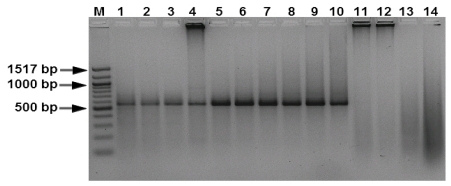
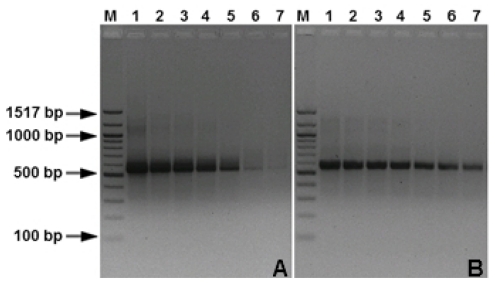
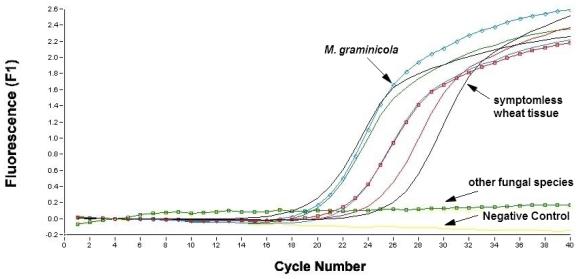
Early detection of infection is very important for efficient management of Mycosphaerella graminicola leaf blotch. To monitor and quantify the occurrence of this fungus during the growing season, a diagnostic method based on real-time PCR was developed. Standard and real-time PCR assays were developed using SYBR Green chemistry to quantify M. graminicola in vitro or in wheat samples. Microsatellite dinucleotide specific-primers were designed based on microsatellite repeats of sequences present in the genome of M. graminicola. Specificity was checked by analyzing DNA of 55 M. graminicola isolates obtained from different geographical origins. The method appears to be highly specific for detecting M. graminicola; no fluorescent signals were observed from 14 other closely related taxa. Primer (CT) 7 G amplified a specific amplicon of 570 bp from all M. graminicola isolates. The primers did not amplify DNA extracted from 14 other fungal species. The approximate melting temperature (Tm) of the (CT) 7 G primer was 84.2 °C. The detection limit of the real-time PCR assay with the primer sets (CT) 7 G is 10 fg/25 μL, as compared to 10 pg/25 μL using conventional PCR technology. From symptomless leaves, a PCR fragment could be generated two days after inoculation. Both conventional and real-time PCR could successfully detect the fungus from artificially inoculated wheat leaves. However, real-time PCR appeared much more sensitive than conventional PCR. The developed quantitative real-time PCR method proved to be rapid, sensitive, specific, cost-effective and reliable for the identification and quantification of M. graminicola in wheat.
早期检测感染对于高效管理小麦黄斑叶枯病非常重要。为了监测和量化这种真菌在生长季节的发生情况,开发了一种基于实时PCR的诊断方法。使用SYBR Green化学方法开发了标准和实时PCR检测方法,以在体外或小麦样品中定量小麦黄斑叶枯病菌。基于小麦黄斑叶枯病菌基因组中存在的序列的微卫星重复序列设计了微卫星二核苷酸特异性引物。通过分析从不同地理来源获得的55株小麦黄斑叶枯病菌株的DNA来检查特异性。该方法似乎对检测小麦黄斑叶枯病菌具有高度特异性;从其他14个密切相关的分类群中未观察到荧光信号。引物(CT)7G从所有小麦黄斑叶枯病菌株中扩增出一条570bp的特异性扩增子。这些引物未扩增从其他14种真菌物种中提取的DNA。(CT)7G引物的近似解链温度(Tm)为84.2°C。与使用传统PCR技术的10 pg/25μL相比,引物组(CT)7G的实时PCR检测限为10 fg/25μL。从无症状叶片接种两天后可产生PCR片段。传统PCR和实时PCR都能成功地从人工接种的小麦叶片中检测到该真菌。然而,实时PCR似乎比传统PCR更敏感。所开发的定量实时PCR方法被证明对于小麦中黄斑叶枯病菌的鉴定和定量是快速、灵敏、特异、经济高效且可靠的。