Department of General Surgery, Maastricht University Medical Centre, PO Box 5800, 6200 Maastricht, The Netherlands.
Int J Colorectal Dis. 2011 Jun;26(6):729-35. doi: 10.1007/s00384-011-1158-z. Epub 2011 Feb 23.
To investigate whether a collagen fleece kept in place by fibrin glue might seal off a colorectal anastomosis, provide reinforcement, and subsequently improve anastomotic healing.
Wistar rats underwent a 1-cm left-sided colonic resection followed by a 4-suture end-to-end anastomosis. They were then randomly assigned to one of three treatment groups: no additional intervention (control, n = 20), the anastomosis covered with fibrin glue (fibrin glue, n = 20), the anastomosis covered with a collagen fleece, kept in place with fibrin glue (collagen fleece, n = 21). At either 3 or 7 days follow-up, anastomotic bursting pressure was measured and tissue was obtained for histology and collagen content assessment after which animals were sacrificed.
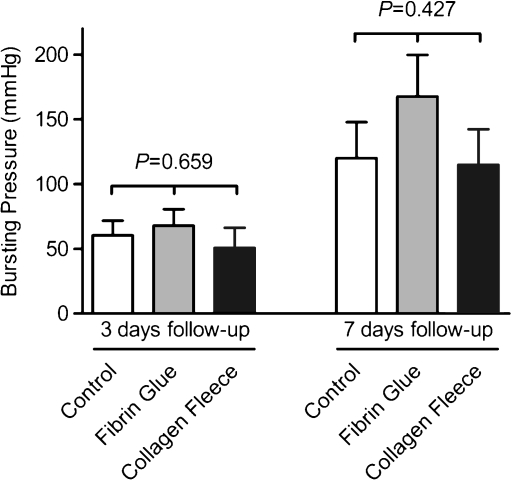
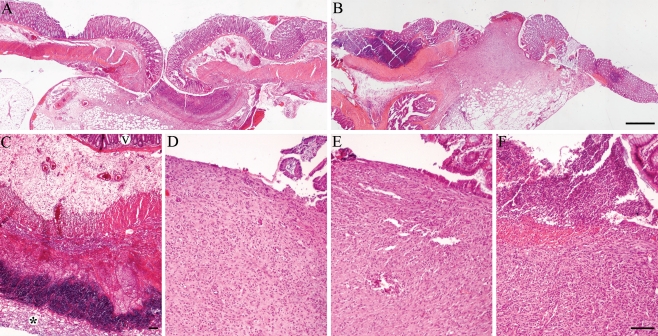
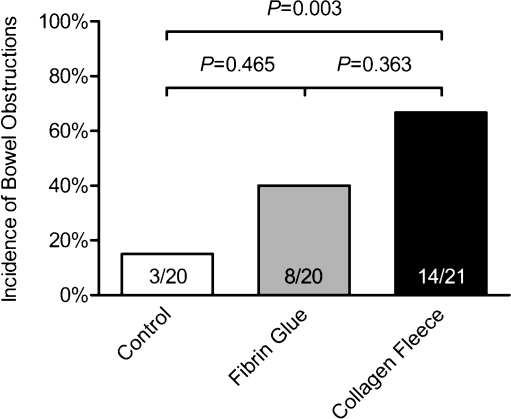
Three rats in the control (15%), three in the fibrin glue (15%), and one in the collagen group (4.8%) died due to anastomotic complications (P = 0.497). Anastomotic bursting pressures were not significantly different between groups at 3 and 7 days follow-up (P = 0.659 and P = 0.427, respectively). However, bowel obstructions occurred significantly more often in the collagen group compared to the control group (14/21 vs. 3/20, P = 0.003). Collagen contents were not different between groups, but histology showed a more severe inflammation in the collagen group compared to the other groups at both 3 and 7 days follow-up.
A collagen fleece kept in place by fibrin glue does not improve healing of colonic anastomoses in rats. Moreover, this technique induces significantly more bowel obstructions in rats, warranting further study before being translated to a clinical setting.
研究纤维蛋白胶固定的胶原绒是否可以封闭结直肠吻合口,提供加固作用,并随后改善吻合口愈合。
Wistar 大鼠进行 1cm 左侧结肠切除术,然后进行 4 针端端吻合术。然后,他们被随机分配到三个治疗组之一:无额外干预(对照组,n = 20)、吻合口覆盖纤维蛋白胶(纤维蛋白胶组,n = 20)、吻合口覆盖胶原绒并用纤维蛋白胶固定(胶原绒组,n = 21)。在 3 或 7 天随访时,测量吻合口爆裂压,并获取组织进行组织学和胶原含量评估,然后处死动物。
对照组有 3 只大鼠(15%)、纤维蛋白胶组有 3 只大鼠(15%)和胶原组有 1 只大鼠(4.8%)因吻合口并发症而死亡(P = 0.497)。在 3 天和 7 天随访时,各组之间的吻合口爆裂压没有显著差异(P = 0.659 和 P = 0.427)。然而,胶原组比对照组更频繁地发生肠阻塞(14/21 对 3/20,P = 0.003)。各组之间的胶原含量没有差异,但组织学显示胶原组在 3 天和 7 天随访时的炎症比其他组更严重。
纤维蛋白胶固定的胶原绒不能改善大鼠结直肠吻合口的愈合。此外,该技术在大鼠中引起更多的肠阻塞,在转化为临床环境之前需要进一步研究。