IRR, Institut de Recherche en Réadaptation, Sion, Switzerland.
J Neuroeng Rehabil. 2011 Feb 24;8:12. doi: 10.1186/1743-0003-8-12.
Motorized treadmills are widely used in research or in clinical therapy. Small kinematics, kinetics and energetics changes induced by Treadmill Walking (TW) as compared to Overground Walking (OW) have been reported in literature. The purpose of the present study was to characterize the differences between OW and TW in terms of stride-to-stride variability. Classical (Standard Deviation, SD) and non-linear (fractal dynamics, local dynamic stability) methods were used. In addition, the correlations between the different variability indexes were analyzed.
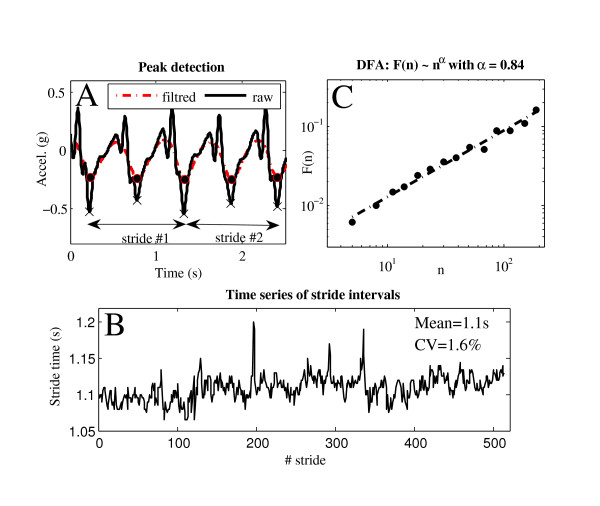
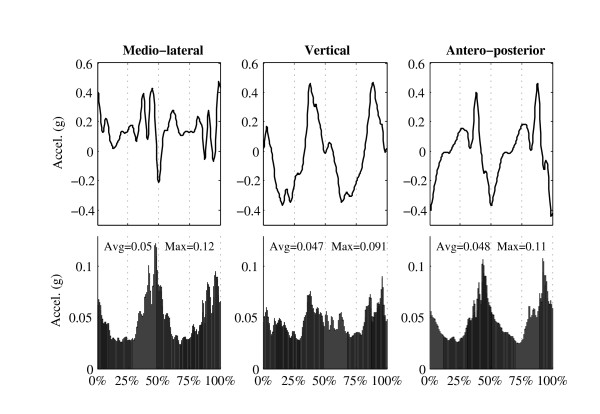
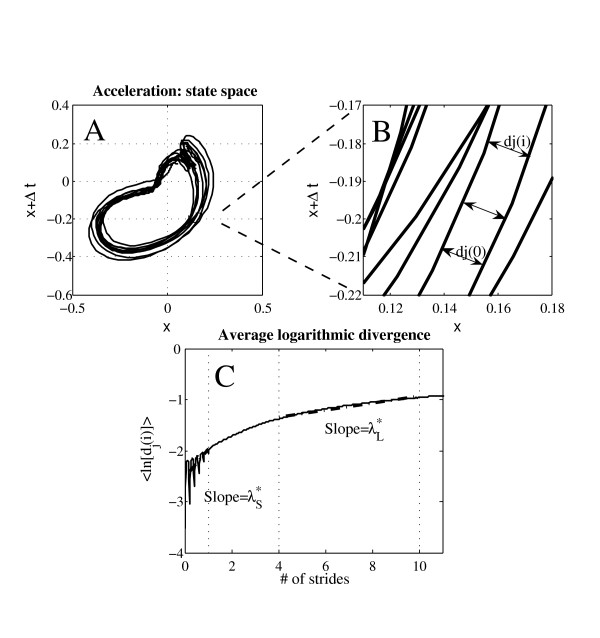
Twenty healthy subjects performed 10 min TW and OW in a random sequence. A triaxial accelerometer recorded trunk accelerations. Kinematic variability was computed as the average SD (MeanSD) of acceleration patterns among standardized strides. Fractal dynamics (scaling exponent α) was assessed by Detrended Fluctuation Analysis (DFA) of stride intervals. Short-term and long-term dynamic stability were estimated by computing the maximal Lyapunov exponents of acceleration signals.
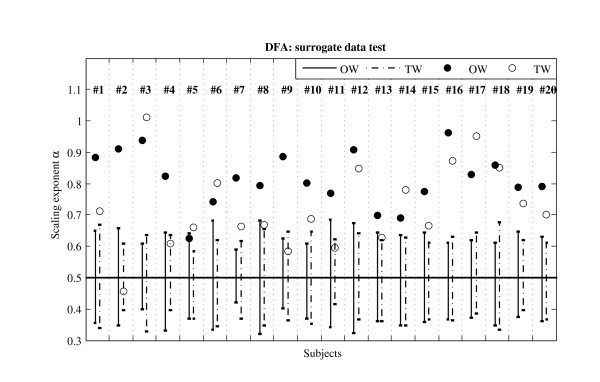
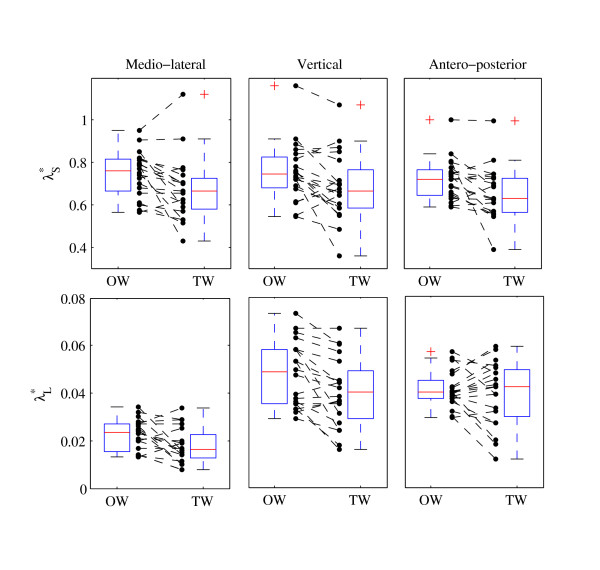
TW did not modify kinematic gait variability as compared to OW (multivariate T(2), p=0.87). Conversely, TW significantly modified fractal dynamics (t-test, p=0.01), and both short and long term local dynamic stability (T(2) p=0.0002). No relationship was observed between variability indexes with the exception of significant negative correlation between MeanSD and dynamic stability in TW (3 × 6 canonical correlation, r=0.94).
Treadmill induced a less correlated pattern in the stride intervals and increased gait stability, but did not modify kinematic variability in healthy subjects. This could be due to changes in perceptual information induced by treadmill walking that would affect locomotor control of the gait and hence specifically alter non-linear dependencies among consecutive strides. Consequently, the type of walking (i.e. treadmill or overground) is important to consider in each protocol design.
电动跑步机在研究或临床治疗中被广泛使用。与地面行走(OW)相比,文献中报道了跑步机行走(TW)引起的较小运动学、动力学和能量学变化。本研究的目的是描述 OW 和 TW 在步长间变异性方面的差异。使用了经典(标准差,SD)和非线性(分形动力学,局部动态稳定性)方法。此外,分析了不同变异性指标之间的相关性。
20 名健康受试者以随机顺序进行 10 分钟 TW 和 OW。三轴加速度计记录躯干加速度。运动学变异性作为标准化步长之间的加速度模式的平均 SD(MeanSD)来计算。通过对步长间隔进行去趋势波动分析(DFA)来评估分形动力学(标度指数α)。通过计算加速度信号的最大 Lyapunov 指数来估计短期和长期动态稳定性。
与 OW 相比,TW 并没有改变运动学步态变异性(多变量 T(2),p=0.87)。相反,TW 显著改变了分形动力学(t 检验,p=0.01),以及短期和长期局部动态稳定性(T(2) p=0.0002)。除了 MeanSD 与 TW 中的动态稳定性之间存在显著负相关(3×6 典型相关,r=0.94)外,变异性指标之间没有相关性。
跑步机行走在步长间隔中产生了较少相关的模式,并增加了步态稳定性,但没有改变健康受试者的运动学变异性。这可能是由于跑步机行走引起的感知信息变化,从而影响步态的运动控制,从而特别改变连续步之间的非线性依赖关系。因此,在每个方案设计中,行走的类型(即跑步机或地面)很重要。