The Key Laboratory of Experimental Marine Biology, Institute of Oceanology, Chinese Academy of Sciences, Qingdao, China.
PLoS One. 2011 Feb 15;6(2):e17089. doi: 10.1371/journal.pone.0017089.
C-type lectins are a superfamily of Ca(2+) dependent carbohydrate-recognition proteins that play significant diverse roles in nonself-recognition and clearance of invaders. Though they are well characterized in vertebrates, the study of the potential function and mechanism of C-type lectins in invertebrate immunity is still in its infancy.
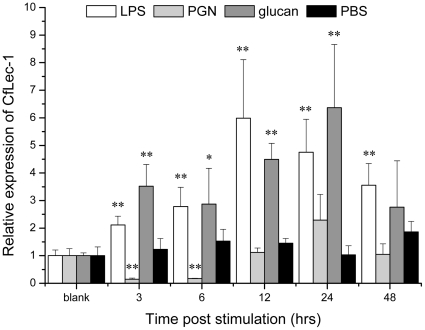
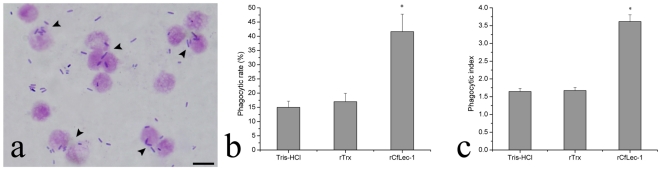
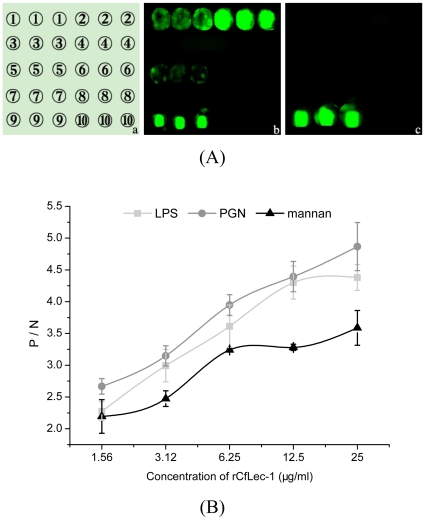
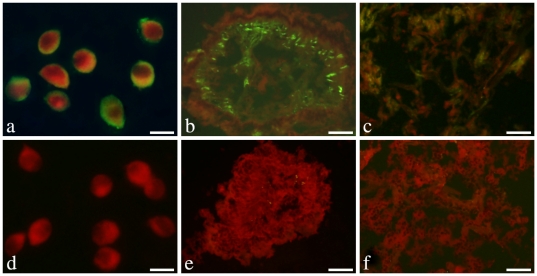
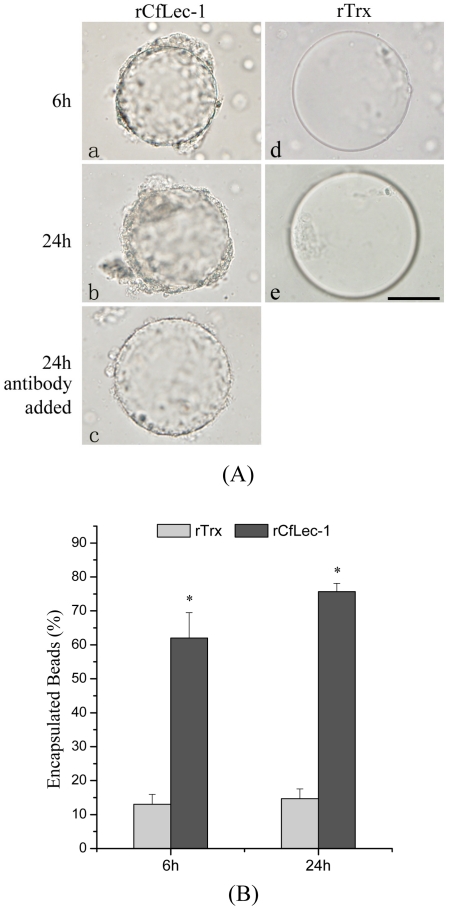
A C-type lectin (CfLec-1) from scallop Chlamys farreri, a dominant cultured mollusk species in China, was selected to investigate its mRNA expression, localization and the possible functions in innate immunity in the present study. After scallop was stimulated by three typical PAMPs, the mRNA expression of CfLec-1 in hemocytes was poles apart. It was significantly up-regulated (p<0.01) after scallops were stimulated by LPS or β-glucan, but significantly down-regulated (p<0.01) after PGN stimulation. The binding ability of recombinant CfLec-1 (designated as rCfLec-1) towards eight PAMPs was investigated subsequently by PAMPs microarray, which revealed rCfLec-1 could bind LPS, PGN and mannan in vitro, indicating CfLec-1 served as a PRR involved in the pathogen recognition. Immunofluorescence assay with polyclonal antibody specific for CfLec-1 revealed that CfLec-1 was mainly located in the mantle and gill of the scallop. CfLec-1 could bind to the surface of scallop hemocytes and recruited hemocytes to enhance their encapsulation in vitro, and this process could be specifically blocked by anti-rCfLec-1 antibody. Meanwhile, rCfLec-1 could also enhance the phagocytic activity of scallop hemocytes against Escherichia coli.
The results clearly suggested that CfLec-1 in C. farreri not only served as a PRR involved in the PAMPs recognition, but also functioned as an opsonin participating in the clearance of invaders. It is therefore suspected that CfLec-1 could be an attachment-molecule to nonself-agents acting as an alternative to immunoglobulin in vertebrates.
C 型凝集素是一类依赖 Ca2+的糖识别蛋白超家族,在非自身识别和清除入侵物方面发挥着重要的多样性作用。虽然它们在脊椎动物中得到了很好的描述,但在无脊椎动物免疫中 C 型凝集素的潜在功能和机制的研究仍处于起步阶段。
本研究选择来自中国主要养殖贝类栉孔扇贝 Chlamys farreri 的 C 型凝集素(CfLec-1),以研究其在先天免疫中的 mRNA 表达、定位和可能的功能。在三种典型的 PAMP 刺激栉孔扇贝后,血细胞中 CfLec-1 的 mRNA 表达明显不同。LPS 或β-葡聚糖刺激后,CfLec-1 的 mRNA 表达显著上调(p<0.01),而 PGN 刺激后则显著下调(p<0.01)。随后通过 PAMP 微阵列研究了重组 CfLec-1(命名为 rCfLec-1)对八种 PAMP 的结合能力,结果表明 rCfLec-1 可以体外结合 LPS、PGN 和甘露聚糖,表明 CfLec-1 作为一种参与病原体识别的 PRR。用特异性多克隆抗体进行的免疫荧光分析显示 CfLec-1 主要位于扇贝的套膜和鳃中。CfLec-1 可以与扇贝血细胞的表面结合,并募集血细胞以增强其体外包被,这个过程可以被抗 rCfLec-1 抗体特异性阻断。同时,rCfLec-1 还可以增强扇贝血细胞对大肠杆菌的吞噬活性。
这些结果清楚地表明,栉孔扇贝 CfLec-1 不仅作为一种参与 PAMP 识别的 PRR,还作为一种参与清除入侵物的调理素发挥作用。因此,CfLec-1 可能是一种非自身附着分子,在脊椎动物中作为免疫球蛋白的替代物。