Oxford University Clinical Research Unit, Hanoi, Vietnam.
PLoS One. 2011 Feb 14;6(2):e16965. doi: 10.1371/journal.pone.0016965.
The spread of infectious diseases from person to person is determined by the frequency and nature of contacts between infected and susceptible members of the population. Although there is a long history of using mathematical models to understand these transmission dynamics, there are still remarkably little empirical data on contact behaviors with which to parameterize these models. Even starker is the almost complete absence of data from developing countries. We sought to address this knowledge gap by conducting a household based social contact diary in rural Vietnam.
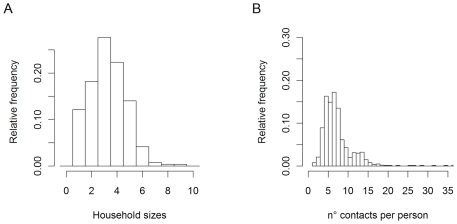
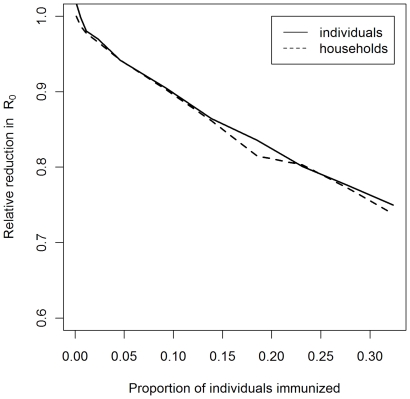
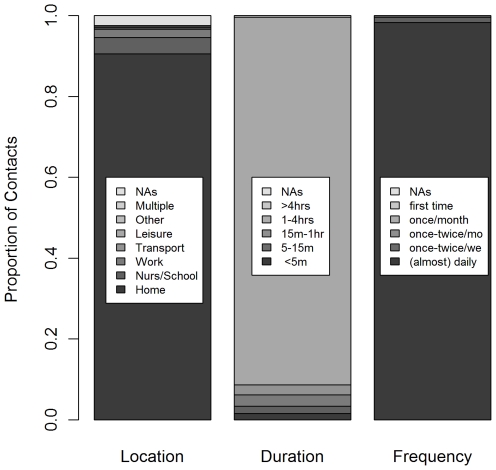
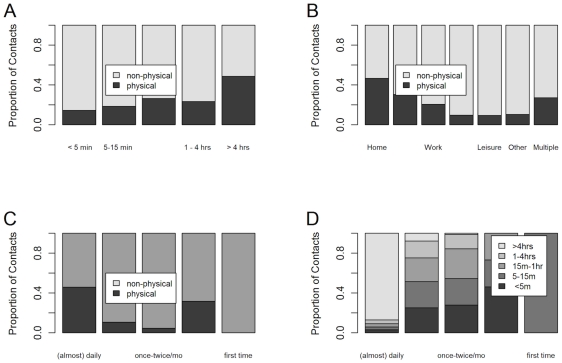
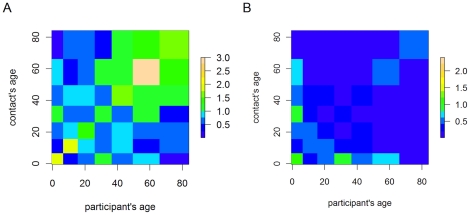
A diary based survey of social contact patterns was conducted in a household-structured community cohort in North Vietnam in 2007. We used generalized estimating equations to model the number of contacts while taking into account the household sampling design, and used weighting to balance the household size and age distribution towards the Vietnamese population. We recorded 6675 contacts from 865 participants in 264 different households and found that mixing patterns were assortative by age but were more homogenous than observed in a recent European study. We also observed that physical contacts were more concentrated in the home setting in Vietnam than in Europe but the overall level of physical contact was lower. A model of individual versus household vaccination strategies revealed no difference between strategies in the impact on R(0).
This work is the first to estimate contact patterns relevant to the spread of infections transmitted from person to person by non-sexual routes in a developing country setting. The results show interesting similarities and differences from European data and demonstrate the importance of context specific data.
人与人之间传染病的传播取决于感染者和易感人群之间接触的频率和性质。尽管长期以来一直使用数学模型来理解这些传播动态,但仍缺乏用于参数化这些模型的接触行为的经验数据。发展中国家的数据几乎完全缺失,这一点更为明显。我们试图通过在越南农村进行基于家庭的社会接触日记来解决这一知识差距。
2007 年,我们在越南北部的一个以家庭为结构的社区队列中进行了基于日记的社会接触模式调查。我们使用广义估计方程来模拟接触次数,同时考虑到家庭抽样设计,并使用加权来平衡家庭规模和年龄分布,使其与越南人口相匹配。我们从 264 个不同家庭的 865 名参与者中记录了 6675 次接触,并发现混合模式按年龄呈聚集性,但比最近的一项欧洲研究更为均匀。我们还观察到,与欧洲相比,越南的身体接触更集中在家中,但身体接触的总体水平较低。个体与家庭疫苗接种策略的模型显示,两种策略对 R(0)的影响没有差异。
这项工作是首次在发展中国家背景下估计与非性传播途径感染传播有关的接触模式。结果显示出与欧洲数据的有趣相似和差异,并证明了特定于背景的数据的重要性。