Clinical Tropical Medicine Laboratory, Queensland Institute of Medical Research, University of Queensland, Herston, Australia.
PLoS Negl Trop Dis. 2011 Feb 8;5(2):e955. doi: 10.1371/journal.pntd.0000955.
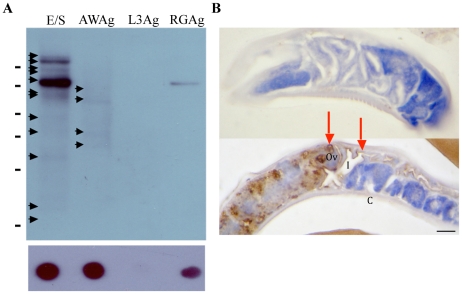
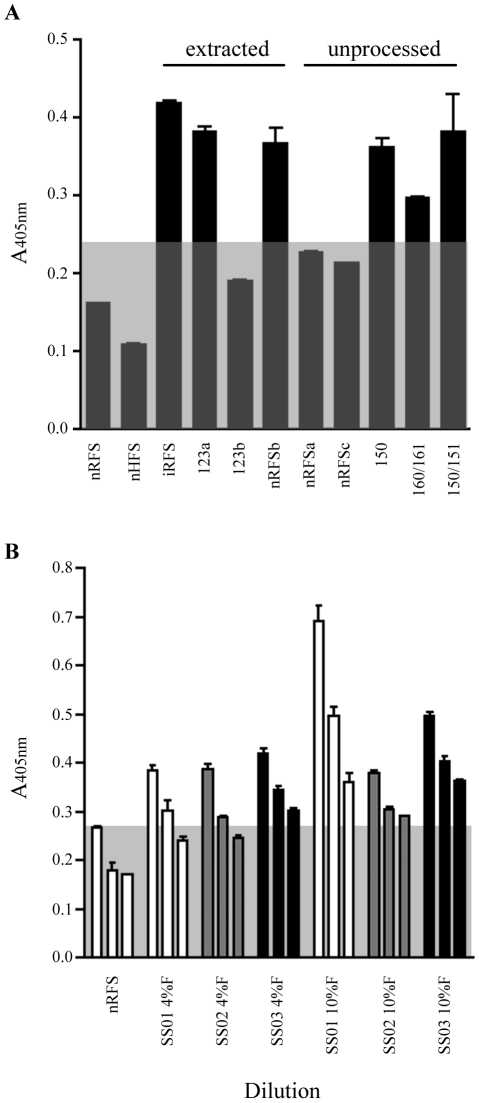
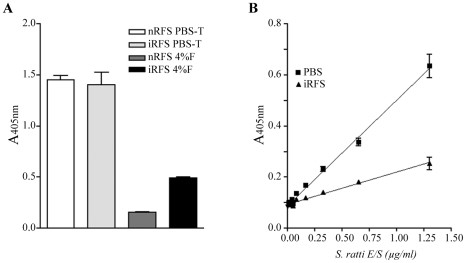
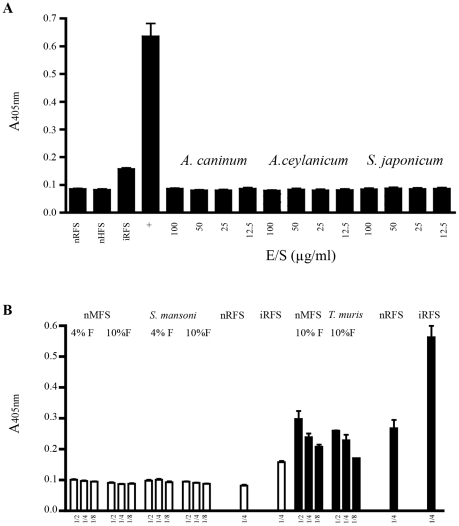
Accurate diagnosis of infection with the parasite Strongyloides stercoralis is hampered by the low concentration of larvae in stool, rendering parasitological diagnosis insensitive. Even if the more sensitive agar plate culture method is used repeated stool sampling is necessary to achieve satisfactory sensitivity. In this manuscript we describe the development of a coproantigen ELISA for diagnosis of infection. Polyclonal rabbit antiserum was raised against Strongyloides ratti excretory/secretory (E/S) antigen and utilized to develop an antigen capture ELISA. The assay enabled detection of subpatent rodent S. ratti and human S. stercoralis infection. No cross-reactivity was observed with purified E/S from Schistosoma japonicum, the hookworms Ancylostoma caninum, A. ceylanicum, nor with fecal samples collected from rodents harboring Trichuris muris or S. mansoni infection. Strongyloides coproantigens that appear stable when frozen as formalin-extracted fecal supernatants stored at -20 °C remained positive up to 270 days of storage, whereas supernatants stored at 4 °C tested negative. These results indicate that diagnosis of human strongyloidiasis by detection of coproantigen is an approach worthy of further development.
寄生虫粪类圆线虫感染的准确诊断受到粪便中幼虫浓度低的阻碍,使得寄生虫学诊断不敏感。即使使用更敏感的琼脂平板培养方法,也需要反复粪便采样才能达到满意的灵敏度。在本文中,我们描述了一种用于诊断感染的粪抗原酶联免疫吸附试验(ELISA)的开发。针对大鼠粪类圆线虫排泄/分泌(E/S)抗原制备了多克隆兔抗血清,并用于开发抗原捕获 ELISA。该检测方法能够检测到亚感染的啮齿动物 S. ratti 和人类 S. stercoralis 感染。与来自日本血吸虫的纯化 E/S、钩虫Ancylostoma caninum、A. ceylanicum 以及来自携带旋毛虫或曼氏血吸虫感染的啮齿动物的粪便样本均无交叉反应。在-20°C 下以甲醛提取粪便上清液冷冻保存时,粪类圆线虫粪抗原表现出稳定,可保存长达 270 天,而在 4°C 下保存的上清液则呈阴性。这些结果表明,通过检测粪抗原诊断人类粪圆线虫病是一种值得进一步开发的方法。