
PLX4720 通过靶向 BRAFV600E 在人类甲状腺癌的临床前模型中显示出强大的抗迁移和抗侵袭活性。
Targeting BRAFV600E with PLX4720 displays potent antimigratory and anti-invasive activity in preclinical models of human thyroid cancer.
机构信息
Harvard Medical School, Massachusetts General Hospital, Boston, MA 02115, USA.
出版信息
Oncologist. 2011;16(3):296-309. doi: 10.1634/theoncologist.2010-0317. Epub 2011 Feb 25.
PURPOSE
B-Raf(V600E) may play a role in the progression from papillary thyroid cancer to anaplastic thyroid cancer (ATC). We tested the effects of a highly selective B-Raf(V600E) inhibitor, PLX4720, on proliferation, migration, and invasion both in human thyroid cancer cell lines (8505c(B-RafV600E) and TPC-1(RET/PTC-1 and wild-type B-Raf)) and in primary human normal thyroid (NT) follicular cells engineered with or without B-Raf(V600E).
EXPERIMENTAL DESIGN
Large-scale genotyping analysis by mass spectrometry was performed in order to analyze >900 gene mutations. Cell proliferation and migration/invasion were performed upon PLX4720 treatment in 8505c, TPC-1, and NT cells. Orthotopic implantation of either 8505c or TPC-1 cells into the thyroid of severe combined immunodeficient mice was performed. Gene validations were performed by quantitative polymerase chain reaction and immunohistochemistry.
RESULTS
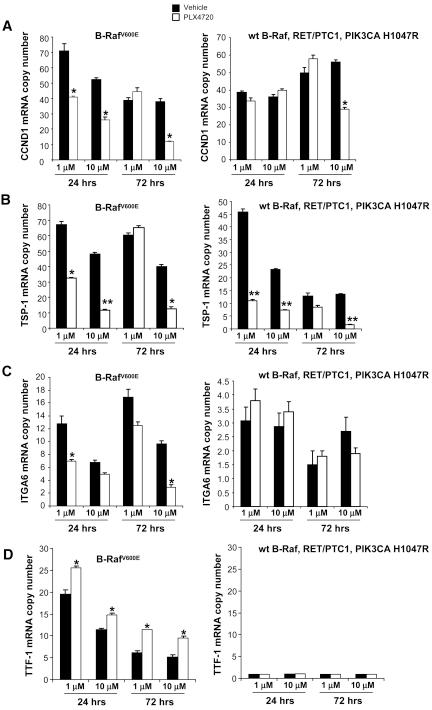
We found that PLX4720 reduced in vitro cell proliferation and migration and invasion of 8505c cells, causing early downregulation of genes involved in tumor progression. PLX4720-treated NT cells overexpressing B-Raf(V600E) (heterozygous wild-type B-Raf/B-Raf(V600E)) showed significantly lower cell proliferation, migration, and invasion. PLX4720 treatment did not block cell invasion in TPC-1 cells with wild-type B-Raf, which showed very low and delayed in vivo tumor growth. In vivo, PLX4720 treatment of 8505c orthotopic thyroid tumors inhibited tumor aggressiveness and significantly upregulated the thyroid differentiation markers thyroid transcription factor 1 and paired box gene 8.
CONCLUSIONS
Here, we have shown that PLX4720 preferentially inhibits migration and invasion of B-Raf(V600E) thyroid cancer cells and tumor aggressiveness. Normal thyroid cells were generated to be heterozygous for wild-type B-Raf/B-Raf(V600E), mimicking the condition found in most human thyroid cancers. PLX4720 was effective in reducing cell proliferation, migration, and invasion in this heterozygous model. PLX4720 therapy should be tested and considered for a phase I study for the treatment of patients with B-Raf(V600E) ATC.
目的
B-Raf(V600E) 可能在甲状腺乳头状癌向间变性甲状腺癌(ATC)进展中发挥作用。我们检测了一种高度选择性的 B-Raf(V600E) 抑制剂 PLX4720 在人甲状腺癌细胞系(8505c(B-RafV600E)和 TPC-1(RET/PTC-1 和野生型 B-Raf))和原发性人正常甲状腺(NT)滤泡细胞中的增殖、迁移和侵袭中的作用,这些细胞经过基因工程改造,携带或不携带 B-Raf(V600E)。
实验设计
通过质谱进行了大规模基因分型分析,以分析 >900 种基因突变。在 8505c、TPC-1 和 NT 细胞中用 PLX4720 处理后进行细胞增殖和迁移/侵袭实验。将 8505c 或 TPC-1 细胞原位植入严重联合免疫缺陷小鼠的甲状腺中。通过定量聚合酶链反应和免疫组织化学进行基因验证。
结果
我们发现 PLX4720 降低了 8505c 细胞的体外细胞增殖、迁移和侵袭,导致参与肿瘤进展的基因早期下调。PLX4720 处理的过表达 B-Raf(V600E)(杂合野生型 B-Raf/B-Raf(V600E))的 NT 细胞显示出明显较低的细胞增殖、迁移和侵袭。PLX4720 处理并未阻止野生型 B-Raf 的 TPC-1 细胞的细胞侵袭,后者显示出非常低且延迟的体内肿瘤生长。在体内,PLX4720 处理 8505c 原位甲状腺肿瘤抑制了肿瘤侵袭性,并显著上调甲状腺分化标志物甲状腺转录因子 1 和配对盒基因 8。
结论
在这里,我们表明 PLX4720 优先抑制 B-Raf(V600E) 甲状腺癌细胞的迁移和侵袭以及肿瘤侵袭性。正常甲状腺细胞被设计为携带野生型 B-Raf/B-Raf(V600E) 的杂合子,模拟了大多数人类甲状腺癌中的情况。PLX4720 在这种杂合模型中有效降低了细胞增殖、迁移和侵袭。PLX4720 治疗应在治疗携带 B-Raf(V600E) 的 ATC 患者的 I 期研究中进行测试和考虑。


 Zotero 插件