Department of Cellular and Molecular Physiology, Yale University, New Haven, CT 06520, USA.
J Gen Physiol. 2011 Mar;137(3):289-97. doi: 10.1085/jgp.201010576.
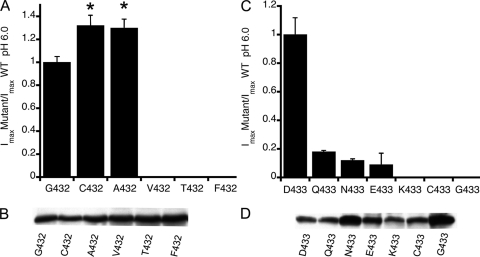
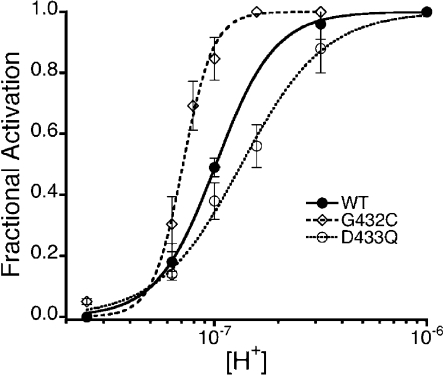
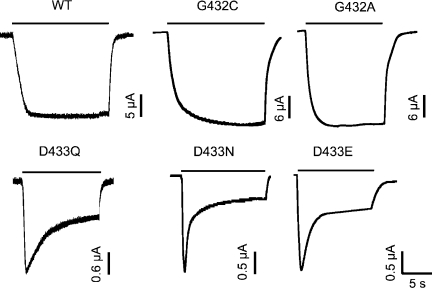
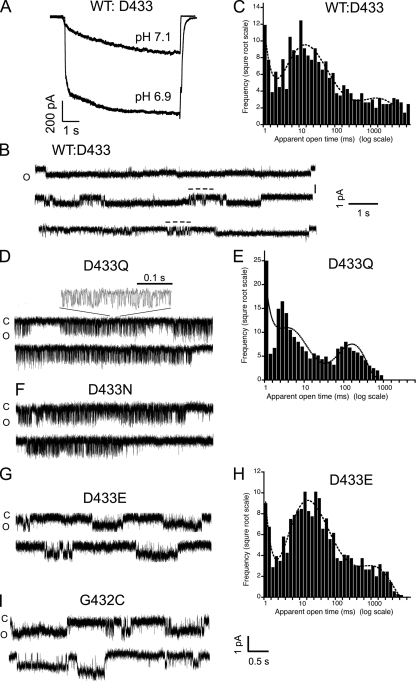
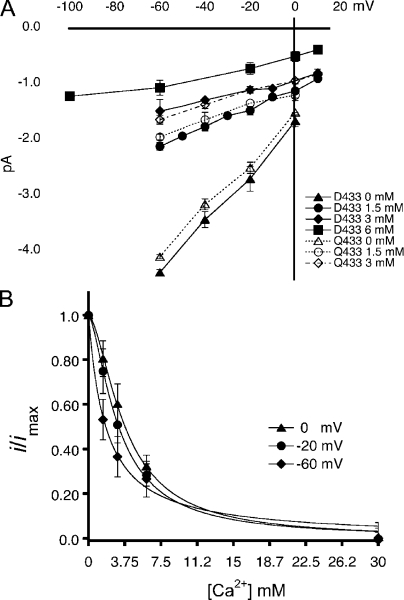
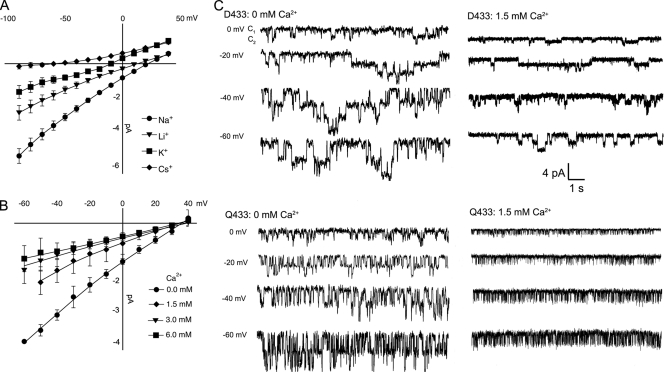
A constriction formed by the crossing of the second transmembrane domains of ASIC1, residues G432 to G436, forms the narrowest segment of the pore in the crystal structure of chicken ASIC1, presumably in the desensitized state, suggesting that it constitutes the "desensitization gate" and the "selectivity filter." Residues Gly-432 and Asp-433 occlude the pore, preventing the passage of ions from the extracellular side. Here, we examined the role of Asp-433 and Gly-432 in channel kinetics, ion selectivity, conductance, and Ca(2+) block in lamprey ASIC1 that is a channel with little intrinsic desensitization in the pH range of maximal activity, pH 7.0. The results show that the duration of open times depends on residue 433, with Asp supporting the longest openings followed by Glu, Gln, or Asn, whereas other residues keep the channel closed. This is consistent with residue Asp-433 forming the pore's closing gate and the properties of the side chain either stabilizing (hydrophobic amino acids) or destabilizing (Asp) the gate. The data also show residue 432 influencing the duration of openings, but here only Gly and Ala support long openings, whereas all other residues keep channels closed. The negative charge of Asp-433 was not required for block of the open pore by Ca(2+) or for determining ion selectivity and unitary conductance. We conclude that the conserved residue Asp-433 forms the closing gate of the pore and thereby determines the duration of individual openings while desensitization, defined as the permanent closure of all or a fraction of channels by the continual presence of H(+), modulates the on or off position of the closing gate. The latter effect depends on less conserved regions of the channel, such as TM1 and the extracellular domain. The constriction made by Asp-433 and Gly-432 does not select for ions in the open conformation, implying that the closing gate and selectivity filter are separate structural elements in the ion pathway of ASIC1. The results also predict a significantly different conformation of TM2 in the open state that relieves the constriction made by TM2, allowing the passage of ions unimpeded by the side chain of Asp-433.
ASIC1 的第二个跨膜结构域的交叉形成了一个缩窄,由残基 G432 到 G436 组成,形成了鸡 ASIC1 晶体结构中孔的最窄部分,推测在脱敏状态下,这构成了“脱敏门”和“选择性过滤器”。残基 Gly-432 和 Asp-433 阻塞孔,防止离子从细胞外侧面通过。在这里,我们研究了天青石 ASIC1 中 Asp-433 和 Gly-432 对通道动力学、离子选择性、电导率和 Ca(2+)阻断的作用,天青石 ASIC1 在最大活性 pH 范围 7.0 时通道的内在脱敏作用很小。结果表明,开放时间的持续时间取决于残基 433,Asp 支持最长的开放,其次是 Glu、Gln 或 Asn,而其他残基则使通道关闭。这与残基 Asp-433 形成孔的关闭门以及侧链稳定(疏水性氨基酸)或不稳定(Asp)门的性质一致。数据还表明,残基 432 影响开放时间的持续时间,但这里只有 Gly 和 Ala 支持长开放,而所有其他残基则使通道关闭。Asp-433 的负电荷对于 Ca(2+)阻断开放孔或确定离子选择性和单位电导不是必需的。我们得出结论,保守的残基 Asp-433 形成孔的关闭门,从而决定了单个开放的持续时间,而脱敏作用,定义为 H(+)的持续存在永久性关闭所有或部分通道,调节关闭门的开启或关闭位置。后一种效应取决于通道的不太保守区域,如 TM1 和细胞外结构域。由 Asp-433 和 Gly-432 形成的缩窄不会选择开放构象中的离子,这意味着关闭门和选择性过滤器是 ASIC1 离子通道中的分离结构元件。结果还预测了 TM2 在开放状态下的构象显著不同,这缓解了由 TM2 形成的缩窄,允许离子不受 Asp-433 侧链的阻碍而通过。