Division of Pharmacognosy, Section Metabolomics, Institute of Biology, Leiden University, 2333 CC, Leiden, The Netherlands.
J Biomol NMR. 2011 Apr;49(3-4):255-66. doi: 10.1007/s10858-011-9487-3. Epub 2011 Feb 26.
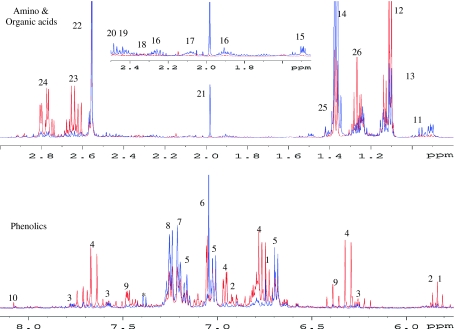
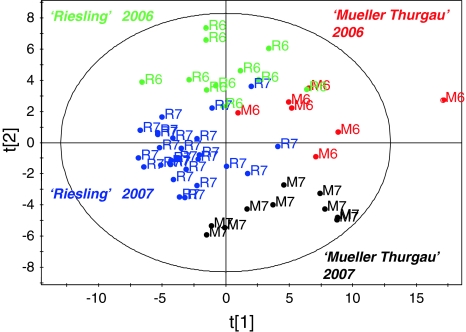
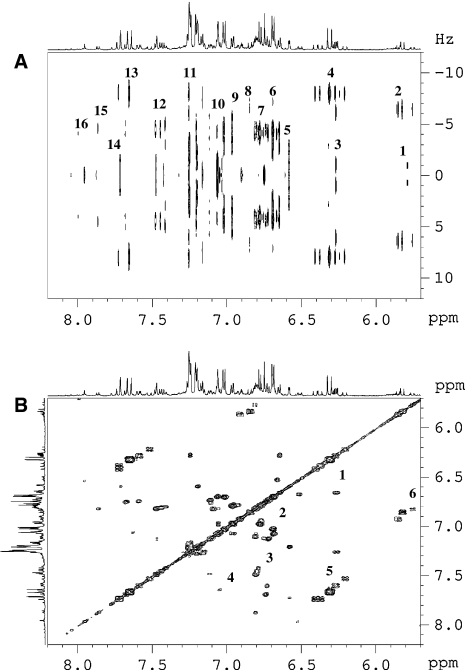
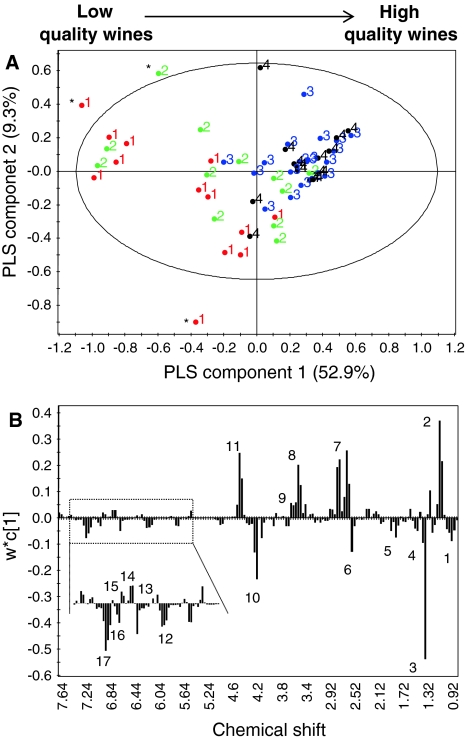
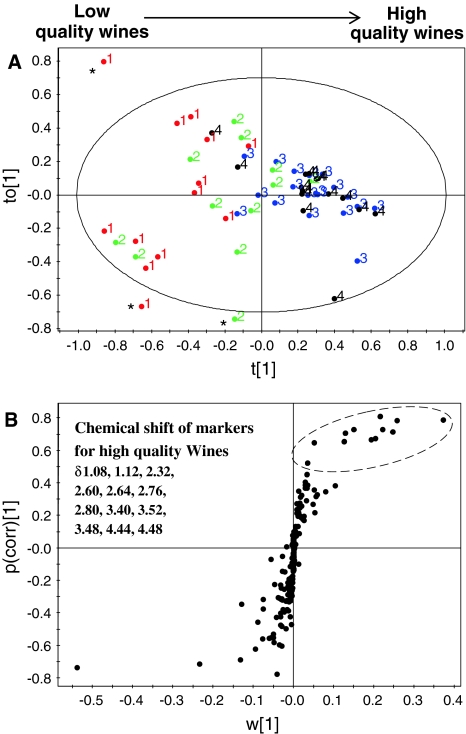
(1)H NMR (nuclear magnetic resonance spectroscopy) has been used for metabolomic analysis of 'Riesling' and 'Mueller-Thurgau' white wines from the German Palatinate region. Diverse two-dimensional NMR techniques have been applied for the identification of metabolites, including phenolics. It is shown that sensory analysis correlates with NMR-based metabolic profiles of wine. (1)H NMR data in combination with multivariate data analysis methods, like principal component analysis (PCA), partial least squares projections to latent structures (PLS), and bidirectional orthogonal projections to latent structures (O2PLS) analysis, were employed in an attempt to identify the metabolites responsible for the taste of wine, using a non-targeted approach. The high quality wines were characterized by elevated levels of compounds like proline, 2,3-butanediol, malate, quercetin, and catechin. Characterization of wine based on type and vintage was also done using orthogonal projections to latent structures (OPLS) analysis. 'Riesling' wines were characterized by higher levels of catechin, caftarate, valine, proline, malate, and citrate whereas compounds like quercetin, resveratrol, gallate, leucine, threonine, succinate, and lactate, were found discriminating for 'Mueller-Thurgau'. The wines from 2006 vintage were dominated by leucine, phenylalanine, citrate, malate, and phenolics, while valine, proline, alanine, and succinate were predominantly present in the 2007 vintage. Based on these results, it can be postulated the NMR-based metabolomics offers an easy and comprehensive analysis of wine and in combination with multivariate data analyses can be used to investigate the source of the wines and to predict certain sensory aspects of wine.
(1)NMR(核磁共振波谱学)已被用于分析德国普法尔茨地区的雷司令和米勒-图高白葡萄酒的代谢组学。已经应用了多种二维 NMR 技术来鉴定代谢物,包括酚类化合物。结果表明,感官分析与基于 NMR 的葡萄酒代谢图谱相关。(1)H NMR 数据与多元数据分析方法(如主成分分析(PCA)、偏最小二乘投影到潜在结构(PLS)和双向正交投影到潜在结构(O2PLS)分析)相结合,用于尝试使用非靶向方法鉴定负责葡萄酒味道的代谢物。优质葡萄酒的特征是高水平的脯氨酸、2,3-丁二醇、苹果酸、槲皮素和儿茶素等化合物。使用正交投影到潜在结构(OPLS)分析对基于类型和年份的葡萄酒进行了表征。雷司令葡萄酒的特征是儿茶素、咖啡酸酯、缬氨酸、脯氨酸、苹果酸和柠檬酸含量较高,而槲皮素、白藜芦醇、没食子酸酯、亮氨酸、苏氨酸、琥珀酸和乳酸等化合物则是米勒-图高葡萄酒的特征。2006 年份的葡萄酒以亮氨酸、苯丙氨酸、柠檬酸、苹果酸和酚类物质为主,而缬氨酸、脯氨酸、丙氨酸和琥珀酸则主要存在于 2007 年份。基于这些结果,可以假设基于 NMR 的代谢组学提供了一种简单而全面的葡萄酒分析方法,并且与多元数据分析相结合,可以用于研究葡萄酒的来源,并预测葡萄酒的某些感官方面。