Department of Pharmaceutical Chemistry, Comenius University Bratislava, Odbojarov 10, SK-832 32 Bratislava, Slovakia.
J Mol Model. 2011 Dec;17(12):3117-28. doi: 10.1007/s00894-011-1000-0. Epub 2011 Mar 2.
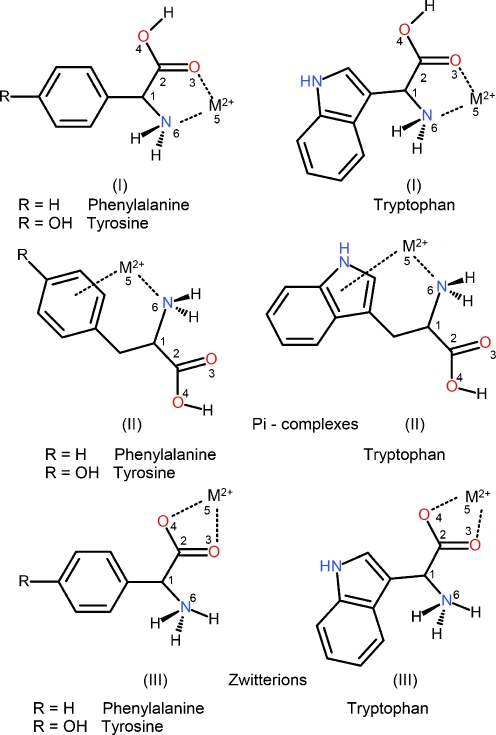
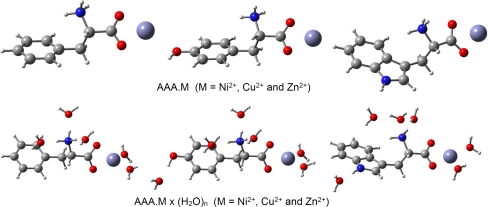
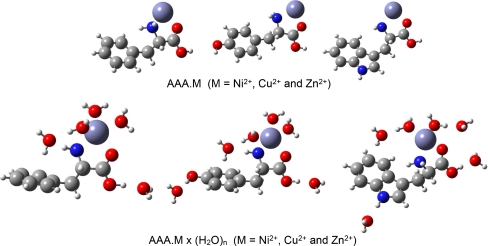
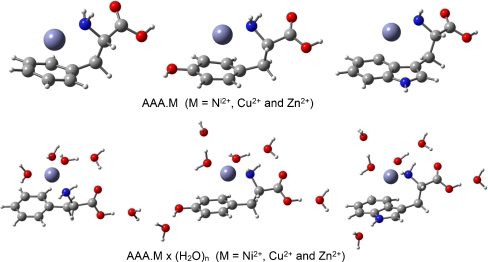
Methods of quantum chemistry have been applied to double-charged complexes involving the transition metals Ni(2+), Cu(2+) and Zn(2+) with the aromatic amino acids (AAA) phenylalanine, tyrosine and tryptophan. The effect of hydration on the relative stability and geometry of the individual species studied has been evaluated within the supermolecule approach. The interaction enthalpies, entropies and Gibbs energies of nine complexes Phe•M, Tyr•M, Trp•M, (M = Ni(2+), Cu(2+) and Zn(2+)) were determined at the Becke3LYP density functional level of theory. Of the transition metals studied the bivalent copper cation forms the strongest complexes with AAAs. For Ni(2+)and Cu(2+) the most stable species are the NO coordinated cations in the AAA metal complexes, Zn(2+)cation prefers a binding to the aromatic part of the AAA (complex II). Some complexes energetically unfavored in the gas-phase are stabilized upon microsolvation.
方法量子化学已被应用于涉及过渡金属 Ni(2+)、Cu(2+)和 Zn(2+)与芳香族氨基酸(AAA)苯丙氨酸、酪氨酸和色氨酸的双电荷配合物。在超分子方法中评估了水合对所研究的各个物种的相对稳定性和几何形状的影响。在 Becke3LYP 密度泛函理论水平下,测定了 9 个配合物 Phe•M、Tyr•M、Trp•M(M = Ni(2+)、Cu(2+)和 Zn(2+))的相互作用焓、熵和吉布斯自由能。在所研究的过渡金属中,二价铜阳离子与 AAAs 形成最强的配合物。对于 Ni(2+)和 Cu(2+),最稳定的物种是 AAA 金属配合物中 NO 配位的阳离子,Zn(2+)阳离子更喜欢与 AAA 的芳香部分结合(复合物 II)。一些在气相中能量不利的配合物在微溶剂化后得到稳定。