Translational Hematology and Oncology Research, Taussig Cancer Institute, Cleveland Clinic, Cleveland, OH 44195, USA.
Br J Cancer. 2011 Mar 15;104(6):957-67. doi: 10.1038/bjc.2011.42. Epub 2011 Mar 1.
Although inhibitors of histone deacetylase inhibitors (HDACis) in combination with genotoxins potentiate apoptosis, the role of proteases other than caspases in this process remained elusive. Therefore, we examined the potentiation of apoptosis and related mechanisms of HDACis and doxorubicin combination in a panel of myeloma cell lines and in 25 primary myelomas.
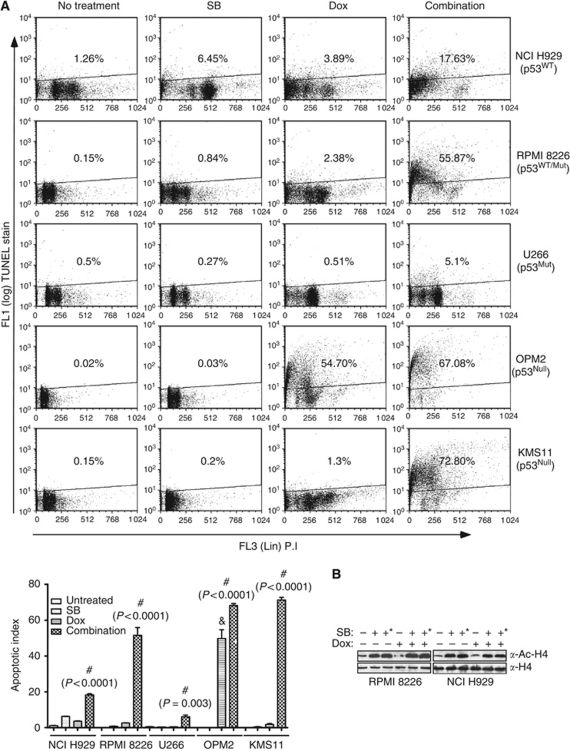
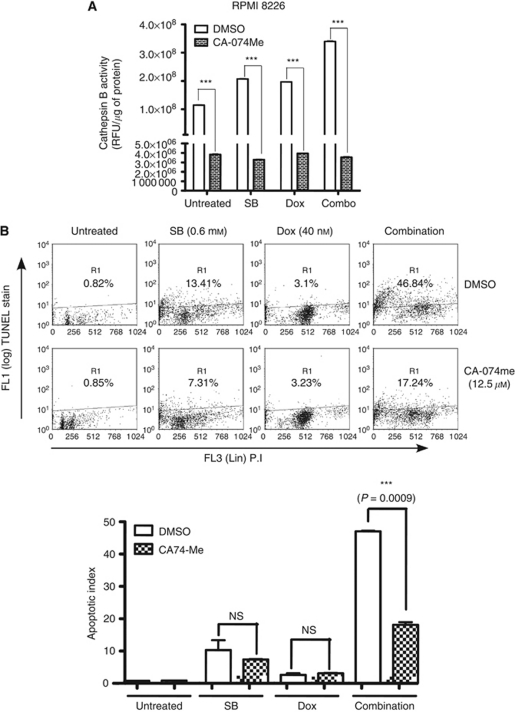
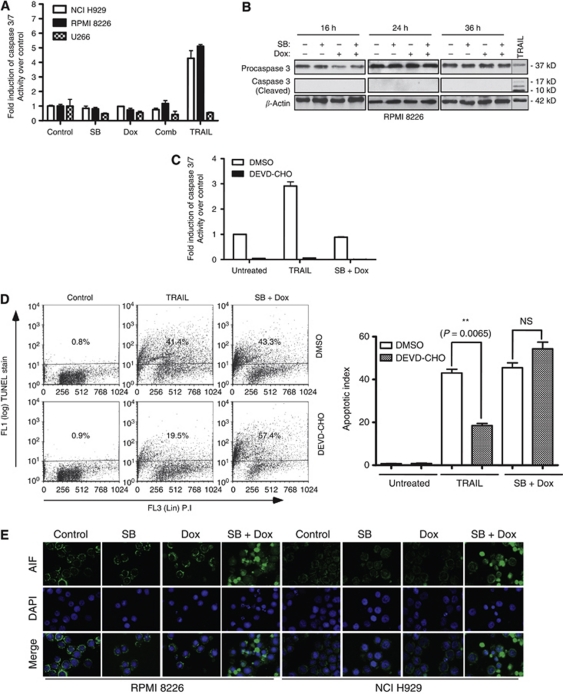
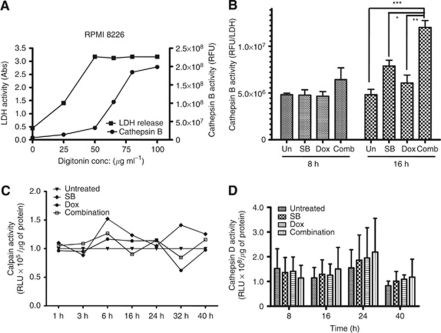
At IC(50) concentrations, sodium butyrate (an HDACi) or doxorubicin alone caused little apoptosis. However, their combination potentiated apoptosis and synergistically reduced the viability of myeloma cells independent of p53 and caspase 3-7 activation. Potentiated apoptosis correlated with nuclear translocation of apoptosis-inducing factor, suggesting the induction of caspase 3- and 7-independent pathways. Consistent with this, butyrate and doxorubicin combination significantly increased the activity of cytoplasmic cathepsin B. Inhibition of cathepsin B either with a small-molecule inhibitor or downregulation with a siRNA reversed butyrate- and doxorubicin-potentiated apoptosis. Finally, ex vivo, clinically relevant concentrations of butyrate or SAHA (suberoylanilide hydroxamic acid, vorinostat, an HDACi in clinical testing) in combination with doxorubicin significantly (P<0.0001) reduced the survival of primary myeloma cells.
Cathepsin B has a prominent function in mediating apoptosis potentiated by HDACi and doxorubicin combinations in myeloma. Our results support a molecular model of lysosomal-mitochondrial crosstalk in HDACi- and doxorubicin-potentiated apoptosis through the activation of cathepsin B.
尽管组蛋白去乙酰化酶抑制剂(HDACi)与遗传毒物联合使用可以增强细胞凋亡,但细胞凋亡过程中除了半胱天冬酶之外的蛋白酶的作用仍不明确。因此,我们在一组骨髓瘤细胞系和 25 例原发性骨髓瘤中检测了 HDACi 和阿霉素联合应用增强细胞凋亡的作用及其相关机制。
在 IC50 浓度下,丁酸钠(一种 HDACi)或阿霉素单独作用时引起的细胞凋亡很少。然而,它们的联合作用增强了细胞凋亡,并协同降低了骨髓瘤细胞的活力,与 p53 和半胱天冬酶 3-7 的激活无关。增强的细胞凋亡与凋亡诱导因子的核转位相关,提示诱导了半胱天冬酶 3 和 7 非依赖性途径。与此一致的是,丁酸钠和阿霉素联合作用显著增加了细胞质组织蛋白酶 B 的活性。用小分子抑制剂抑制组织蛋白酶 B 或用 siRNA 下调组织蛋白酶 B 逆转了丁酸钠和阿霉素增强的细胞凋亡。最后,在体外,丁酸钠或 SAHA(丁酸钠羟肟酸,vorinostat,一种正在临床试验中的 HDACi)与阿霉素的临床相关浓度显著降低了原发性骨髓瘤细胞的存活(P<0.0001)。
组织蛋白酶 B 在介导 HDACi 和阿霉素联合增强骨髓瘤细胞凋亡中具有重要作用。我们的结果支持了一种通过激活组织蛋白酶 B 介导的溶酶体-线粒体串扰的分子模型,用于解释 HDACi 和阿霉素增强细胞凋亡的机制。