School of Biological Sciences, University of Canterbury, Christchurch, New Zealand.
PLoS One. 2011 Feb 22;6(2):e17199. doi: 10.1371/journal.pone.0017199.
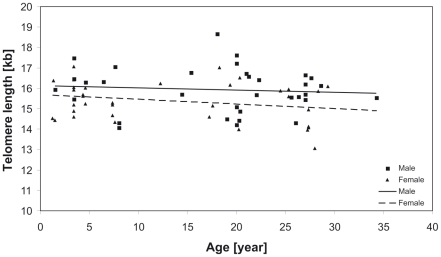
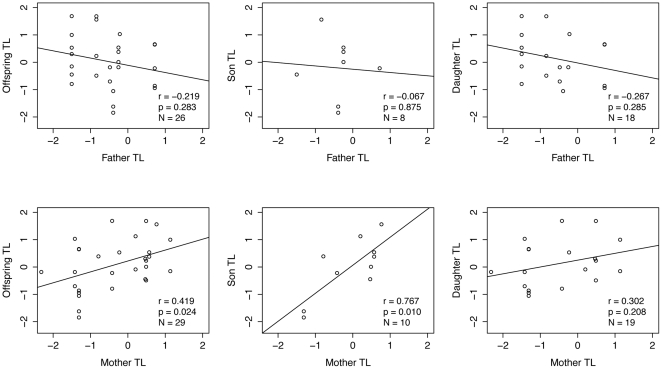
Telomere dynamics are intensively studied in human ageing research and epidemiology, with many correlations reported between telomere length and age-related diseases, cancer and death. While telomere length is influenced by environmental factors there is also good evidence for a strong heritable component. In human, the mode of telomere length inheritance appears to be paternal and telomere length differs between sexes, with females having longer telomeres than males. Genetic factors, e.g. sex chromosomal inactivation, and non-genetic factors, e.g. antioxidant properties of oestrogen, have been suggested as possible explanations for these sex-specific telomere inheritance and telomere length differences. To test the influence of sex chromosomes on telomere length, we investigated inheritance and sex-specificity of telomere length in a bird species, the kakapo (Strigops habroptilus), in which females are the heterogametic sex (ZW) and males are the homogametic (ZZ) sex. We found that, contrary to findings in humans, telomere length was maternally inherited and also longer in males. These results argue against an effect of sex hormones on telomere length and suggest that factors associated with heterogamy may play a role in telomere inheritance and sex-specific differences in telomere length.
端粒动态在人类衰老研究和流行病学中被深入研究,许多研究报告表明端粒长度与年龄相关疾病、癌症和死亡之间存在相关性。虽然端粒长度受环境因素的影响,但也有强有力的证据表明其具有很强的遗传性。在人类中,端粒长度的遗传模式似乎是父系的,并且男女之间的端粒长度存在差异,女性的端粒比男性长。遗传因素,例如性染色体失活,和非遗传因素,例如雌激素的抗氧化特性,被认为是这些性别特异性端粒遗传和端粒长度差异的可能解释。为了检验性染色体对端粒长度的影响,我们在一种鸟类——鸮鹦鹉(Strigops habroptilus)中研究了端粒长度的遗传和性别特异性,在这种鸟类中,雌性是异型性染色体(ZW),雄性是同型性染色体(ZZ)。我们发现,与人类的发现相反,端粒长度是母系遗传的,而且雄性的端粒更长。这些结果排除了性激素对端粒长度的影响,并表明与异型性相关的因素可能在端粒遗传和端粒长度的性别特异性差异中起作用。