Department of Biochemistry and Molecular Biology, and Institute of Bioinformatics, University of Georgia, Athens, Georgia, United States of America.
PLoS One. 2011 Feb 18;6(2):e16875. doi: 10.1371/journal.pone.0016875.
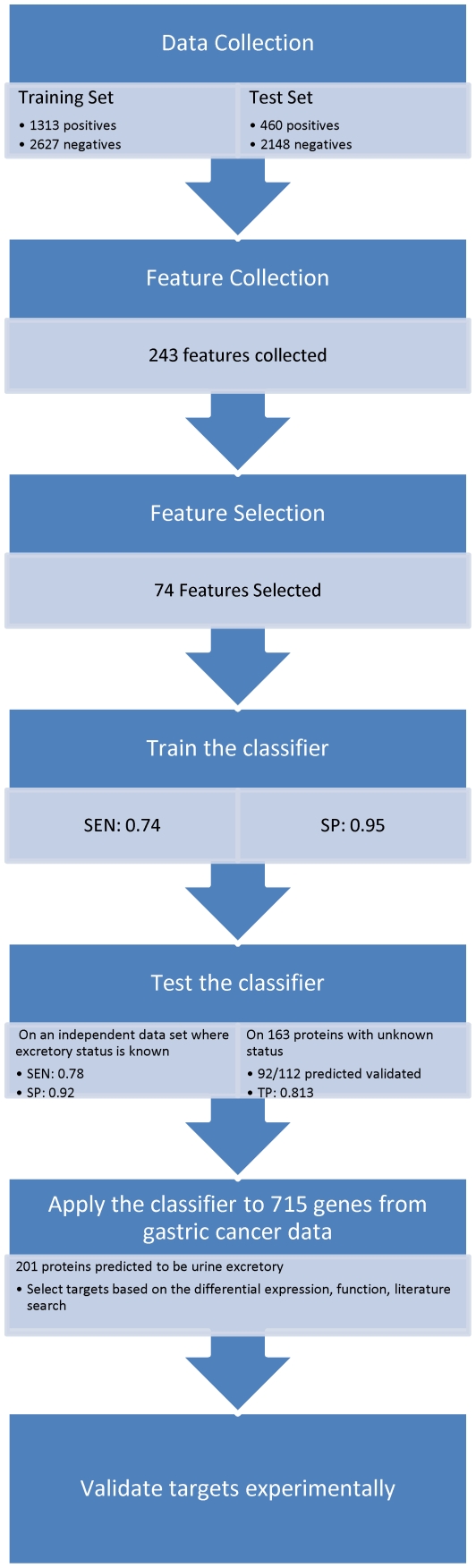
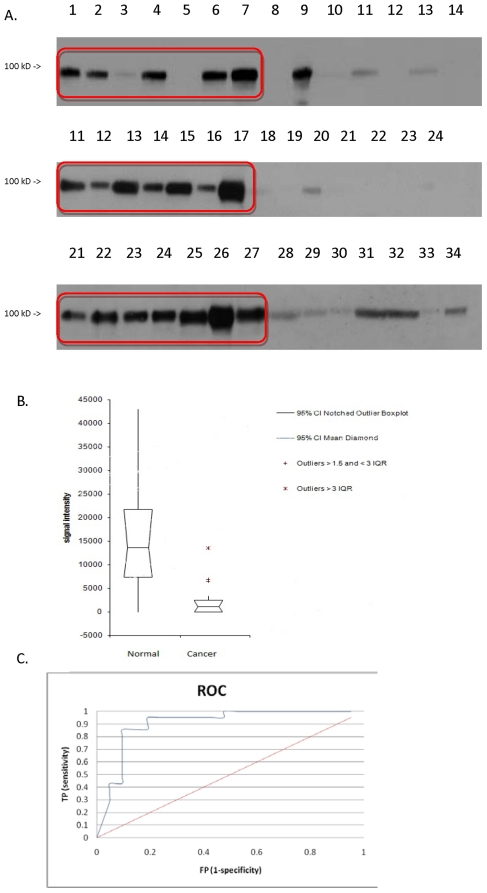
A novel computational method for prediction of proteins excreted into urine is presented. The method is based on the identification of a list of distinguishing features between proteins found in the urine of healthy people and proteins deemed not to be urine excretory. These features are used to train a classifier to distinguish the two classes of proteins. When used in conjunction with information of which proteins are differentially expressed in diseased tissues of a specific type versus control tissues, this method can be used to predict potential urine markers for the disease. Here we report the detailed algorithm of this method and an application to identification of urine markers for gastric cancer. The performance of the trained classifier on 163 proteins was experimentally validated using antibody arrays, achieving >80% true positive rate. By applying the classifier on differentially expressed genes in gastric cancer vs normal gastric tissues, it was found that endothelial lipase (EL) was substantially suppressed in the urine samples of 21 gastric cancer patients versus 21 healthy individuals. Overall, we have demonstrated that our predictor for urine excretory proteins is highly effective and could potentially serve as a powerful tool in searches for disease biomarkers in urine in general.
本文提出了一种预测分泌到尿液中的蛋白质的新计算方法。该方法基于识别健康人尿液中存在的蛋白质与被认为不是尿液排泄的蛋白质之间的一组区别特征。这些特征用于训练分类器以区分这两类蛋白质。当与特定类型疾病组织与对照组织中差异表达的蛋白质信息结合使用时,该方法可用于预测疾病的潜在尿液标志物。本文报告了该方法的详细算法及其在胃癌尿液标志物识别中的应用。使用抗体阵列对 163 种蛋白质进行了训练分类器的性能实验验证,获得了 >80%的真阳性率。通过将分类器应用于胃癌与正常胃组织中的差异表达基因,发现内皮脂肪酶(EL)在 21 名胃癌患者的尿液样本中明显低于 21 名健康个体。总体而言,我们已经证明,我们的尿液分泌蛋白预测器非常有效,并且可能成为一般尿液疾病生物标志物搜索的有力工具。