Division of Digestive Diseases, David Geffen School of Medicine, University of California Los Angeles, Los Angeles, CA, USA.
J Neurogastroenterol Motil. 2011 Jan;17(1):28-34. doi: 10.5056/jnm.2011.17.1.28. Epub 2011 Jan 26.
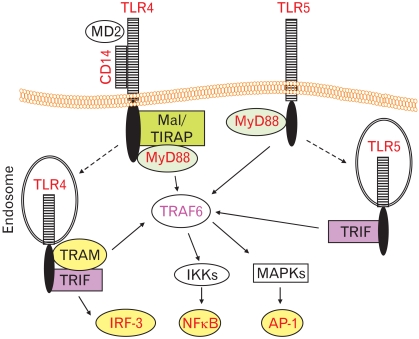
Microbial recognition by multicellular organisms is initially accomplished by a group of pattern recognition receptors which are specialized to recognize microbe-associated molecular patterns (MAMPs) such as lipopolysaccharide, bacterial lipoprotein, CpG DNA motif, double strand RNA and flagellin. Toll-like receptors (TLRs) are the representative pattern recognition receptors, and microbial recognition by TLRs elicits innate and inflammatory responses. Ten TLR family members have been presently identified in human genome, and numerous studies discovered that intracellular responses from MAMPs-TLR engagements are mediated by a participation of at least 4 immediate adaptor molecules such as myeloid differentiation primary response gene-88 (MyD88), MyD88 adaptor-like (Mal) (also known as Toll/IL-1 receptor domain-containing adaptor protein [TIRAP]), Toll/IL-1 receptor domain-containing adaptor-inducing interferon-β (TRIF) and TRIF-related adaptor molecule (TRAM) leading to activate transcription factors including nuclear factor κB, activator protein-1 and interferon-regulatory factors. Given that large amounts of commensal microbiota constantly reside in the intestinal lumen, enteric microbial recognition by TLRs at the intestinal epithelium provides a critical impact on regulating intestinal homeostasis. Indeed, aberrant TLR4 and TLR5 activations are etiologically associated with the development and progress of intestinal inflammatory diseases including inflammatory bowel disease and necrotizing enterocolitis. In this review article, we present the molecular mechanism by which TLRs elicit intracellular signal transduction, and summarize the physiological relevance of TLRs related to the gastrointestinal tract.
多细胞生物对微生物的识别最初是由一组模式识别受体完成的,这些受体专门识别微生物相关分子模式(MAMPs),如脂多糖、细菌脂蛋白、CpG DNA 基序、双链 RNA 和鞭毛蛋白。Toll 样受体(TLRs)是代表性的模式识别受体,TLRs 对微生物的识别会引发先天和炎症反应。目前在人类基因组中已鉴定出 10 个 TLR 家族成员,大量研究发现,MAMPs-TLR 结合的细胞内反应是由至少 4 种直接衔接分子(如髓样分化初级反应基因-88(MyD88)、MyD88 衔接样(Mal)(也称为 Toll/IL-1 受体域包含衔接蛋白 [TIRAP])、Toll/IL-1 受体域包含衔接诱导干扰素-β(TRIF)和 TRIF 相关衔接分子(TRAM)的参与来介导的,这些分子会激活转录因子,包括核因子 κB、激活蛋白-1 和干扰素调节因子。鉴于大量共生菌群经常存在于肠道腔中,TLRs 在肠道上皮对肠道微生物的识别对调节肠道内稳态具有重要影响。事实上,TLR4 和 TLR5 的异常激活与肠道炎症性疾病(包括炎症性肠病和坏死性小肠结肠炎)的发生和发展在病因上有关联。在这篇综述文章中,我们介绍了 TLR 引发细胞内信号转导的分子机制,并总结了 TLR 与胃肠道相关的生理相关性。