Tsang Tim K, Fang Vicky J, Perera Ranawaka A P M, Ip Dennis K M, Leung Gabriel M, Peiris J S Malik, Cauchemez Simon, Cowling Benjamin J
From theaWHO Collaborating Centre for Infectious Disease Epidemiology and Control, School of Public Health, Li Ka Shing Faculty of Medicine, The University of Hong Kong, Hong Kong Special Administrative Region, China;bCentre for Influenza Research, Li Ka Shing Faculty of Medicine, The University of Hong Kong, Hong Kong Special Administrative Region, China; andcMathematical Modelling of Infectious Diseases Unit, Institut Pasteur, Paris, France.
Epidemiology. 2016 Jan;27(1):152-8. doi: 10.1097/EDE.0000000000000408.
In influenza epidemiology, analysis of paired sera collected from people before and after influenza seasons has been used for decades to study the cumulative incidence of influenza virus infections in populations. However, interpretation becomes challenging when sera are collected after the start or before the end of an epidemic, and do not neatly bracket the epidemic.
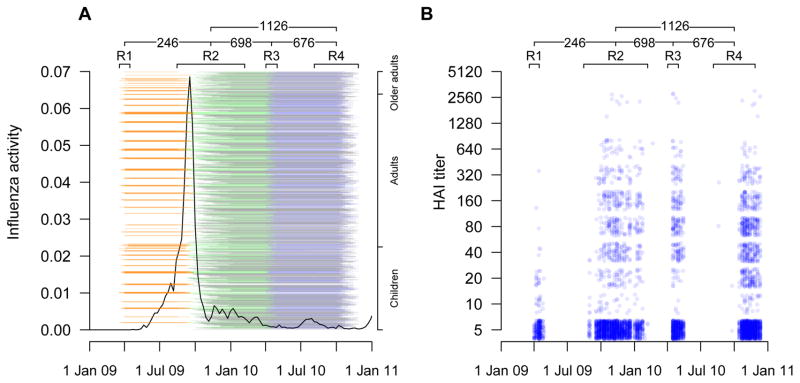
Serum samples were collected longitudinally in a community-based study. Most participants provided their first serum after the start of circulation of influenza A(H1N1)pdm09 virus in 2009. We developed a Bayesian hierarchical model to correct for nonbracketing sera and estimate the cumulative incidence of infection from the serological data and surveillance data in Hong Kong.
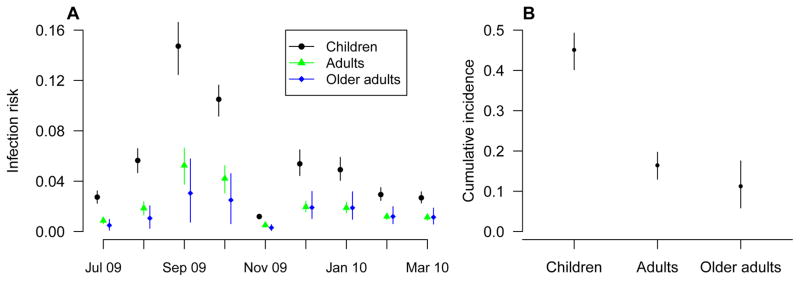
We analyzed 4,843 sera from 2,097 unvaccinated participants in the study, collected from April 2009 to December 2010. After accounting for nonbracketing, we estimated that the cumulative incidence of H1N1pdm09 virus infection was 45% (95% credible interval [CI] = 40%, 49%), 17% (95% CI = 13%, 20%), and 11% (95% CI = 6%, 18%) for children ages 0-18 years, adults 19-50 years, and older adults >50 years, respectively. Including all available data substantially increased precision compared with a simpler analysis based only on sera collected at 6-month intervals in a subset of participants.
We developed a framework for the analysis of antibody titers that accounted for the timing of sera collection with respect to influenza activity and permitted robust estimation of the cumulative incidence of infection during an epidemic.
在流感流行病学中,几十年来一直通过分析流感季节前后采集的成对血清来研究人群中流感病毒感染的累积发病率。然而,当在疫情开始后或结束前采集血清,且这些血清没有恰好涵盖整个疫情期间时,解读就变得具有挑战性。
在一项基于社区的研究中纵向采集血清样本。大多数参与者在2009年甲型H1N1流感大流行病毒开始传播后提供了他们的第一份血清。我们开发了一种贝叶斯分层模型,以校正未涵盖整个疫情期间的血清,并根据香港的血清学数据和监测数据估计感染的累积发病率。
我们分析了该研究中2097名未接种疫苗参与者的4843份血清,这些血清采集于2009年4月至2010年12月。在考虑了未涵盖整个疫情期间的情况后,我们估计0至18岁儿童、19至50岁成年人以及50岁以上老年人中甲型H1N1流感大流行病毒感染的累积发病率分别为45%(95%可信区间[CI]=40%,49%)、17%(95%CI=13%,20%)和11%(95%CI=6%,18%)。与仅基于部分参与者每隔6个月采集的血清进行的简单分析相比,纳入所有可用数据显著提高了估计精度。
我们开发了一个分析抗体滴度的框架,该框架考虑了血清采集时间相对于流感活动的情况,并能够可靠地估计疫情期间感染的累积发病率。