Department of Orthopaedics, Center for Musculoskeletal Research, University of Rochester Medical Center, 601 Elmwood Avenue, Box 665, Rochester, New York 14642, USA.
J Orthop Res. 2011 Aug;29(8):1145-51. doi: 10.1002/jor.21368. Epub 2011 Mar 3.
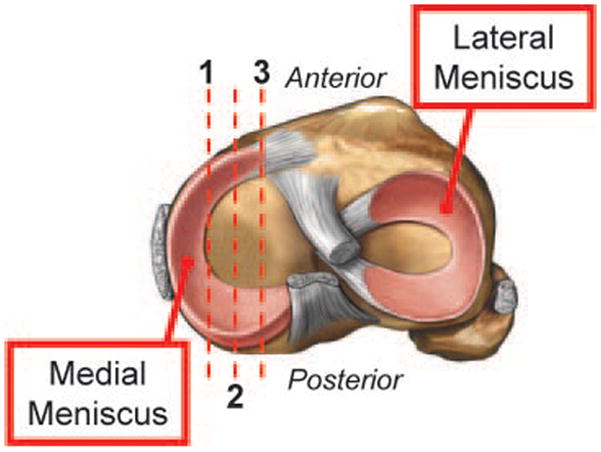
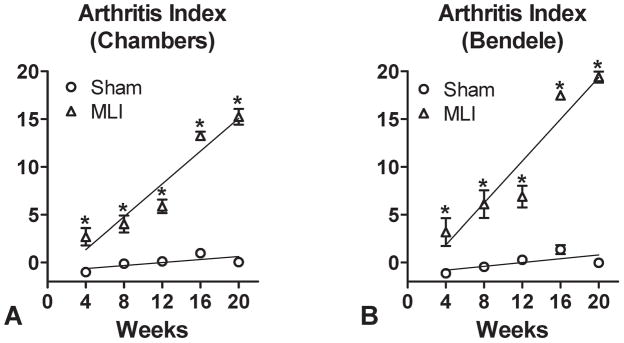
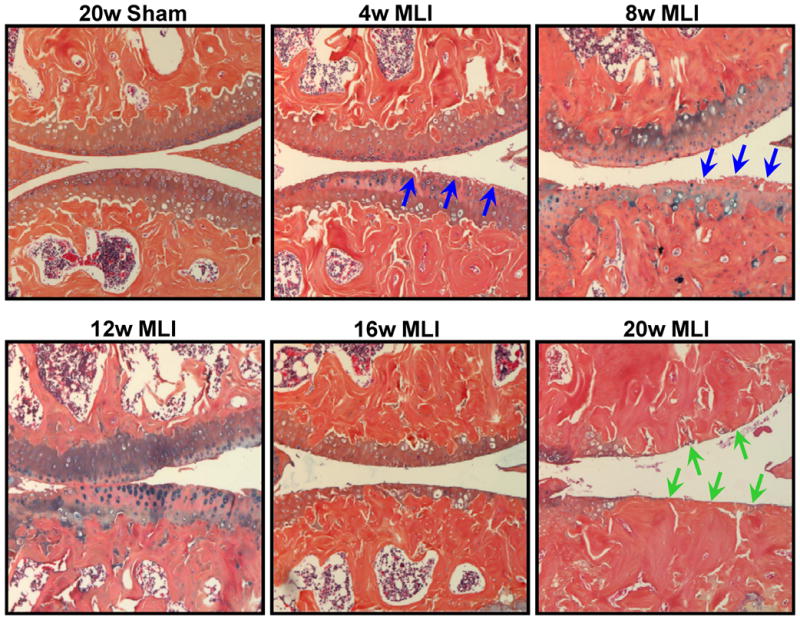
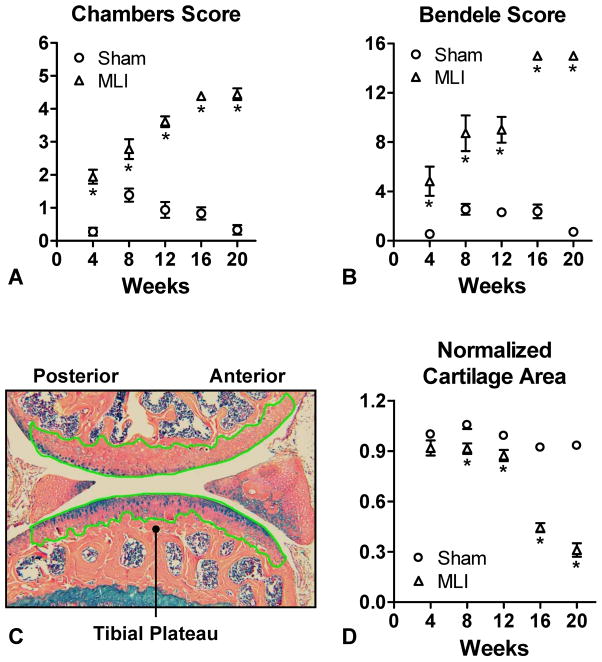
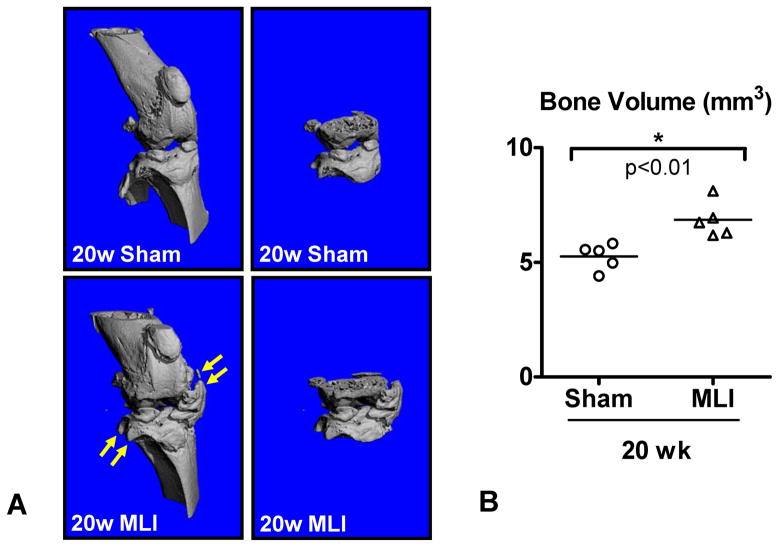
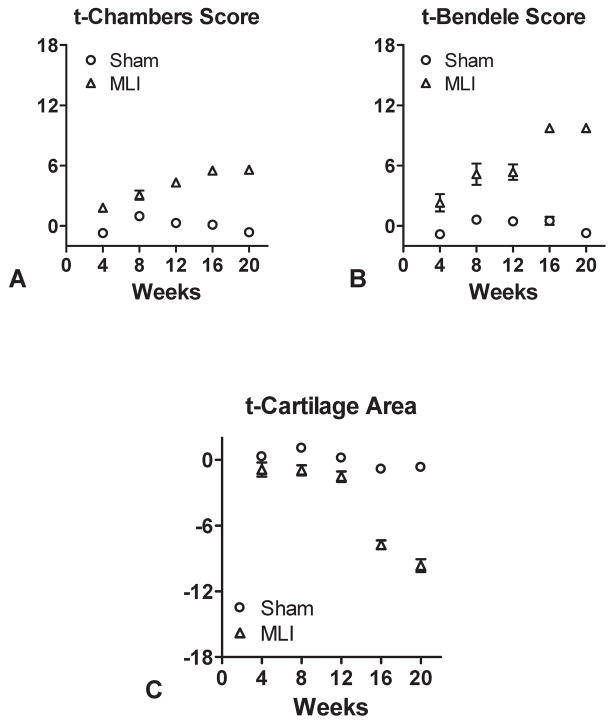
The goals of our study were to establish quantitative outcomes for assessing murine knee arthritis and develop an Arthritis Index that incorporates multiple outcomes into a single calculation that provides enhanced sensitivity. Using an accepted model of meniscal/ligamentous injury (MLI)-induced osteoarthritis (OA), we assessed mouse knee arthritis using several approaches. Histology-based methods were performed to visualize joint tissues including articular cartilage and subchondral bone. Accepted histologic scoring methods and histomorphometry were performed to grade cartilage degeneration and determine articular cartilage area, respectively. MicroCT was used to visualize and quantify the bony structures of the joint including osteophytes and joint bone volume. A statistical algorithm was then developed that combined histologic scores and cartilage areas into a single Arthritis Index. MLI induced progressive, OA-like articular cartilage degeneration characterized by increasing (worsening) histologic score and decreasing cartilage area. MicroCT revealed osteophytes and increased joint bone volume between the femoral and tibial physes following MLI. Lastly, an Arthritis Index calculation was established, which incorporated histologic scoring and cartilage area. The Arthritis Index provided enhanced quantitative sensitivity in assessing the level of joint degeneration compared to either histologic scoring or cartilage area determination alone; when using the Index, between 29% and 43% fewer samples are needed to establish statistical significance in studies of murine arthritis. Arthritis in the mouse knee can be quantitatively assessed by histologic scoring, measuring cartilage area, and determining joint bone volume. Enhanced sensitivity can be achieved by performing the Arthritis Index calculation, a novel method for quantitatively assessing mouse knee arthritis.
我们研究的目的是建立评估小鼠膝关节关节炎的定量指标,并开发一种关节炎指数,该指数将多个指标纳入单一计算中,以提高敏感性。我们使用公认的半月板/韧带损伤(MLI)诱导的骨关节炎(OA)模型,通过几种方法评估小鼠膝关节关节炎。采用基于组织学的方法来可视化关节组织,包括关节软骨和软骨下骨。采用公认的组织学评分方法和组织形态计量学方法分别对软骨退变和关节软骨面积进行分级。MicroCT 用于可视化和量化关节的骨结构,包括骨赘和关节骨体积。然后开发了一种统计算法,将组织学评分和软骨面积组合成一个单一的关节炎指数。MLI 诱导进行性、OA 样关节软骨退变,表现为组织学评分增加(恶化)和软骨面积减少。MicroCT 显示 MLI 后股骨和胫骨干骺端之间出现骨赘和关节骨体积增加。最后,建立了关节炎指数计算,该计算将组织学评分和软骨面积纳入其中。与单独进行组织学评分或软骨面积测定相比,关节炎指数在评估关节退变程度方面提供了更高的定量敏感性;使用该指数时,在研究小鼠关节炎时,需要减少 29%至 43%的样本才能达到统计学意义。通过组织学评分、测量软骨面积和确定关节骨体积,可以对小鼠膝关节关节炎进行定量评估。通过进行关节炎指数计算,可以提高定量评估小鼠膝关节关节炎的敏感性,这是一种新的方法。