Department of Pediatrics, Division of Allergy and Immunology, Duke University Medical Center, Durham, NC, USA.
J Allergy Clin Immunol. 2011 Mar;127(3):654-60. doi: 10.1016/j.jaci.2010.12.1111.
Open-label oral immunotherapy (OIT) protocols have been used to treat small numbers of patients with peanut allergy. Peanut OIT has not been evaluated in double-blind, placebo-controlled trials.
To investigate the safety and effectiveness of OIT for peanut allergy in a double-blind, placebo-controlled study.
In this multicenter study, children ages 1 to 16 years with peanut allergy received OIT with peanut flour or placebo. Initial escalation, build-up, and maintenance phases were followed by an oral food challenge (OFC) at approximately 1 year. Titrated skin prick tests (SPTs) and laboratory studies were performed at regular intervals.
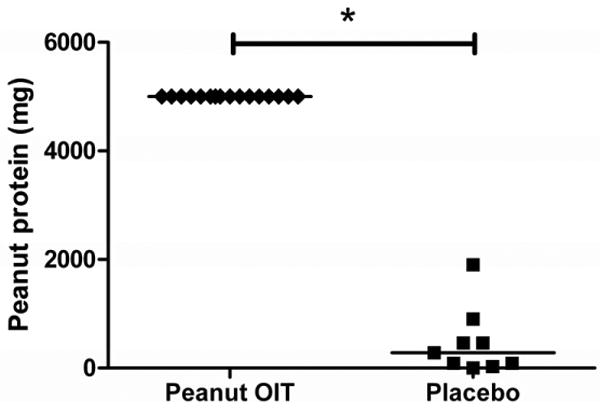
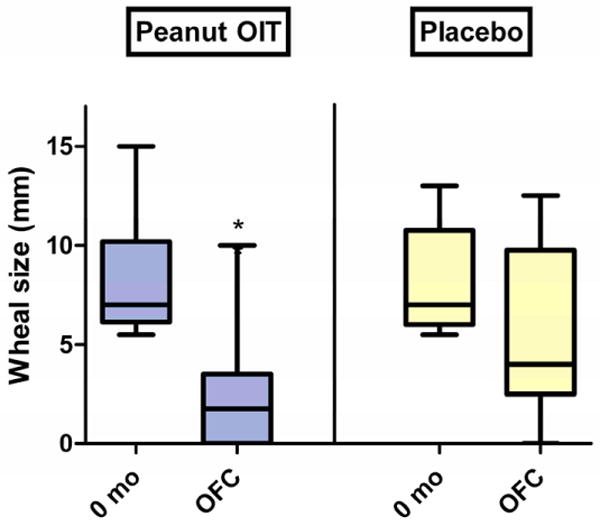
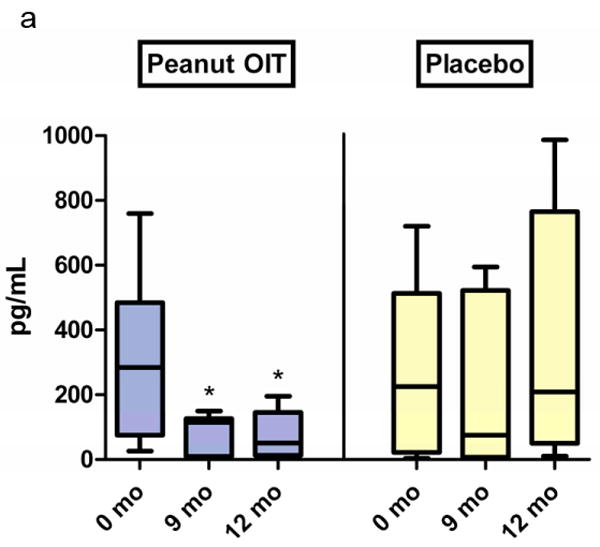
Twenty-eight subjects were enrolled in the study. Three peanut OIT subjects withdrew early in the study because of allergic side effects. During the double-blind, placebo-controlled food challenge, all remaining peanut OIT subjects (n = 16) ingested the maximum cumulative dose of 5000 mg (approximately 20 peanuts), whereas placebo subjects (n = 9) ingested a median cumulative dose of 280 mg (range, 0-1900 mg; P < .001). In contrast with the placebo group, the peanut OIT group showed reductions in SPT size (P < .001), IL-5 (P = .01), and IL-13 (P = .02) and increases in peanut-specific IgG(4) (P < .001). Peanut OIT subjects had initial increases in peanut-specific IgE (P < .01) but did not show significant change from baseline by the time of OFC. The ratio of forkhead box protein 3 (FoxP3)(hi): FoxP3(intermediate) CD4+ CD25+ T cells increased at the time of OFC (P = .04) in peanut OIT subjects.
These results conclusively demonstrate that peanut OIT induces desensitization and concurrent immune modulation. The current study continues and is evaluating the hypothesis that peanut OIT causes long-term immune tolerance.
已使用开放标签口服免疫疗法(OIT)方案治疗少数花生过敏患者。尚未在双盲、安慰剂对照试验中评估花生 OIT。
在一项双盲、安慰剂对照研究中调查 OIT 治疗花生过敏的安全性和有效性。
在这项多中心研究中,1 至 16 岁的花生过敏儿童接受花生粉或安慰剂的 OIT。初始升级、建立和维持阶段后,大约 1 年进行口服食物挑战(OFC)。定期进行滴定皮肤点刺试验(SPT)和实验室研究。
共有 28 名受试者入组该研究。3 名花生 OIT 受试者在研究早期因过敏副作用而提前退出。在双盲、安慰剂对照食物挑战期间,所有其余接受花生 OIT 的受试者(n = 16)摄入了 5000mg 的最大累积剂量(约 20 颗花生),而安慰剂组受试者(n = 9)摄入的累积剂量中位数为 280mg(范围为 0-1900mg;P<.001)。与安慰剂组相比,花生 OIT 组的 SPT 大小(P<.001)、IL-5(P =.01)和 IL-13(P =.02)降低,花生特异性 IgG(4)(P<.001)增加。花生 OIT 受试者最初花生特异性 IgE 增加(P<.01),但在 OFC 时与基线相比无显著变化。OFC 时 FoxP3(hi):FoxP3(中间)CD4+CD25+T 细胞的叉头框蛋白 3(FoxP3)比例增加(P =.04)花生 OIT 受试者。
这些结果确凿地表明花生 OIT 诱导脱敏和同时的免疫调节。目前的研究仍在继续,并正在评估 OIT 导致长期免疫耐受的假设。