Physiological Laboratory, University of Cambridge, Cambridge, UK.
Am J Physiol Heart Circ Physiol. 2011 May;300(5):H1853-62. doi: 10.1152/ajpheart.00034.2011. Epub 2011 Mar 4.
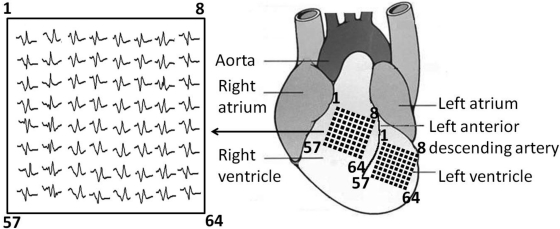
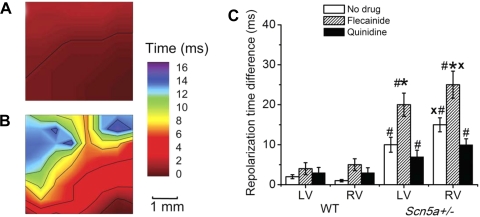
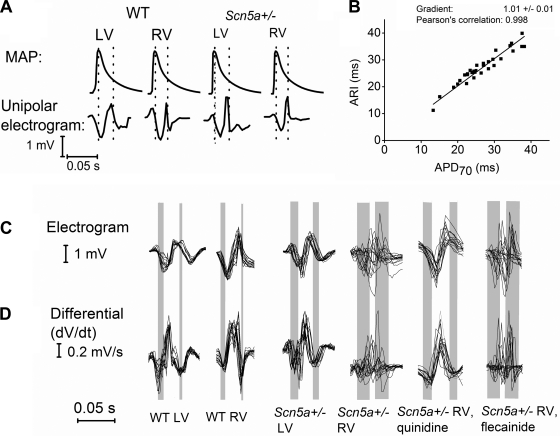
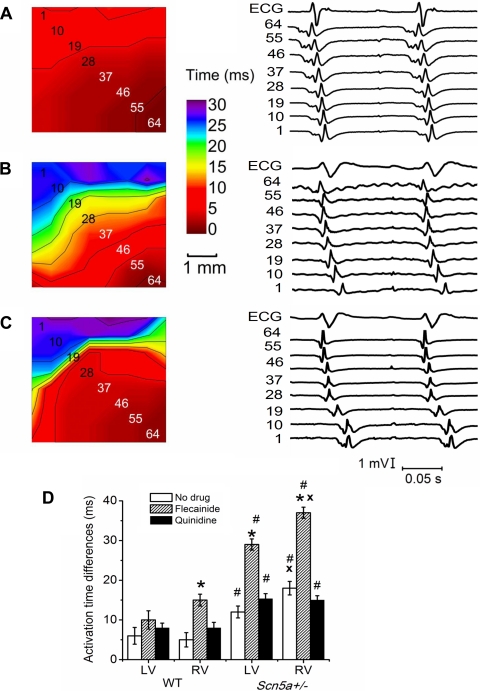
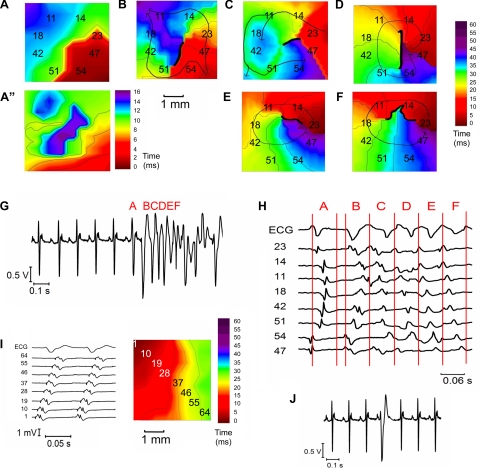
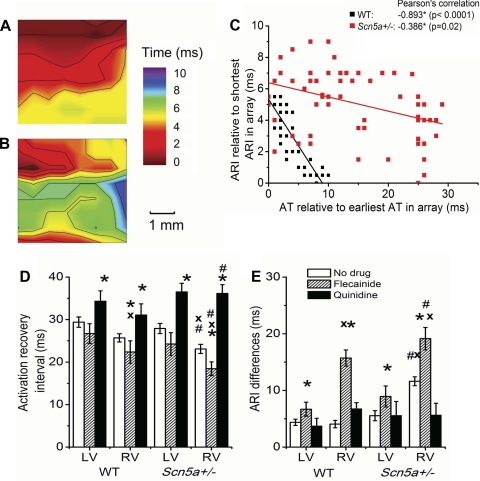
Two major mechanisms have been postulated for the arrhythmogenic tendency observed in Brugada Syndrome (BrS): delays in conduction or increased heterogeneities in repolarization. We use a contact mapping system to directly investigate the interacting roles of these two mechanisms in arrhythmogenesis using a genetic murine model for BrS for the first time. Electrograms were obtained from a multielectrode recording array placed against the left ventricle and right ventricle (RV) of spontaneously beating Langendorff-perfused wild type (WT) and Scn5a+/- mouse hearts. Scn5a+/- hearts showed activation waves arriving at the epicardial surface consistent with slowed conduction, which was exacerbated in the presence of flecainide. Lines of conduction block across the RV resulting from premature ventricular beats led to the formation of reentrant circuits and polymorphic ventricular tachycardia. WT hearts showed an inverse relationship between activation times and activation recovery intervals measured at the epicardial surface, which resulted in synchronicity of repolarization times. In contrast, Scn5a+/- hearts, despite having smaller mean activation recovery intervals, demonstrated a greater heterogeneity compared with WT. Isochronal maps showed that their normal activation recovery interval gradients at the epicardial surface were disrupted, leading to heterogeneity in repolarization times. We thus directly demonstrate the initiation of arrhythmia in the RV of Scn5a+/- hearts. This occurs as a result of the combination of repolarization heterogeneities leading to lines of conduction block and unidirectional conduction, with conduction slowing allowing the formation of reentrant circuits. The repolarization heterogeneities may also be responsible for the changing pattern of block, leading to the polymorphic character of the resulting ventricular tachycardia.
两种主要的机制被认为是 Brugada 综合征(BrS)中观察到的心律失常倾向的原因:传导延迟或复极异质性增加。我们首次使用一种遗传的 BrS 小鼠模型,使用接触映射系统直接研究这两种机制在心律失常发生中的相互作用。电描记图是从放置在左心室和右心室(RV)的多电极记录阵列中获得的,该阵列用于自发跳动的 Langendorff 灌注的野生型(WT)和 Scn5a+/- 小鼠心脏。Scn5a+/- 心脏的激动波到达心外膜表面,与传导减慢一致,在氟卡尼存在下,传导减慢更为明显。由于室性早搏引起的 RV 中的传导阻滞线导致折返性心动过速的形成。WT 心脏的激动时间与心外膜表面测量的激动恢复间期呈反比关系,这导致复极时间的同步性。相比之下,尽管 Scn5a+/- 心脏的平均激动恢复间期较小,但与 WT 相比,其表现出更大的复极异质性。等时地图显示,它们在心外膜表面的正常激动恢复间期梯度被打乱,导致复极时间的异质性。因此,我们直接证明了 Scn5a+/- 心脏 RV 中的心律失常的起始。这是由于复极异质性导致的传导阻滞线和单向传导的组合,以及传导减慢允许折返性心动过速的形成。复极异质性也可能是导致阻滞模式变化的原因,导致形成的室性心动过速的多形性特征。