Department of Cell Biology, University of Alberta, Edmonton, Canada.
PLoS Pathog. 2011 Feb;7(2):e1001291. doi: 10.1371/journal.ppat.1001291. Epub 2011 Feb 17.
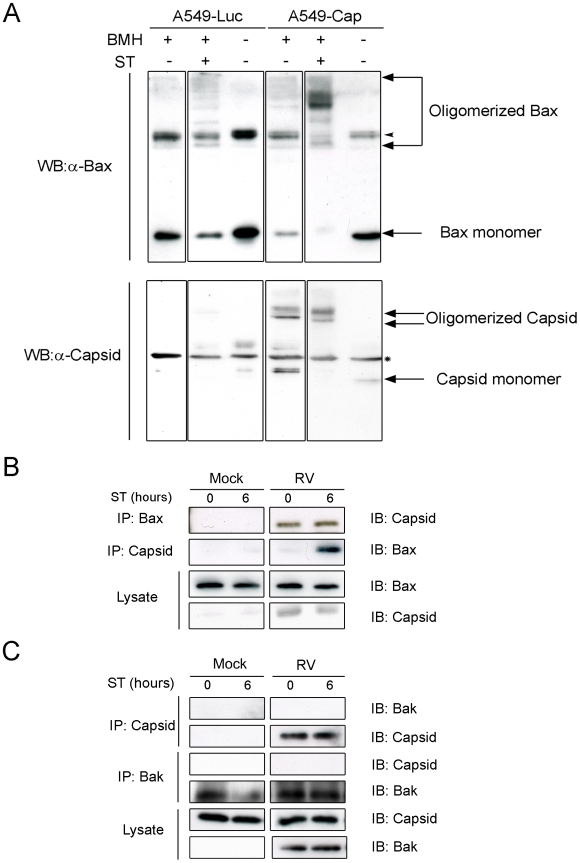
Apoptosis is an important mechanism by which virus-infected cells are eliminated from the host. Accordingly, many viruses have evolved strategies to prevent or delay apoptosis in order to provide a window of opportunity in which virus replication, assembly and egress can take place. Interfering with apoptosis may also be important for establishment and/or maintenance of persistent infections. Whereas large DNA viruses have the luxury of encoding accessory proteins whose primary function is to undermine programmed cell death pathways, it is generally thought that most RNA viruses do not encode these types of proteins. Here we report that the multifunctional capsid protein of Rubella virus is a potent inhibitor of apoptosis. The main mechanism of action was specific for Bax as capsid bound Bax and prevented Bax-induced apoptosis but did not bind Bak nor inhibit Bak-induced apoptosis. Intriguingly, interaction with capsid protein resulted in activation of Bax in the absence of apoptotic stimuli, however, release of cytochrome c from mitochondria and concomitant activation of caspase 3 did not occur. Accordingly, we propose that binding of capsid to Bax induces the formation of hetero-oligomers that are incompetent for pore formation. Importantly, data from reverse genetic studies are consistent with a scenario in which the anti-apoptotic activity of capsid protein is important for virus replication. If so, this would be among the first demonstrations showing that blocking apoptosis is important for replication of an RNA virus. Finally, it is tempting to speculate that other slowly replicating RNA viruses employ similar mechanisms to avoid killing infected cells.
细胞凋亡是宿主清除病毒感染细胞的一种重要机制。因此,许多病毒已经进化出了防止或延迟细胞凋亡的策略,以便为病毒复制、组装和逸出提供机会。干扰细胞凋亡对于建立和/或维持持续性感染也可能很重要。虽然大型 DNA 病毒有奢侈地编码辅助蛋白的优势,其主要功能是破坏程序性细胞死亡途径,但人们普遍认为,大多数 RNA 病毒并不编码这类蛋白。在这里,我们报告风疹病毒的多功能衣壳蛋白是一种有效的凋亡抑制剂。主要作用机制是针对 Bax,衣壳与 Bax 结合并阻止 Bax 诱导的凋亡,但不结合 Bak,也不抑制 Bak 诱导的凋亡。有趣的是,与衣壳蛋白的相互作用导致 Bax 在没有凋亡刺激的情况下被激活,但是线粒体中的细胞色素 c 释放和伴随的 caspase 3 激活没有发生。因此,我们提出,衣壳与 Bax 的结合诱导形成不能形成孔的异寡聚体。重要的是,来自反向遗传学研究的数据与这样一种情况一致,即衣壳蛋白的抗凋亡活性对病毒复制很重要。如果是这样,这将是第一个证明阻止细胞凋亡对 RNA 病毒复制很重要的例证之一。最后,人们不禁要推测,其他复制缓慢的 RNA 病毒可能会采用类似的机制来避免杀死感染细胞。