Institute for Molecular and Clinical Immunology, Otto-von-Guericke University Magdeburg, Magdeburg, Germany.
PLoS One. 2011 Feb 23;6(2):e17314. doi: 10.1371/journal.pone.0017314.
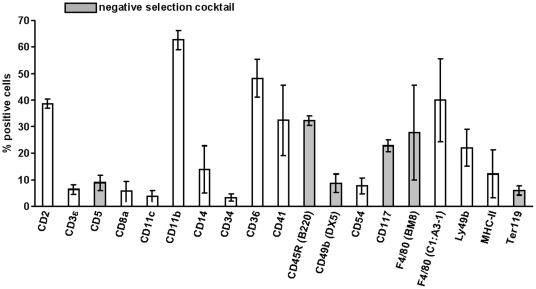
Polymorphonuclear neutrophils (PMN) mediate early immunity to infection but can also cause host damage if their effector functions are not controlled. Their lack or dysfunction is associated with severe health problems and thus the analysis of PMN physiology is a central issue. One prerequisite for PMN analysis is the availability of purified cells from primary organs. While human PMN are easily isolated from peripheral blood, this approach is less suitable for mice due to limited availability of blood. Instead, bone marrow (BM) is an easily available reservoir of murine PMN, but methods to obtain pure cells from BM are limited. We have developed a novel protocol allowing the isolation of highly pure untouched PMN from murine BM by negative immunomagnetic isolation using a complex antibody cocktail. The protocol is simple and fast (~1 h), has a high yield (5-10*10⁶ PMN per animal) and provides a purity of cells equivalent to positive selection (>80%). Most importantly, cells obtained by this method are non-activated and remain fully functional in vitro or after adoptive transfer into recipient animals. This method should thus greatly facilitate the study of primary murine PMN in vitro and in vivo.
多形核粒细胞 (PMN) 介导早期抗感染免疫,但如果其效应功能不受控制,也会导致宿主损伤。PMN 的缺乏或功能障碍与严重的健康问题有关,因此 PMN 生理学的分析是一个核心问题。PMN 分析的一个前提条件是能够从原代器官获得纯化的细胞。虽然人 PMN 很容易从外周血中分离出来,但由于血液供应有限,这种方法对小鼠不太适用。相反,骨髓 (BM) 是小鼠 PMN 的一个容易获得的储备库,但从 BM 中获得纯细胞的方法有限。我们开发了一种新的方案,通过使用复杂的抗体鸡尾酒进行负免疫磁珠分离,从鼠 BM 中分离出高度纯净的未经处理的 PMN。该方案简单快速(~1 小时),产率高(每只动物 5-10*10⁶ PMN),并提供与阳性选择相当的细胞纯度 (>80%)。最重要的是,通过这种方法获得的细胞是非激活的,在体外或在过继转移到受体动物后仍保持完全功能。因此,该方法应极大地促进体内外研究原代鼠 PMN。