Department of Clinical Epidemiology, Institute of Clinical Medicine, Aarhus University Hospital, Olof Palmes Alle, Aarhus N 8240, Denmark.
Crit Care. 2011;15(2):R87. doi: 10.1186/cc10085. Epub 2011 Mar 7.
Beta-blockers have cardioprotective, metabolic and immunomodulating effects that may be beneficial to patients in intensive care. We examined the association between preadmission beta-blocker use and 30-day mortality following intensive care.
We identified 8,087 patients over age 45 admitted to one of three multidisciplinary intensive care units (ICUs) between 1999 and 2005. Data on the use of beta-blockers and medications, diagnosis, comorbidities, surgery, markers of socioeconomic status, laboratory tests upon ICU admission, and complete follow-up for mortality were obtained from medical databases. We computed probability of death within 30 days following ICU admission for beta-blocker users and non-users, and the odds ratio (OR) of death as a measure of relative risk using conditional logistic regression and also did a propensity score-matched analysis.
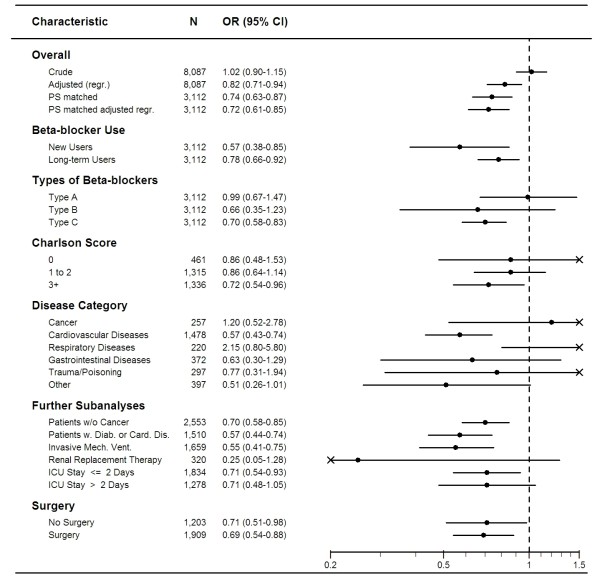
Inclusion of all 8,087 ICU patients in a logistic regression analysis yielded an adjusted OR of 0.82 (95% confidence interval (CI): 0.71 to 0.94) for beta-blocker users compared with non-users. In the propensity score-matched analysis we matched all 1,556 beta-blocker users (19.2% of the entire cohort) with 1,556 non-users; the 30-day mortality was 25.7% among beta-blocker users and 31.4% among non-users (OR 0.74 (95% CI: 0.63 to 0.87)]. The OR was 0.69 (95% CI: 0.54 to 0.88) for surgical ICU patients and 0.71 (95% CI: 0.51 to 0.98) for medical ICU patients. The OR was 0.99 (95% CI: 0.67 to 1.47) among users of non-selective beta-blockers, and 0.70 (95% CI: 0.58 to 0.83) among users of cardioselective beta-blockers.
Preadmission beta-blocker use is associated with reduced mortality following ICU admission.
β受体阻滞剂具有心脏保护、代谢和免疫调节作用,可能对重症监护患者有益。我们研究了重症监护前β受体阻滞剂的使用与 30 天死亡率之间的关系。
我们确定了 1999 年至 2005 年间在三个多学科重症监护病房(ICU)之一住院的 8087 名 45 岁以上的患者。从医疗数据库中获得了关于β受体阻滞剂和药物使用、诊断、合并症、手术、社会经济地位标志物、入住 ICU 时的实验室检查以及完整的死亡率随访的数据。我们计算了 ICU 入院后 30 天内β受体阻滞剂使用者和非使用者的死亡率概率,并使用条件逻辑回归计算了死亡的比值比(OR)作为相对风险的衡量标准,还进行了倾向评分匹配分析。
将所有 8087 名 ICU 患者纳入逻辑回归分析,与非使用者相比,β受体阻滞剂使用者的调整后 OR 为 0.82(95%置信区间:0.71 至 0.94)。在倾向评分匹配分析中,我们将所有 1556 名β受体阻滞剂使用者(整个队列的 19.2%)与 1556 名非使用者匹配;β受体阻滞剂使用者的 30 天死亡率为 25.7%,而非使用者为 31.4%(OR 0.74(95% CI:0.63 至 0.87))。手术 ICU 患者的 OR 为 0.69(95% CI:0.54 至 0.88),内科 ICU 患者的 OR 为 0.71(95% CI:0.51 至 0.98)。非选择性β受体阻滞剂使用者的 OR 为 0.99(95% CI:0.67 至 1.47),而选择性β受体阻滞剂使用者的 OR 为 0.70(95% CI:0.58 至 0.83)。
重症监护前β受体阻滞剂的使用与 ICU 入院后死亡率降低相关。