Population Services International, Cotonou, Benin.
BMC Public Health. 2011 Mar 8;11:155. doi: 10.1186/1471-2458-11-155.
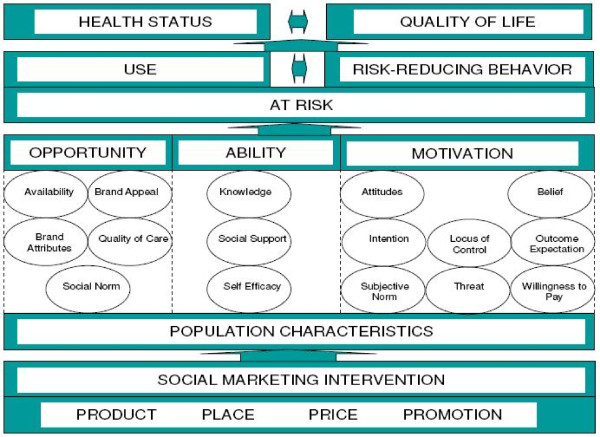
Diarrhea is the second leading cause of death for children under five in Burundi; however, use of oral rehydration salts (ORS), the recommended first-line treatment, remains low. In 2004, PSI/Burundi launched a social marketing intervention to promote ORASEL among caregivers of children under five; the product was relaunched in 2006 with a new flavor. This study evaluates the intervention after the ORASEL relaunch, which included mass media and interpersonal communication activities. The study looks at trends in ORASEL use in Burundi and in behavioral determinants that may be related to its use.
In 2006 and 2007, PSI conducted household surveys among Burundian females of reproductive age (15-49). Both surveys used a two-stage sampling process to select 30 households in each of 115 rural and urban collines throughout the nation. Survey respondents were asked about diarrhea treatment-related behavior; key behavioral determinants; and exposure to the ORASEL intervention. Data were analyzed to identify trends over time, characteristics of ORASEL users, and associations between exposure to the intervention and changes in ORASEL use and related behavioral determinants.
ORASEL use among caregivers at their children's last diarrheal episode increased significantly from 20% in 2006 to 30% in 2007, and there were also desirable changes in several behavioral determinants associated with ORASEL use. Evaluation analysis showed that a higher level of exposure to the social marketing campaign was associated with greater use of ORASEL and with significant improvements in perceived availability, knowledge of the signs of diarrhea and dehydration, social support, and self-efficacy.
ORS use can be improved through social marketing and educational campaigns that make the public aware of the availability of the product, encourage dialogue about its use, and increase skills and confidence relating to correct product preparation and administration. Further interventions in Burundi and elsewhere should promote ORS through a variety of mass media and interpersonal communication channels, and should be rigorously evaluated in the context of the total market for diarrhea treatment products.
腹泻是布隆迪五岁以下儿童的第二大死因;然而,口服补液盐(ORS)的使用率较低,ORS 是推荐的一线治疗方法。2004 年,PSI/布隆迪启动了一项社会营销干预措施,在五岁以下儿童的照顾者中推广 ORASEL;该产品于 2006 年重新推出,并推出了一种新口味。本研究评估了 ORASEL 重新推出后的干预效果,其中包括大众媒体和人际沟通活动。本研究探讨了布隆迪 ORASEL 使用的趋势以及可能与其使用相关的行为决定因素。
2006 年和 2007 年,PSI 在布隆迪育龄女性(15-49 岁)中进行了家庭调查。这两项调查都采用了两阶段抽样过程,在全国 115 个农村和城市丘陵地区的每个地区选择了 30 户家庭。调查对象被问及与腹泻治疗相关的行为、关键行为决定因素以及接触 ORASEL 干预措施的情况。对数据进行了分析,以确定随时间的变化趋势、ORASEL 用户的特征以及接触干预措施与 ORASEL 使用和相关行为决定因素的变化之间的关联。
在儿童最近一次腹泻发作时,照顾者使用 ORASEL 的比例从 2006 年的 20%显著上升至 2007 年的 30%,与 ORASEL 使用相关的几个行为决定因素也发生了理想的变化。评估分析表明,更高水平的社会营销活动暴露与更高的 ORASEL 使用以及感知可用性、腹泻和脱水迹象知识、社会支持和自我效能的显著提高有关。
通过使公众了解产品的可用性、鼓励关于其使用的对话以及提高与正确产品准备和管理相关的技能和信心的社会营销和教育活动,可以改善 ORS 的使用。布隆迪和其他地方的进一步干预措施应通过各种大众媒体和人际沟通渠道推广 ORS,并在腹泻治疗产品的总市场背景下进行严格评估。