Boardman Jason D, Blalock Casey L, Corley Robin P, Stallings Michael C, Domingue Benjamin W, Mcqueen Matthew B, Crowley Thomas J, Hewitt John K, Lu Ying, Field Samuel H
Institute of Behavioral Science and University of Colorado Population Center, University of Colorado, Boulder, Colorado 80309-0483, USA.
Biodemography Soc Biol. 2010;56(2):123-36. doi: 10.1080/19485565.2010.524589.
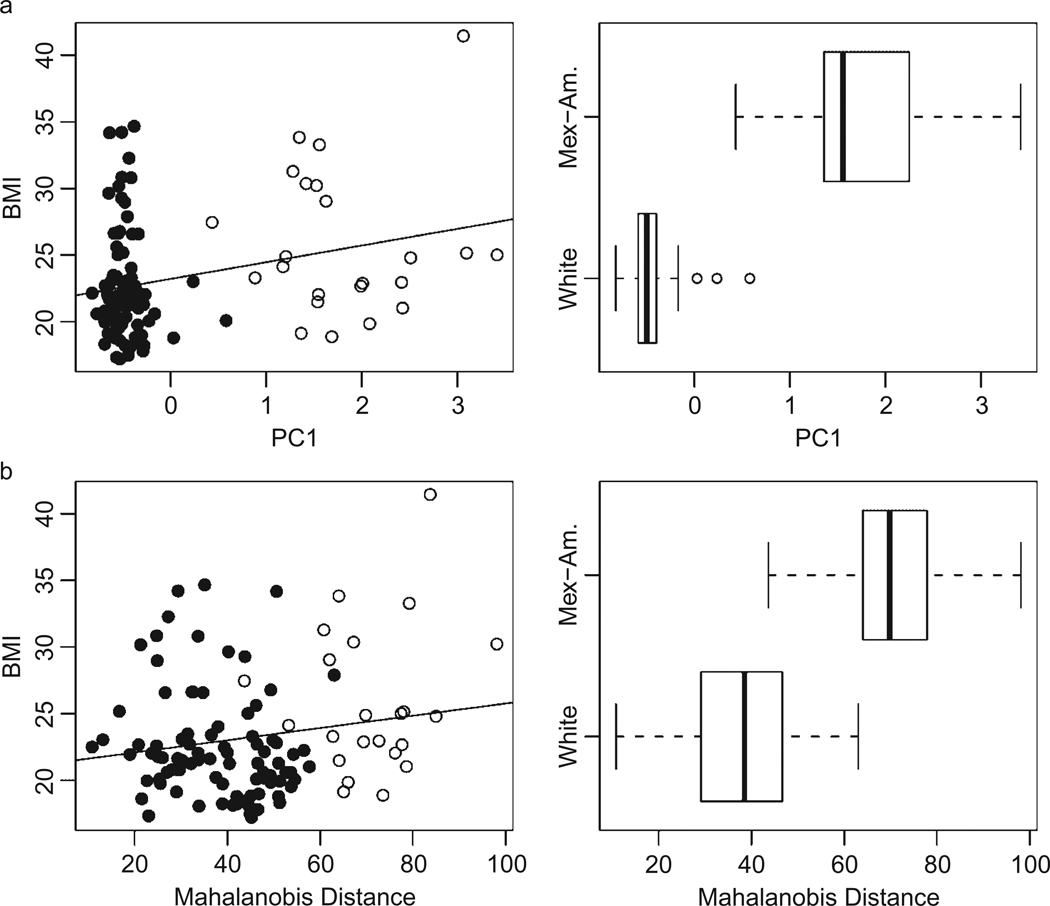
This article combines social and genetic epidemiology to examine the influence of self-reported ethnicity on body mass index (BMI) among a sample of adolescents and young adults. We use genetic information from more than 5,000 single nucleotide polymorphisms in combination with principal components analysis to characterize population ancestry of individuals in this study. We show that non-Hispanic white and Mexican-American respondents differ significantly with respect to BMI and differ on the first principal component from the genetic data. This first component is positively associated with BMI and accounts for roughly 3% of the genetic variance in our sample. However, after controlling for this genetic measure, the observed ethnic differences in BMI remain large and statistically significant. This study demonstrates a parsimonious method to adjust for genetic differences among individual respondents that may contribute to observed differences in outcomes. In this case, adjusting for genetic background has no bearing on the influence of self-identified ethnicity.
本文结合社会流行病学和遗传流行病学,研究自我报告的种族对青少年和青年样本中体重指数(BMI)的影响。我们使用来自5000多个单核苷酸多态性的遗传信息,并结合主成分分析来表征本研究中个体的群体血统。我们发现,非西班牙裔白人和墨西哥裔美国受访者在BMI方面存在显著差异,并且在遗传数据的第一主成分上也有所不同。这第一主成分与BMI呈正相关,在我们的样本中约占遗传变异的3%。然而,在控制了这一遗传指标后,观察到的BMI种族差异仍然很大且具有统计学意义。本研究展示了一种简洁的方法,可用于调整个体受访者之间可能导致观察到的结果差异的遗传差异。在这种情况下,调整遗传背景对自我认同的种族的影响没有作用。