Research Institute MOVE, Faculty of Human Movement Sciences, VU University, Amsterdam, The Netherlands.
PLoS One. 2011 Feb 24;6(2):e16697. doi: 10.1371/journal.pone.0016697.
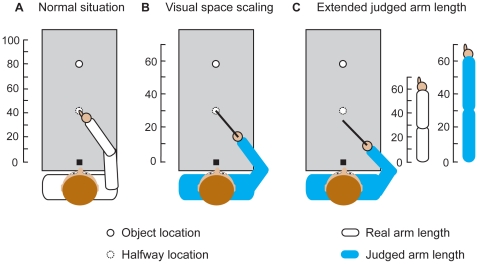
It has been reported that participants judge an object to be closer after a stick has been used to touch it than after touching it with the hand. In this study we try to find out why this is so.
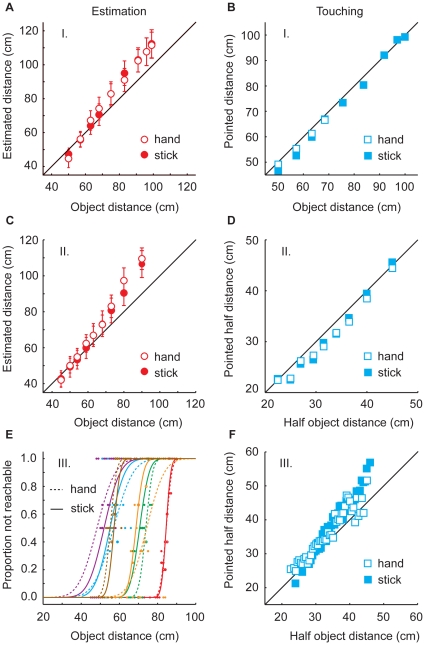
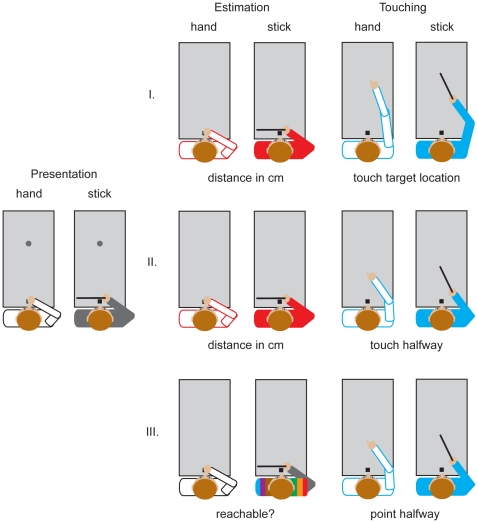
We showed six participants a cylindrical object on a table. On separate trials (randomly intermixed) participants either estimated verbally how far the object is from their body or they touched a remembered location. Touching was done either with the hand or with a stick (in separate blocks). In three different sessions, participants touched either the object location or the location halfway to the object location. Verbal judgments were given either in centimeters or in terms of whether the object would be reachable with the hand. No differences in verbal distance judgments or touching responses were found between the blocks in which the stick or the hand was used.
Instead of finding out why the judged distance changes when using a tool, we found that using a stick does not necessarily alter judged distances or judgments about the reachability of objects.
据报道,参与者在使用棍棒触摸物体后,会比直接用手触摸时认为物体更靠近。在这项研究中,我们试图找出原因。
我们向六名参与者展示了桌子上的一个圆柱形物体。在单独的试验中(随机混合),参与者要么口头估计物体离他们身体有多远,要么触摸记忆中的位置。触摸可以用手或棍棒完成(在单独的块中)。在三个不同的会话中,参与者触摸的是物体的位置或距离物体位置一半的位置。口头判断是用厘米还是用手是否能够到达物体来给出的。在使用棍棒或手的块中,没有发现口头距离判断或触摸反应之间的差异。
我们没有发现使用工具时判断距离变化的原因,而是发现使用棍棒不一定会改变对物体可及性的判断距离或判断。