Shaffer Dennis M, McManama Eric, Swank Charles, Durgin Frank H
Department of Psychology, Ohio State University, 1760 University Drive, Mansfield, OH 44906, USA; e-mail:
Iperception. 2013 May 7;4(3):147-55. doi: 10.1068/i0592. Print 2013.
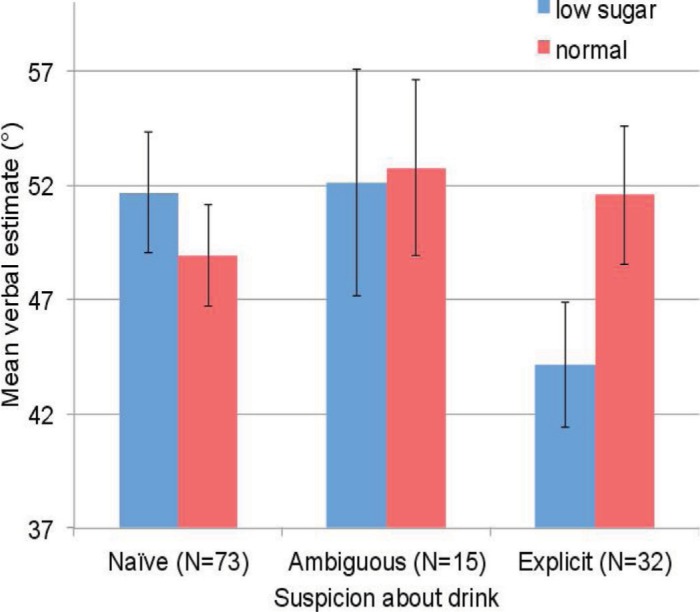
There is a current debate concerning whether people's physiological or behavioral potential alters their perception of slanted surfaces. One way to directly test this is to physiologically change people's potential by lowering their blood sugar and comparing their estimates of slant to those with normal blood sugar. In the first investigation of this (Schnall, Zadra, & Proffitt, 2010), it was shown that people with low blood sugar gave higher estimates of slanted surfaces than people with normal blood sugar. The question that arises is whether these higher estimates are due to lower blood sugar, per se, or experimental demand created by other aspects of the experiment. Here evidence was collected from 120 observers showing that directly manipulating physiological potential, while controlling for experimental demand effects, does not alter the perception of slant. Indeed, when experimental demand went against behavioral potential, it produced judgmental biases opposite to those predicted by behavioral potential in the low blood sugar condition. It is suggested that low blood sugar only affects slant judgments by making participants more susceptible to judgmental biases.
目前存在一场关于人们的生理或行为潜能是否会改变他们对倾斜表面的感知的争论。直接测试这一点的一种方法是通过降低血糖来生理上改变人们的潜能,并将他们对倾斜度的估计与血糖正常的人进行比较。在对此的首次调查中(施纳尔、扎德拉和普罗菲特,2010年),结果显示低血糖的人对倾斜表面的估计高于血糖正常的人。由此产生的问题是,这些更高的估计是由于低血糖本身,还是实验其他方面产生的实验需求。这里从120名观察者那里收集了证据,表明在控制实验需求效应的同时直接操纵生理潜能,并不会改变对倾斜度的感知。事实上,当实验需求与行为潜能相悖时,它会产生与低血糖条件下行为潜能所预测的相反的判断偏差。有人认为,低血糖只会通过使参与者更容易受到判断偏差的影响来影响倾斜度判断。