Department of Psychiatry, Brighton & Sussex Medical School (BSMS), Falmer, UK.
J Neurosci Methods. 2011 Apr 30;197(2):283-8. doi: 10.1016/j.jneumeth.2011.02.029. Epub 2011 Mar 8.
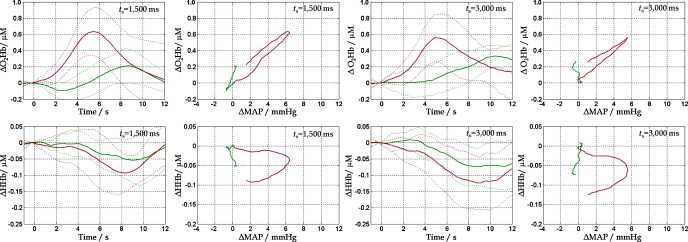
Brain near-infrared spectroscopy (NIRS) is an emerging neurophysiological tool that combines straightforward activity localization with cost-economy, portability and patient compatibility. NIRS is proving its empirical utility across specific cognitive and emotional paradigms. However, a potential limitation is that it is not only sensitive to haemodynamic changes taking place in the cortex, and task-related cardiovascular responses expressed in the perfusion of extracranial layers may be confounding. Existing literature reports correlations between brain NIRS and systemic blood pressure, yet it falls short of establishing whether in normal participants the blood pressure changes encountered in experimental settings can have confounding effects. Here, we tested this hypothesis by performing two experimental manipulations while recording from superficial occipital cortex, encompassing striate and extrastriate regions. Visual stimulation with reversing chequerboards evoked cortical haemodynamic responses. Simultaneously and independently, transient systemic blood pressure changes were generated through rapid arm-raising. Shallow-penetration NIRS recordings, probing only extra-cerebral tissues, highlighted close haemodynamic coupling with blood pressure. A different coupling pattern was observed in deep-penetration recordings directed at haemodynamic signals from visual cortex. In absence of blood-pressure changes, NIRS signals tracked differences in visual stimulus duration. However when blood pressure was actively manipulated, this effect was absent and replaced by a very large pressure-related response. Our observations demonstrate that blood pressure fluctuations can exert confounding effects on brain NIRS, through expression in extracranial tissues and within the brain itself. We highlight the necessity for continuous blood pressure monitoring alongside brain NIRS, and for further research on methods to correct for physiological confounds.
脑近红外光谱(NIRS)是一种新兴的神经生理学工具,它将活动定位与经济、便携性和患者兼容性相结合。NIRS 在特定的认知和情感范式中证明了其经验实用性。然而,一个潜在的限制是,它不仅对皮层内发生的血液动力学变化敏感,而且与任务相关的心血管反应在颅外层的灌注中表达可能会产生混淆。现有文献报告了脑 NIRS 与全身血压之间的相关性,但尚未确定在正常参与者中,实验环境中遇到的血压变化是否会产生混淆效应。在这里,我们通过在记录浅层枕叶皮层(包括纹状和纹外区域)的同时进行两项实验操作来测试这一假设。使用反转棋盘的视觉刺激引起皮层血液动力学反应。同时,通过快速抬起手臂,产生短暂的全身血压变化。浅层穿透 NIRS 记录仅探测到脑外组织,突出了与血压的密切血液动力学耦合。在针对来自视觉皮层的血液动力学信号的深穿透记录中观察到不同的耦合模式。在没有血压变化的情况下,NIRS 信号跟踪视觉刺激持续时间的差异。然而,当主动操纵血压时,这种效应消失,取而代之的是非常大的与压力相关的反应。我们的观察表明,血压波动可以通过颅外组织和大脑内部的表达对脑 NIRS 产生混淆效应。我们强调需要在脑 NIRS 旁边进行连续血压监测,并对用于纠正生理混淆的方法进行进一步研究。